Corneal irregularity (astigmatism)
ICD codes: H52.2 What are ICD codes?
With astigmatism, the light is not beamed onto the eye’s retina correctly. As a result, vision becomes blurred, both close-up and at a distance. This sight defect can be corrected by spectacles, contact lenses or, sometimes, surgical intervention.
At a glance
- With astigmatism, the light is beamed onto the retina not in the form of dots, but of lines: as a result the image is distorted and unclear.
- It is usually caused by a distorted cornea, sometimes also by an irregular curvature of the lens.
- Astigmatism is usually hereditary. It can sometimes hinder the development of a child’s sight.
- In typical cases, vision is unclear both close-up and at a distance.
- Astigmatism can be corrected by spectacles or contact lenses. The sight defect can also be adjusted through surgical intervention, for example laser treatment.
Note: The information in this article cannot and should not replace a medical consultation and must not be used for self-diagnosis or treatment.
What is astigmatism?
With astigmatism, the cornea of the eye, and sometimes the lens too, is irregularly curved. As a result, incoming light beams do not form a dot on the retina, but lines. This distorts the image perceived so that it is blurred. Astigmatism is also known as a corneal irregularity.
The term “astigmatism” itself comes from the Greek and means something like “lacking dots”. This type of visual impairment is usually congenital and it is often combined with short-sightedness or far-sightedness.
What are the symptoms of astigmatism?
A mild corneal irregularity often causes no problems and goes unnoticed. If it is less mild, the following symptoms may occur:
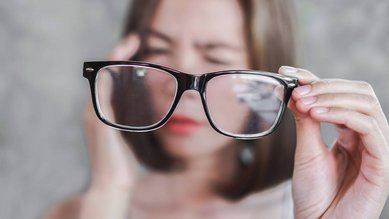
- objects are seen blurred or distorted
- eyes are strained or painful
- headaches

A feature of astigmatism is that vision is blurred both close-up and in the distance – in contrast to short- or far-sightedness, with which vision is blurred with objects that are either far away or up close.
What causes astigmatism?
Astigmatism is usually caused by a curving of the cornea. The cornea is particularly important in refracting light. But astigmatism can also be caused by the lens of the eye not being curved.
The cornea is normally equally curved in every direction, like a ball. This bundles the incoming light precisely into a dot on the retina. However, this is impossible if the cornea is more curved in the vertical than in the horizontal – like a ball that is gently pressed together with the hands. This results in a distorted, blurred image.
A corneal irregularity is usually congenital. If so, it cannot be altered much. If one eye is more affected than the other, it can result in the brain being unable to process the different images on the retina, and so-called weak-sightedness (amblyopia) will develop in the child.
Astigmatism sometimes develops during a person’s life. This may be caused by, for example:
- eye injuries and corneal scars
- abnormal distortions of the cornea (keratokonus)
- eye operations
How common is astigmatism?
As many people do not have a perfectly curved cornea, astigmatism is quite common. For example, around one-third of adults in Germany have a corneal irregularity. It is diagnosed more frequently with age. However, the sight defect can be mild so there is no need to correct it.
How can astigmatism be detected early on?
In children, sight defects should be detected as early as possible to prevent problems at school. But children are often unaware that they have a sight defect or they do not complain about it.
So since 2008 in Germany additional screening (U7a) has been in place for children who are three years old. It complements the other medical checkups for children (U tests) and it aims to detect sight defects such as astigmatism early on.
How is astigmatism diagnosed?
To diagnose astigmatism, opticians use a range of methods and equipment:
- testing the refractive power of the eye (refraction test)
- measuring the corneal irregularity (ophthalmometry)
- examining the surface of the cornea (corneal topography)
Subjective refraction test
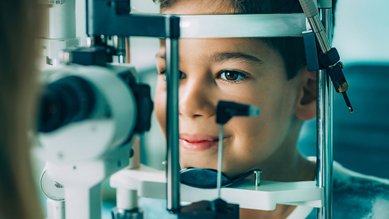
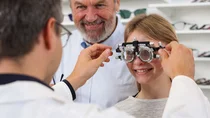
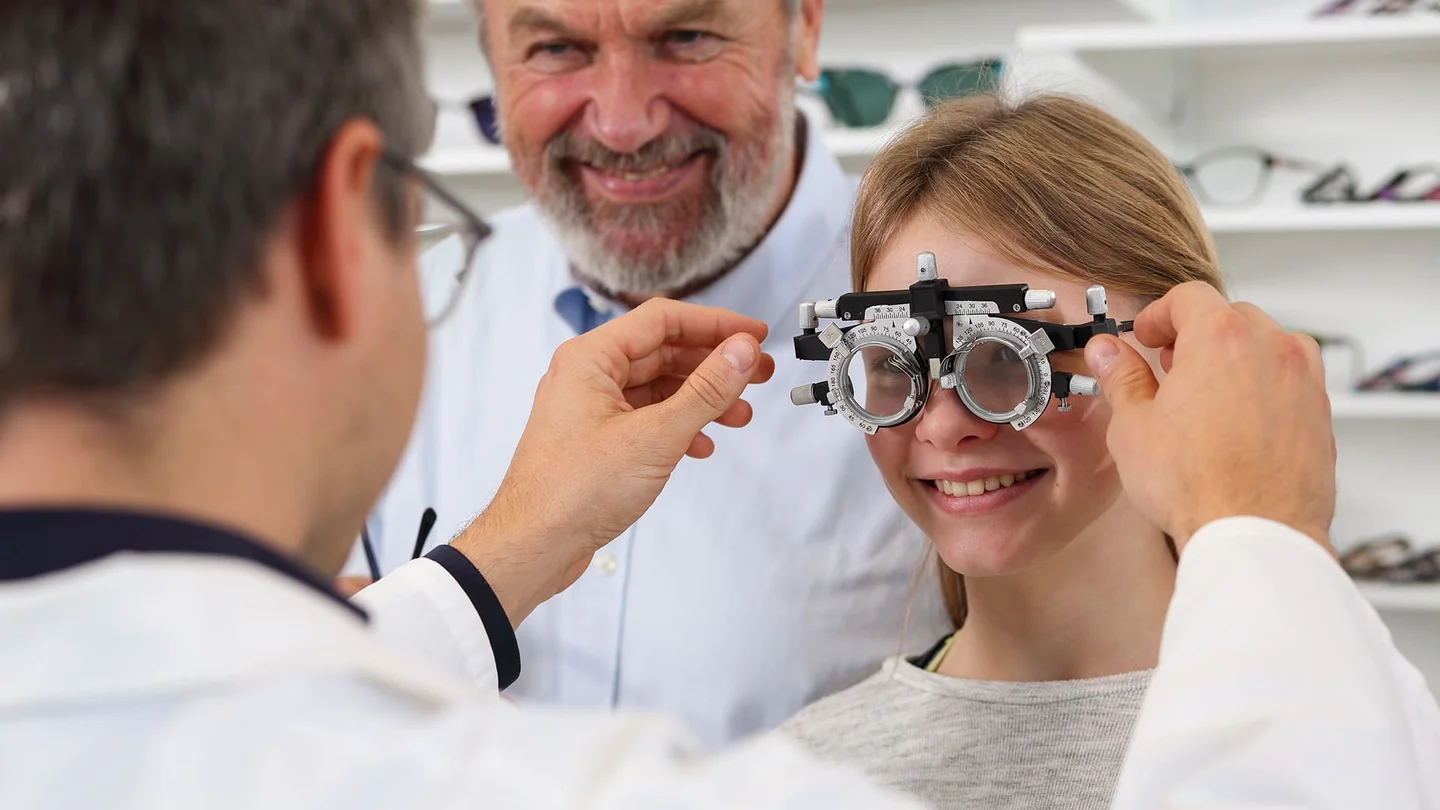
In this test, the person looks through a range of corrective lenses at an eye chart, and is asked whether the image is better or worse. The questioning clarifies exactly what the eye’s refractive power is. So this method is called a subjective refraction test. The device used, with the different lenses, is called a phoropter.
Objective refraction test
The refraction in the eye can also be calculated objectively, without any interaction. Medical practitioners call this an objective refraction test. To do this, automatic devices are used, for example, to project an infrared image onto the retina while measuring how sharp the image is. With children, though, a manual method is usually used that involves illuminating the retina and observing the light reflex. This method is called a skiascopy. It enables the type of refractive defect to be diagnosed.
Important: To get the truest possible measurements, special eye drops are used to enlarge the pupils of the eyes of small children in particular, and to relax the lens.
Ophthalmometry and corneal topography
The curvature of the cornea can also be measured precisely, for example using so-called ophthalmometry. The instrument used to do this, the ophthalmometer, is similar to a microscope. A computer-based upgrade of this method is called a corneal topography. Like on a map, it shows the detail of the entire surface of the cornea, which is necessary with complex types of astigmatism or in preparation for operations.
How is astigmatism treated?
A corneal irregularity is usually corrected by glasses or suitable contact lenses. This involves using so-called cylindrical glasses or lenses that refract the light to a different degree in different directions, thus compensating for the corneal irregularity.

There are also various surgical procedures for treating this sight defect. The best method depends, for example, on the severity of the astigmatism and the optician needs to judge this.
Laser beams are often used in corneal surgery. Laser treatment is used to change the curvature of the cornea. Artificial lenses can also be used in the eye to correct the refraction.
Surgical procedures are only normally used with adults. With children, an operation is only an option in specific cases that cannot be treated in a different way.
- American Academy of Ophthalmology. What Is Astigmatism? Aufgerufen am 20.01.2021.
- Berufsverband der Augenärzte Deutschlands e.V. (BVA). Hornhautverkrümmung (Astigmatismus). Aufgerufen am 20.01.2021.
- Gesellschaft für Neuropädiatrie e.V. (GNP) und andere Fachgesellschaften. Visuelle Wahrnehmungsstörungen. Sk2 Leitlinie. AWMF-Registernummer 022/020. 04/2017.
- Schiefer U, Kraus C, Baumbach P et al. Refraktionsfehler: Epidemiologie, Auswirkungen und Behandlungsmöglichkeiten. Dtsch Arztebl Int 2016; 113: 693–702. doi: 10.3238/arztebl.2016.0693
- UpToDate (Internet). Refractive errors in children. Wolters Kluwer 2020. Aufgerufen am 20.01.2021.
- UpToDate (Internet). Visual impairment in adults: Refractive disorders and presbyopia. Wolters Kluwer 2019. Aufgerufen am 20.01.2021.

In cooperation with the Institute for Quality and Efficiency in Health Care (Institut für Qualität und Wirtschaftlichkeit im Gesundheitswesen) (IQWiG).
As at: