Presbyopia
ICD codes: H52.4 What are ICD codes?
Most people notice that their eyes’ ability to focus on nearby objects begins to deteriorate from their mid-forties on. This loss of close-up vision is known as presbyopia. The process cannot be stopped or reversed. However, it is possible to compensate for the vision loss.
At a glance
- Close-up vision gradually deteriorates due to the normal aging process of the eyes – usually starting from the mid-forties.
- One of the main symptoms experienced is difficulty reading.
- Presbyopia can be diagnosed by an ophthalmologist or optician.
- While presbyopia cannot be reversed, treatments (e.g., with glasses or contact lenses) can compensate effectively for the vision loss.
- In most cases, there is no further worsening of vision after the age of about 65.
Note: The information in this article cannot and should not replace a medical consultation and must not be used for self-diagnosis or treatment.

What is presbyopia?
It happens to most people sooner or later, and usually from the mid-forties on – having to hold books or newspapers further and further away in order to read without strain and see each letter clearly. This phenomenon is known as presbyopia, or age-related far-sightedness. Close-up vision worsens as part of the normal aging process in the eyes.
While this condition cannot be cured, treatment can compensate for the symptoms, and the simplest form of treatment is to use reading glasses.
What are the signs of presbyopia?
Most people first notice that they are suffering from presbyopia when they experience difficulty reading things up-close. This is particularly obvious if they are feeling tired or reading in poor light. Reading for long periods is a strain because the letters become blurred. It is difficult to focus. The eyes begin to sting, which may in turn cause headaches.
What are the causes of presbyopia?
Presbyopia is part of the normal aging process in the eye. It is caused, above all, by changes in the adaptability of the lens in the eye, which enables clear vision. The lens bundles the light rays that enter the eye so that they produce a clear picture on the retina. The eyes need to adapt to varying distances in order to focus on objects in the close-up range and in the distance. For this purpose, the lens changes its refractive (focusing) power. When looking at nearby objects, the lens thickens. When looking at objects in the distance, it becomes thinner and flatter. The medical term for this adjustment is “accommodation”.
Accommodation is controlled by a circular muscle called the ciliary muscle. It is connected to the edge of the lens by thin fibers. This muscle contracts to make the lens thicken and enable clear vision in the close-up range. However, as part of the aging process, the lens becomes less flexible and increasingly loses the ability to thicken. At the same time, the ciliary muscle becomes weaker.
Do certain factors increase the likelihood of developing presbyopia?
Presbyopia doesn’t always begin at the same age for everyone. Some people notice that they have difficulty focusing while reading once they reach their early forties. For others, the symptoms begin much later. It is unclear what factors are at play here. Certain diseases, such as diabetes, cardiovascular diseases, or multiple sclerosis may increase the likelihood of an individual developing presbyopia.
There is no difference between women and men in terms of age of onset. It often seems that women need to start using reading glasses earlier than men. However, this is not because they experience presbyopia any sooner, but rather because they tend to do something about it earlier than their male counterparts.
How does presbybopia progress?
Even before the onset of presbyopia, the flexibility of the lens declines over time. While young children can see things clearly even if they are right in front of them, adults normally need a reading distance of about 35 centimeters. This distance increases gradually after the age of 40. Most people need reading glasses from the age of 45. In most cases, there is no further worsening of vision from the age of about 65.

People with near-sightedness (also known as short-sightedness or myopia) usually have milder symptoms of presbyopia that also occur somewhat later. They can compensate for their presbyopia by removing the glasses they use for long-distance vision.
People who are far-sighted tend to find the effects of their hardening lenses more disruptive. The reason for this is that presbyopia intensifies their eyes’ existing problems with adjusting to close-up vision.
Can presbyopia be prevented?
To prevent presbyopia, vision-training exercises are sometimes recommended to strengthen the muscles in the eyes. Many instructions for these can be found online or in books. However, ciliary muscle training cannot prevent the lenses of the eyes from becoming less elastic over time. This means that exercises cannot prevent presbyopia.
How is presbyopia diagnosed?
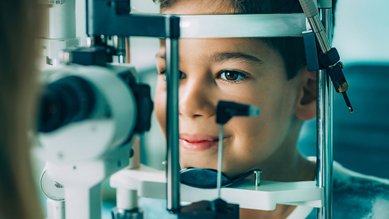
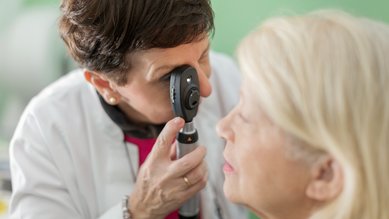
Presbyopia can be diagnosed by an ophthalmologist or an optician. First, a small instrument called an auto-refractometer is used to measure the refractive power of the eye. Next, an eye test is performed to determine which lenses are required to correct the patient’s distance vision and close-up vision. As the eyesight is usually different in each eye, the eyes are tested individually by first covering one eye and then the other. Using eye charts, this test determines which corrective lenses best suit each eye. The test may also use a projector to project letters, numbers, or broken rings to test the eyesight.
The refractive power of corrective lenses, of the natural lenses in the eyes, and of contact lenses is measured in diopters (dpt).
What treatments help alleviate presbyopia?
There is no effective method to stop or reverse presbyopia. However, treatment can compensate effectively for the symptoms. The simplest solution is to purchase a pair of ready-made reading glasses. However, these are not always sufficient, as they don’t take account of any differences in vision between the two eyes or of any other unique features, such as astigmatism.
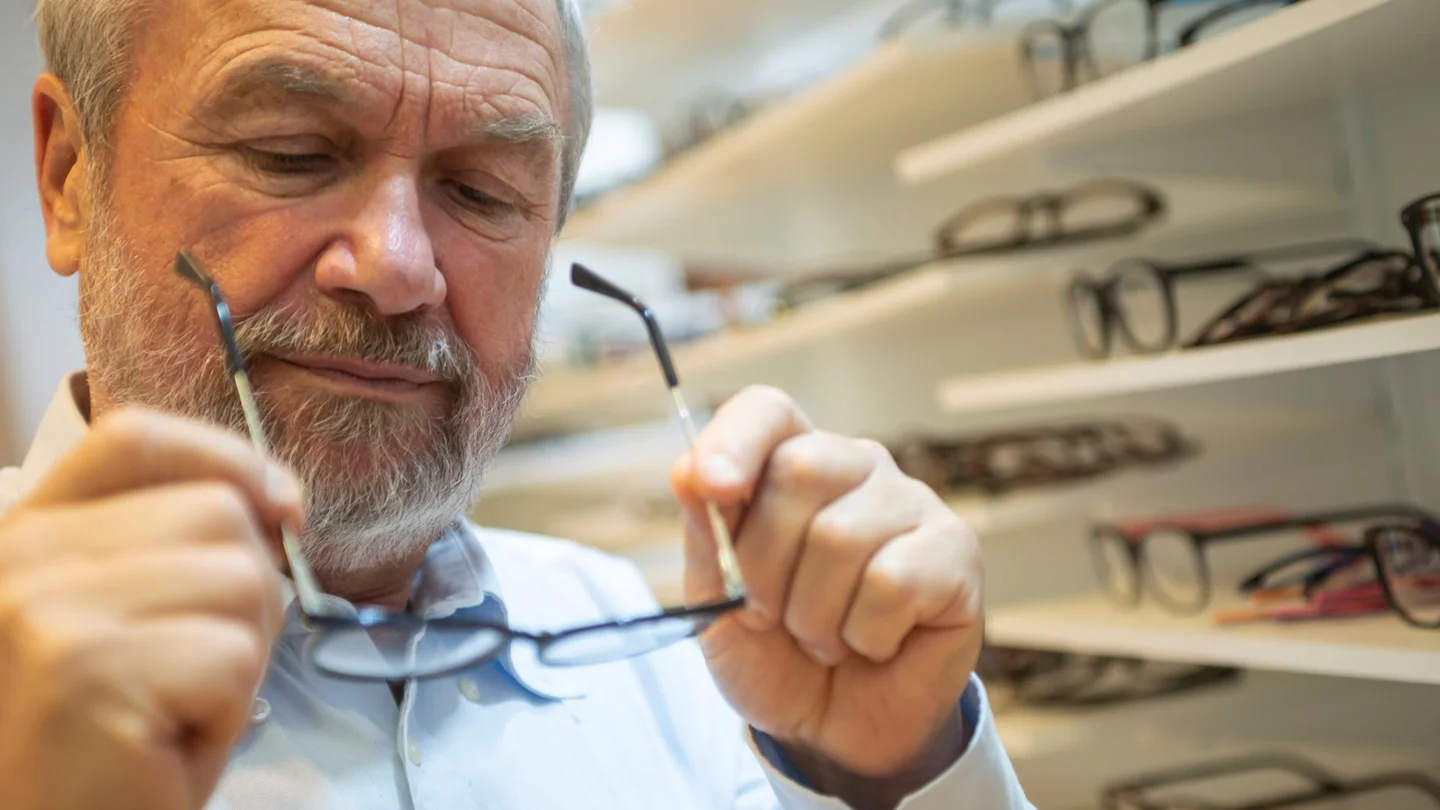
Opticians provide individually adjusted reading glasses based on the results of an eye test. They also take account of the distance between the pupils of both eyes and any other unique features. Reading glasses are often slim so that it is easy to see over them. This allows the wearer to focus on images in the distance without having to take the reading glasses off.
Multifocal lenses can be useful for people who are already wearing glasses when diagnosed with presbyopia. These can be bifocal lenses (bifocals), trifocal lenses (trifocals), or varifocal lenses (varifocals). Bifocal lenses have two areas separated by a visible horizontal line in the middle – the area above the line is for distance vision, while the area below is for close-up vision. Trifocals have a third distinct area used for vision in the middle distance. Varifocals are the most common. With these lenses, the division between the different areas is polished smooth and so there are no visible lines.
Contact lenses can also be used to correct presbyopia. However, glasses are often more practical for people who don’t have any other issues with their vision and don’t require vision correction all of the time.
The same considerations apply to other surgical procedures, such as synthetic lenses or corneal inlays. Eye surgery can be associated with risks and unwanted outcomes and only offers the benefit of allowing the patient to avoid wearing glasses.
For more detailed information, e.g., about how presbyopia can be corrected, visit gesundheitsinformation.de.
- American Optometric Association. Optometric Clinical Practice Guideline. Care of the Patient with Presbyopia. St. Louis; 2011. Aufgerufen am 18.10.2024.
- Bourne RR, Flaxman SR, Braithwaite T et al. Magnitude, temporal trends, and projections of the global prevalence of blindness and distance and near vision impairment: a systematic review and meta-analysis. Lancet Glob Health 2017; 5(9): e888-e897. Aufgerufen am 18.10.2024.
- Charman WN. Developments in the correction of presbyopia I: spectacle and contact lenses. Ophthalmic Physiol Opt 2014; 34(1): 8-29. Aufgerufen am 18.10.2024.
- Deutsche Ophthalmologische Gesellschaft (DOG), Kommission Refraktive Chirurgie (KRC), Berufsverband der Augenärzte Deutschlands (BVA). Bewertung und Qualitätssicherung refraktiv-chirurgischer Eingriffe durch die DOG und den BVA: KRC-Empfehlungen. Ophtalmologie 2023; 120: 633-644. Aufgerufen am 18.10.2024.
- Grehn F. Augenheilkunde. Berlin: Springer; 2019.
- Hickenbotham A, Roorda A, Steinmaus C, Glasser A. Meta-analysis of sex differences in presbyopia. Invest Ophthalmol Vis Sci 2012; 53(6): 3215-3220. Aufgerufen am 18.10.2024.
- Kelava L, Barić H, Bušić M et al. Monovision Versus Multifocality for Presbyopia: Systematic Review and Meta-Analysis of Randomized Controlled Trials. Adv Ther 2017; 34(8): 1815-1839. Aufgerufen am 18.10.2024.
- Lang G, Esser J, Garels O, Lang G, Lang S. Augenheilkunde. Stuttgart: Thieme; 2019.
- National Institute for Health and Care Excellence (NICE). Treating presbyopia by inserting an artificial lens in the cornea. 2013. Aufgerufen am 18.10.2024.
- Tabernero J, Chirre E, Hervella L et al. The accommodative ciliary muscle function is preserved in older humans. Sci Rep 2016; 6: 25551. Aufgerufen am 18.10.2024.
- Wang L, Moss H, Ventura BV et al. Advances in Refractive Surgery. Asia Pac J Ophthalmol (Phila) 2013; 2(5): 317-327. Aufgerufen am 18.10.2024.

In cooperation with the Institute for Quality and Efficiency in Health Care (Institut für Qualität und Wirtschaftlichkeit im Gesundheitswesen – IQWiG).
As at: