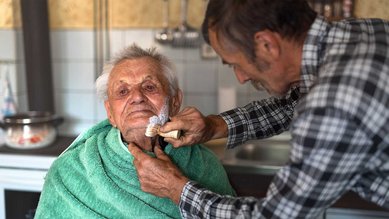
Pflege Family carers

There are many aspects to consider when caring for relatives. How can you balance care with working? What forms have to be completed in order to care for relatives and what care insurance benefits are specifically available to family carers? The articles below provide information about entitlements and respite services.

Family carers

Advice and training for carers

Looking after and supporting a person in need of care is a challenging task. The advice and further training opportunities offered by long-term care insurance help support carers in their role.

Care knowledge for relatives

Providing care for people who are in need of it is often a demanding task. Training courses and advisory services provide the necessary expertise.

Social security for family carers

When a person is being cared for a home, long-term care insurance will cover the costs of the carer’s various social insurance contributions, subject to certain conditions.

Avoiding freedom-restricting measures in the care sector

Freedom-restricting measures prevent people from moving around freely. The use of such measures can be avoided in various ways.

Hot weather: protecting older people and people in need of care

Heatwaves can cause serious health problems in older people and people in need of care in particular. Precautions can be taken that significantly reduce the risk.

Mental and physical stress and strain experienced by family caregivers

Acting as a caregiver for a loved one can be very stressful, both mentally and physically. In this article, caregivers will learn how to avoid burnout.

Additional relief allowance – a flexible benefit for care at home

The additional relief allowance is a versatile, flexible benefit that can be used in various ways for care at home. An annual total of 1,572 euros is available.

24-hour care – support from live-in care staff

With live-in support (also known as 24-hour care), care staff move into the household where the care recipient is living. The legal aspects of the employment relationship need to be considered.

Caring for people with dementia

This article tells family caregivers what is important in relation to caring for people with dementia, and which support options are available.

Preventing abuse in a home care setting

Abuse and aggression by those providing care to loved ones at home is an important topic. Read more here about its causes, the forms it may take and how it can be prevented.

Reconciling care and work

Reconciling care and work is usually difficult. Care services, leave entitlements and company policies can help to improve reconciliation.

Relief and support for family carers in older age

Many older people provide care to their loved ones. Older family carers are particularly reliant on support and relief to enable them to fulfill their caring role.

Palliative care for children

Palliative care services for critically ill children and adolescents offer support to the family as a whole. Read on to find out what palliative care means and which options are available.

Lasting powers of attorney, guardianship directives and advance healthcare directives

Advance directives enable you to control who can make decisions and act on your behalf in health, legal and financial matters if you are no longer able to do so for yourself.