Conditions Lichen simplex
ICD codes: L28 What are ICD codes?
People with lichen simplex feel persistent, severe itching that induces repeated scratching and rubbing. This results in dry, flaky, thickened patches of skin that, in turn, itch badly and induce increased scratching. A targeted treatment helps to break this cycle.
At a glance
- Lichen simplex is a chronic, inflammatory skin condition.
- Severe itching and repeated scratching result in an “itch and scratch cycle”.
- The condition usually occurs between the ages of 35 and 50, in women more often than in men.
- It often follows on from pre-existing conditions such as neurodermatitis and psoriasis.
- Lichen simplex is usually treated with anti-inflammatory or allergy drugs.
Note: The information in this article cannot and should not replace a medical consultation and must not be used for self-diagnosis or treatment.

What is lichen simplex?
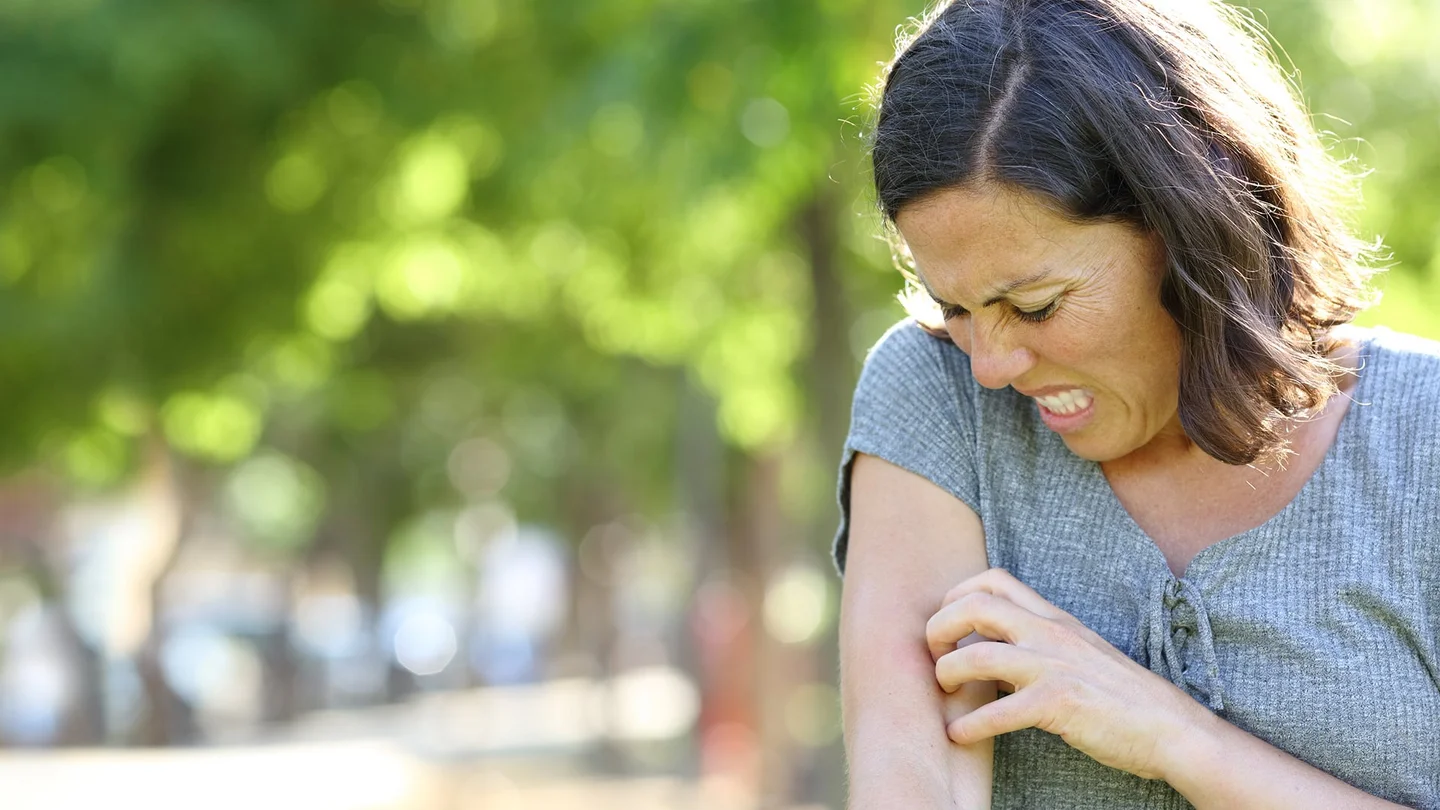
Lichen simplex chronicus, as the condition is known in full, is a common, chronic skin inflammation. Typical symptoms are dry, flaky, thickened skin that itches badly.
The itchy areas are often on the neck, arms and legs, the scalp, and the genital organs. Inflamed patches of skin occur due to excessive rubbing or scratching. This makes the itching worse. More scratching results in a cycle.
How is lichen simplex identified?
The condition presents as single or multiple sites on the skin that repeatedly and spontaneously start to itch severely. The itching is made worse by, for example, heat, sweating, or particular items of clothing. It may also be worse at night, when it disrupts sleep.

The changes to the skin typically occur in these places:
- neck
- scalp
- arms, particularly elbows
- hands
- legs, particularly knees
- inner thighs
- genital organs, particularly vulva and testicles
The inflamed skin becomes thick or even leathery due to repeated rubbing and scratching. Affected areas are often dry, pale or reddened, and cracked and flaky.
If the itching is particularly stubborn, frequent scratching can damage deeper layers of the skin and cause bleeding. If the scalp is affected, this can cause hair to fall out.
What are the causes of lichen simplex?
Various irritants can cause increased itching. Excessive scratching leads to more skin irritation which, in turn, leads to increased itching: an “itch and scratch” cycle emerges.
These irritations may emerge due to:
- mechanical rubbing, for example due to coarse clothing
- heat and sweating
- insect stings, bites from lice or other parasites
- ointments applied locally, for example against thrush
- irritants such as creams, soaps, shaving foam, sanitary towels, tampons, or perfumed toilet paper
- (emotional) stress
Certain illnesses can also cause increased itching.
These include skin conditions such as:
- neurodermatitis
- psoriasis
- thrush, particularly in the vagina
- warts
- lichen sclerosus
- contact allergies, for example to nickel
But kidney, liver, thyroid gland and blood cell illnesses can also be triggers.
What are the risk factors for lichen simplex?
How common is lichen simplex?
It is mainly people aged between 35 and 50 who develop lichen simplex. The condition is twice as common in women as in men. But children, too, may have lichen simplex symptoms.
What are the possible complications of lichen simplex?
Constant scratching can damage the skin. These areas then get inflamed easily and may be a gateway for germs to enter.
The skin cells can also be changed or damaged so that the skin is no longer able to regenerate properly. In very rare cases, cancer can occur in damaged skin.
How can lichen simplex be diagnosed?
There is no specific test to diagnose lichen simplex. During a thorough consultation the doctor will ask, for example, where and how often the itching occurs, and whether there are any known pre-existing conditions.
Skin samples help identify the thickenings of the horny layer of the skin which characterizes lichen simplex, and any other changes to the skin.
Evidence of possible fungal infections can also be found under the microscope or in the laboratory.
How is lichen simplex treated?
The treatment aims to break the “itch and scratch” cycle. So doctors try to get rid of everything that triggers the itching if possible.

If lichen simplex is the symptom of another condition, it is the latter that should be treated.
If the itching and inflammation is severe, anti-inflammatory cortisone ointments can help alleviate the symptoms.
If the itching is disrupting sleep, antihistamines can help. They soothe and act against allergic reactions.
In severe cases, under certain circumstances, light therapy using UVA and UVB rays may be an option.
What is everyday life with lichen simplex like?
The constant itching that comes with lichen simplex can be very stressful. Simple measures help alleviate the symptoms and cope with everyday life.
- Acute itching can be soothed using ice, cold compresses, or anti-itching products containing menthol.
- Irritated areas of skin can be protected by oil-replenishing, hygroscopic care products. These should be applied immediately after showering, when the skin is still damp.
- It is best to replace any irritating textiles or body care products with soothing products.
- To prevent unintentional scratching during sleep, it helps to keep fingernails short or wear gloves.
- Charifa A, Badri T, Harris BW. Lichen Simplex Chronicus. [Updated 2020 Aug 10]. In: StatPearls [Internet]. Treasure Island (FL): StatPearls Publishing; 2021 Jan-. Aufgerufen am 09.11.2020.
- DynaMed (Internet), Ipswich (MA). Lichen Simplex Chronicus. EBSCO Information Services. Record No. T116176. 2018 (1995). Aufgerufen am 09.11.2020.
- Juarez MC, Kwatra SG. A systemic review of evidence based treatments for lichen simplex chronicus. J Dermatolog Treat. 2020 Mar 6;1–9. Aufgerufen am 09.11.2020.
- Swick BL: Lichen Simplex Chronicus. BMJ Best Practice. Last updated: Oct 15, 2019. Aufgerufen am 09.11.2020.

In cooperation with the Institute for Quality and Efficiency in Health Care (Institut für Qualität und Wirtschaftlichkeit im Gesundheitswesen) (IQWiG).
As at: