Head lice
ICD codes: B85 What are ICD codes?
An itchy head may be a sign of head lice. Head lice are irritating but harmless. Targeted treatment is required to get rid of these tiny parasites and prevent them from spreading.
At a glance
- Head lice are wingless insects that feed on blood they suck from the scalp.
- Tickling and itching sensations on the scalp usually indicate that head lice are nesting in the hair.
- Head lice are particularly common in children of kindergarten/pre-school and elementary/primary school age.
- Head-to-head contact is usually required in order for head lice to spread. However, it is also possible for them to spread via objects.
- Various steps can be taken to prevent head lice from spreading.
- Effective medicated treatments are available. Health insurance providers cover the cost of most of these treatments for children up to the age of 12.
Note: The information in this article cannot and should not replace a medical consultation and must not be used for self-diagnosis or treatment.
What are head lice?
Head lice are tiny, wingless parasites. They nest in the hair and suck blood from the scalp. Bites from head lice can be itchy but are otherwise harmless. Unlike other blood-sucking insects like ticks, head lice don’t carry any diseases.
The eggs laid by head lice are called nits. Nits usually stick to the hair shaft close to the scalp. Head lice can multiply and spread quickly – a new generation normally takes just a week to hatch.
Head lice commonly occur in daycare settings, kindergartens/pre-schools and schools. Once they have become established, they do not disappear again by themselves. But there are various effective treatment options.
What are the symptoms of head lice?
Head lice are not always immediately noticeable but the following symptoms can occur:

- a tickling sensation on the scalp
- itchy bite and puncture sites or scratch marks/wounds on the skin
- sleep disturbances due to itching, as head lice are active at night
What are the causes of head lice?
Head lice mostly affect children. These parasites are almost always spread by direct physical contact – for example, when children play together.
Some people think that head lice are a sign of poor hygiene but this is not true – as head lice feed on blood, they don’t care whether hair is clean or dirty. Anyone can catch head lice.
They tend to spread somewhat more easily between girls than boys. Experts believe that this may be because girls tend to “put their heads together” more often and for longer than boys. Hair length has no influence on the risk of infestation. However, head lice are more difficult to detect in long, thick and curly hair.
How common are head lice?
Head lice are common – especially in children aged between 3 and 12. However, there are no exact figures for their prevalence in Germany. It is estimated that between 1 and 3 percent of children have head lice.

There are repeated outbreaks in kindergartens, daycare facilities and schools. Head lice normally occur in the first months after summer vacation – so from late summer to early fall.
How can head lice be prevented?
There is no fail-safe way to prevent an adult or child from getting head lice. However, anyone with head lice can help stop them spreading, as they are almost always passed on by head-to-head contact.
Head lice have to suck blood every 2 to 4 hours. They usually do not survive for long away from the scalp. Lice that fall out of the head dry out after just a few hours. The eggs of head lice also have to be near the scalp because the offspring cannot hatch without warm temperatures. This is why head lice are in general not transmitted via objects. However, this means of spreading cannot be entirely ruled out. To be on the safe side, it’s advisable to avoid sharing hats, scarves and brushes.
Other possible steps to prevent the spread of head lice include the following:
- Wash combs, brushes and hair clips thoroughly with hot water and soap and do not use them for a few days.
- Wash used bed linen, pajamas, clothing and hand towels at 60 degrees or put them in the dryer.
- Keep clothing and items like stuffed animals that cannot be washed at 60 degrees in a sealed plastic bag for 3 days.
How is a head lice infestation diagnosed?
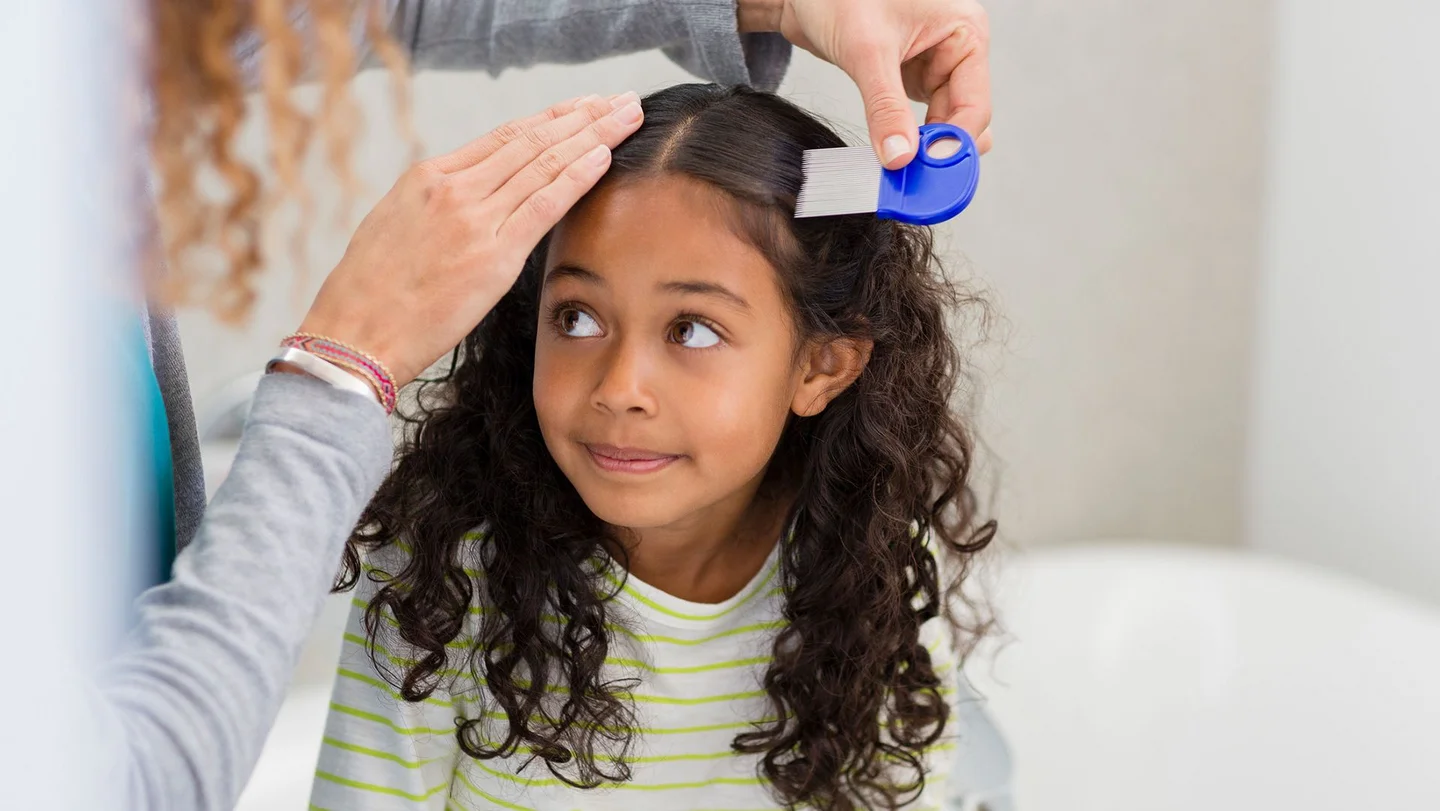
Parents are usually prompted to check their own children for head lice when they receive a “lice alert” from the kindergarten or school. A special lice comb is helpful when doing so.
Lice combs are available in drugstores or medical stores. When checking for lice, it is best to wet the hair first. The hair line should then be combed through carefully toward the hair ends – strand by strand and at least twice. The lice and their eggs (nits) can be more easily identified if the comb is wiped on a paper towel or hand towel after each strand.
Adult lice are only 2 to 3 mm in size, making them hard to see in a tuft of hair. Their body is gray-brown, flat and wingless. Unlike fleas, head lice cannot jump. They have six legs, which they use to latch onto human hair and run along it. Lice that are not yet fully grown can be seen more easily with a magnifying glass.
Head lice normally lay their eggs behind the ears or at the back of the neck. The eggs stick firmly to the hair shafts, usually at a maximum distance of one centimeter from the scalp.
Nits can sometimes be confused with other particles found in the hair, such as skin flakes or dandruff. Unlike nits, however, dandruff and other loose particles don’t stick to the hair and fall out when the hair is shaken.
How is a head lice infestation treated?
Head lice treatment is only required if live lice or viable eggs are found in the hair. In this case, rapid treatment is advisable before the lice can spread any further. Treatments containing insecticidal agents and silicone oil are effective against head lice.

Plant-based treatments are also available – for example, based on coconut oil. Alternatively, some people use home remedies like olive oil or mayonnaise. However, the effectiveness of these remedies has not been studied in depth.
Some insecticides are no longer as effective against head lice as they once were. For this reason, treatments based on silicone oil are more common today. They don’t use insecticide and their effectiveness is also long-lasting. The reason: agents with silicone oil cover the lice with a layer of oil that suffocates them.
Head lice treatments generally need to be repeated after about 7 to 10 days. The package insert details how exactly the head lice treatment is to be applied. Health insurance providers cover the cost of most treatments for children – doctors can prescribe these for children up to the age of 12.
Important: Carefully combing through the hair with a lice comb will reveal whether the head lice treatment has worked. Doctors recommend repeating the treatment, followed by a thorough comb-through, every 3 days for at least 2 weeks.
If a few nits remain following treatment but no lice are visible, this indicates that the parasite infestation has been cleared. However, nits or particles of them can still stick to the hair for several weeks. The distance of the nits from the scalp indicates whether they are old eggs or eggs from a new infestation – as hair only grows about 1 centimeter per month, nits found further than 1 cm away from the scalp are likely to simply be remnants of the old infestation.
For more detailed information about treating head lice, see gesundheitsinformation.de.
- Bauer E, Jahnke C, Feldmeier H. Seasonal fluctuations of head lice infestation in Germany. Parasitol Res. 2009 Feb;104(3):677-81. doi: 10.1007/s00436-008-1245-4. Epub 2008 Nov 18. PMID: 19015879.
- Bundesministerium der Justiz und für Verbraucherschutz, Juris. Gesetz zur Verhütung und Bekämpfung von Infektionskrankheiten beim Menschen (Infektionsschutzgesetz – IfSG). Aufgerufen am 08.06.2020.
- Burgess IF, Silverston P. Head lice. BMJ Clin Evid. 2009 Jan 14;2009:1703. PMID: 19445766; PMCID: PMC2907830.
- Deutsche Gesellschaft für Kinder- und Jugendmedizin (DGKJ). Kopflausbefall (Pediculosis capitis): ein Ratgeber für Kinderärzte. 2018.
- Devore CD, Schutze GE. Head lice (American Academy of Pediatrics Clinical Report). Pediatrics. 2015 May;135(5):e1355-65. doi: 10.1542/peds.2015-0746. Erratum in: Pediatrics. 2015 Oct;136(4):781-2. PMID: 25917986.
- Eppinger M, Müller M. Pädiatrie. Für Studium und Praxis. Medizinische Verlags- und Informationsdienste: Breisach 2017/18.
- Robert Koch-Institut (RKI). Kopflausbefall. RKI-Ratgeber. Aufgerufen am 20.05.2022.
- Speare R, Cahill C, Thomas G. Head lice on pillows, and strategies to make a small risk even less. Int J Dermatol. 2003 Aug;42(8):626-9. doi:10.1046/j.1365-4362.2003.01927.x. PMID: 12890107.

In cooperation with the Institute for Quality and Efficiency in Health Care (Institut für Qualität und Wirtschaftlichkeit im Gesundheitswesen – IQWiG).
As at: