Emergency care from the tele-emergency service or tele-stroke unit
A doctor is not always immediately available in an emergency. This particularly applies in rural areas, where there is a shortage of emergency doctors and permanent specialists such as neurologists in hospitals. This article explains how telemedical emergency services and tele-stroke units improve patient care in emergencies.
At a glance
- Telemedical emergency services help improve patients’ chances of survival and recovery in emergencies.
- Tele-emergency doctors provide remote support to the emergency responders at the scene if there is no emergency doctor present.
- In rural regions with few emergency doctors in particular people can obtain more reliable access to medical care through the use of tele-emergency services.
- Networking with tele-stroke units in larger hospitals enables even smaller hospitals to provide high-level care for stroke patients.
How does telemedicine provide support in emergencies?
In medical emergencies, every second often counts when it comes to saving lives or avoiding permanent damage. However, in rural regions in particular there is a lack of emergency doctors or specialized stroke units in hospitals. Telemedicine can be used to improve patient care in emergencies. To that end, tele-emergency doctors in control centers support the emergency responders at the scene. They help make diagnoses and direct the treatment remotely. As a result, appropriate care can be provided in many emergencies, such as blood pressure derailments, with the support of a tele-emergency doctor.
Furthermore, many regional hospitals that do not have a permanent neurologist on site are now digitally connected to larger specialized clinics. This enables cooperation with the stroke unit in the larger hospital so stroke patients can be appropriately treated in regional hospitals with the aid of telemedicine. In Germany, almost one in ten stroke patients are already treated using telemedicine.
What do tele-emergency doctors do?
When an ambulance is sent to an emergency, there is often no doctor on board. The control center uses the caller’s information to determine whether to request an emergency doctor in addition to the paramedics. The emergency doctor drives to the scene independently of the ambulance and often arrives later. In many situations, it can also be useful for a tele-emergency doctor to remotely support the emergency responders at the scene.
In Germany, paramedics have limited powers to treat patients and administer medication. By involving a tele-emergency service, the emergency situation can be assessed and the necessary treatment can be provided quickly and safely. The tele-emergency doctor is responsible for the treatment initiated.
In rural regions in particular there are often only a few emergency medical centers, which have to cover large areas. To nevertheless enable rapid medical assessments and treatments in emergencies, a growing number of municipalities are setting up tele-emergency services to support the conventional emergency services.
How does assistance from tele-emergency doctors work?
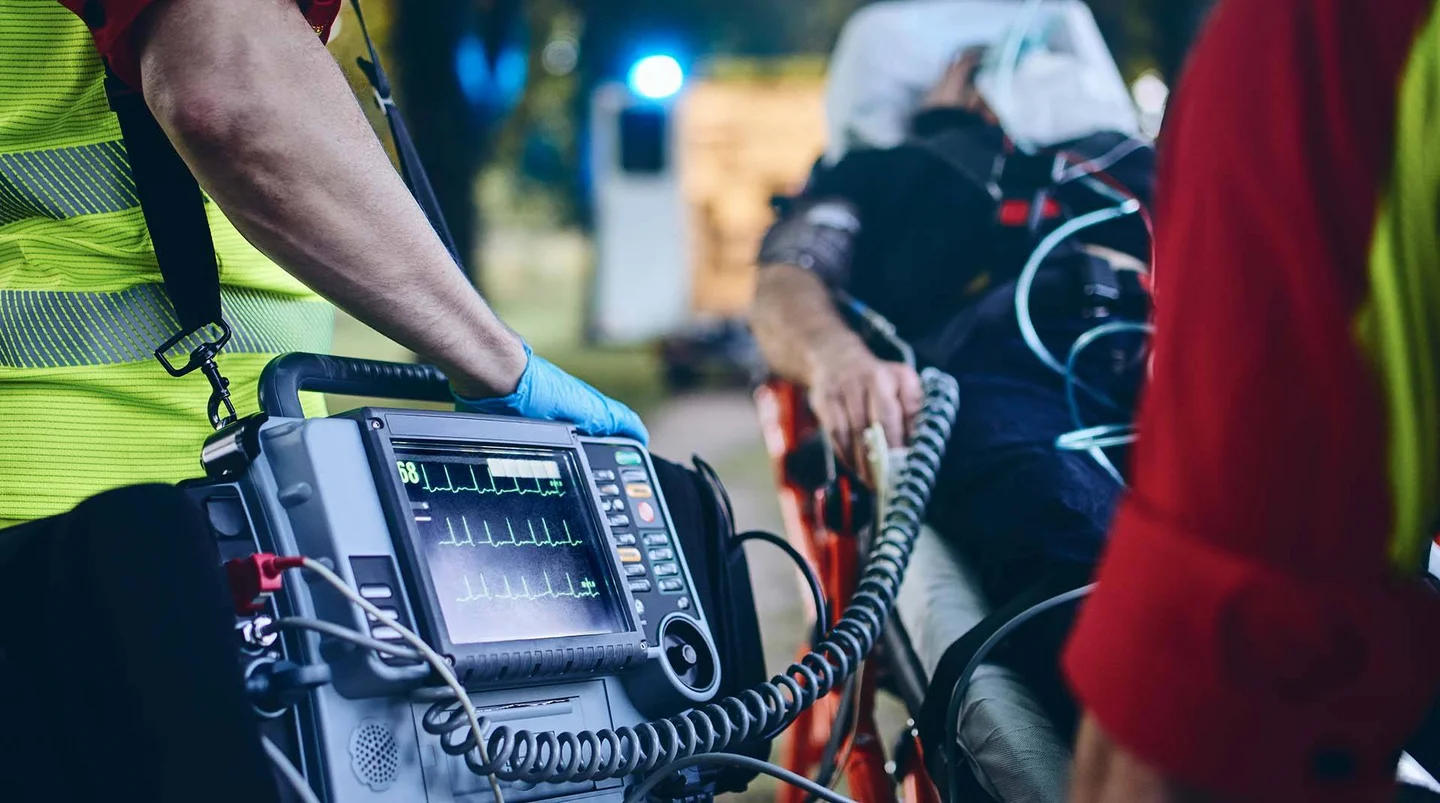
Tele-emergency doctors provide the emergency responders at the scene with remote medical and organizational support. They are connected to the ambulance by a live feed that provides both video and sound. Conversely, the emergency responders can give tele-emergency doctors important information and data about patients’ blood pressure, heart function (ECG) and breathing. This cooperation enables the tele-emergency doctor to provide the emergency responders at the scene with advice and guidance as they assess the emergency situation and instigate treatment.
What are the duties of a tele-emergency doctor?
The main duties of a tele-emergency doctor include offering advice and guidance to the emergency responders at the scene. Tele-emergency doctors can:
- help make diagnoses
- approve treatments, such as the administration of medication
- retrospectively order an emergency doctor to the scene if required (in consultation with the emergency services)
- assist the emergency doctor at the scene with decisions
- notify the hospital of a patient’s arrival
- provide advice and support during onward transportation and patient transfers to another hospital
For what kinds of emergencies can tele-emergency services provide assistance?
In emergencies where there is no acute risk to life, the main roles of an emergency doctor include providing a medical assessment, prescribing treatments, for example through medication, or deciding whether a patient should be transported to the hospital. These tasks can also be performed by the tele-emergency services. Examples of areas in which tele-emergency services can provide support therefore include:
- blood pressure derailments
- hypoglycemia
- pain management for non-life-threatening injuries
- strokes not involving a loss of consciousness
Studies and the experience gained from medical care to date have shown that tele-emergency services are able to provide the same (if not a better) level of medical care for non-life-threatening emergencies as emergency doctors at the scene.
Good to know: emergency doctors sometimes have to take hands-on action, for example in the event of life-threatening injuries or a loss of consciousness. In such cases, telemedical care does not suffice but can be used to bridge the period until the emergency doctor arrives at the scene.
Do tele-emergency doctors require special training?
Tele-emergency doctors are experienced, specially trained medical practitioners. Prior to working for tele-emergency services, a doctor must have attended more than 500 emergencies in person and acquired additional qualifications in emergency medicine. Doctors are appropriately trained before they can work as tele-emergency doctors.
How can stroke patients be treated using telemedicine?
A stroke is a medical emergency in which rapid diagnosis and treatment are particularly decisive with regard to how the condition will progress. To ensure that stroke patients receive the best possible medical care, many larger hospitals therefore have a specialized stroke unit. Such stroke units have highly qualified teams of doctors and nurses as well as special diagnosis and treatment options.
Smaller, regional hospitals, on the other hand, do not always have a stroke unit or similar specialist department and are therefore unable to ensure the provision of special stroke care around the clock. As a result, a growing number of them are joining together to form telemedical networks.
What is a tele-stroke unit?
A tele-stroke unit remotely supports the medical care of stroke patients. The medical experts from the large hospitals with a stroke unit are available 24 hours a day. Thanks to their support, even hospitals without a stroke unit or on-site neurologist can ensure the provision of a high level of stroke care. Germany now has over 20 telemedical networks, involving over 200 hospitals/clinics.

How do tele-stroke units work?
The neurological experts from a tele-stroke unit use digital media to advise and support the attending doctors. The experts can therefore get involved in both examining and treating the patients. For example, with the support of the on-site doctor, they can use a remote-controlled, high-resolution camera to perform examinations remotely. This makes it possible to jointly determine and initiate the best form of treatment. This often eliminates the need for transportation to a more distant hospital with a stroke unit. In some cases, however, transportation to a larger hospital is still necessary, for example for special interventions.
What is a tele-stroke unit?
A tele-stroke unit provides remote support for stroke patients: As not all hospitals are able to guarantee special stroke care round the clock, a growing number of them are coming together to form telemedical networks. The medical experts from a national stroke unit are available 24 hours a day. Thanks to their support, even hospitals without a neurological department can provide a high level of stroke care. Germany now has over 20 telemedical networks, involving over 200 hospitals/clinics.
How do tele-stroke units work?
If a patient has had a stroke, the neurological experts from a tele-stroke unit advise and support the attending doctors on site. By using digital media, they can get involved in both examining and treating the patients. For example, with the support of the on-site doctor, they can use a remote-controlled, high-resolution camera to perform examinations remotely. This makes it possible to jointly determine and initiate the best form of treatment. This often eliminates the need for patients to be transported to a further away hospital with a stroke unit.
Tele-stroke units are also subject to a certification procedure. This acts as the quality seal for regional and national stroke units.
What is a STEMO/MSU?
The sooner the exact cause of a stroke is determined and treated, the greater the chance of preventing permanent damage and patient death. As a result, specially equipped emergency vehicles were developed for stroke patients. These are known as STEMO, from the German “Stroke-Einsatz-Mobile”, meaning “mobile stroke unit” (MSU).
STEMO or MSU are equipped with a computer tomograph (CT), an X-ray machine and a mini laboratory. Their crew comprises not only paramedics but also a neurologist who is trained in emergency care. The CT enables the crew to determine whether the stroke has been caused by a brain bleed (hemorrhage) or a blood clot while still at the scene. In the case of a blood clot, patients can be given an infusion with a drug for dissolving the clot even while on route to the hospital (thrombolysis).
This significantly improves their chances of survival and recovery: According to a study by the German Stroke Society (DSG) and a Berlin research team, the risk of people dying or developing disabilities from a stroke reduced by a quarter if they were treated in the ambulance. More than half of MSU patients are treated with thrombolysis. In addition, treatment was initiated an average of 20 minutes faster than in patients who had to wait to get to hospital for treatment.
At present, the number of STEMO/MSU in permanent use in Germany is still very low. This is due to the special requirements they have to meet: As computer tomographs are large, heavy devices, they cannot be retrofitted in normal ambulances but instead need custom-made basic vehicles.
Despite the high procurement costs, the German Stroke Society (DSG) recommends the increased use of STEMO/MSU, especially in rural areas, due to their proven benefits.
- Bergrath S, Müller M, Rossaint R et al. Guideline adherence in acute coronary syndromes between telemedically supported paramedics and conventional on-scene physician care: A longitudinal pre-post intervention cohort study. Health Informatics J. 2019 Dec;25(4):1528-1537.
- Brinkrolf, P., Kuntosch, J., Metelmann, B., Metelmann, C., Hahnenkamp, K., Süss, R., Hasebrook, J. P., & Fleßa, S. (2022). Ist das Telenotarzt-System eine sinnvolle Ergänzung im ländlichen Raum? – Eine Analyse aus medizinischer und ökonomischer Perspektive. Bundesgesundheitsblatt, Gesundheitsforschung, Gesundheitsschutz, 65(10), 1007–1015.
- Deutsche Gesellschaft für Anästhesiologie und Intensivmedizin – Strukturkommission Telemedizin. Telemedizin in der prähospitalen Notfallmedizin: Strukturempfehlung der DGAI. Anästh Intensivmed. 2016;57:2–8.
- Deutsche Gesellschaft für Neuroradiologie e. V. Thrombektomie beim Schlaganfall: Schnellste Transporte und Netzwerkbildung erforderlich. Aufgerufen am 25.06.2024.
- Deutsche Schlaganfall-Gesellschaft. Telemedizinische Schlaganfallversorgung: Warum besonders Patienten in ländlichen Regionen profitieren. Aufgerufen am 25.06.2024.
- Follmann A, Schröder H, Neff G et al. Wenn Notarzt und Telenotarzt gemeinsam Leben retten: Eine Fallbeschreibung für die Anwendung der prähospitalen Telemedizin bei einer kreislaufinstabilen ventrikulären Tachykardie. Anaesthesist. 2021 Jan;70(1):34-39.
- Hubert G., Handschu R., Barlinn J., Berrouschot J., Audebert H. J. Telemedizin beim akuten Schlaganfall. Aktuelle Neurologie 2016; 43(10): 615-623.
- Koncz, V., Kohlmann, T., Bielmeier, S., Urban, B., Prueckner, S. (2019). Telenotarzt: Neues Versorgungskonzept in der Notfallmedizin. Der Unfallchirurg. 122.
- Schröder, H., Beckers, S. K., Borgs, C., Rossaint, R., & Felzen, M. (2023). Update Telenotfallmedizin : Status quo und Ausblick. Die Anaesthesiologie, 72(7), 506–517.
- Stiftung Deutsche Schlaganfall-Hilfe. Stroke Unit - Was ist das? Aufgerufen am 25.06.2024.
- Uniklinik RWTH Aachen. Der Telenotarzt. Aufgerufen am 25.06.2024.
- Uniklinik RWTH Aachen. Aufgaben des Telenotarztes im 24/7-Dienst. Aufgerufen am 25.06.2024.
As at: