Short-sightedness
ICD codes: H52.1 What are ICD codes?
Short-sightedness is a vision condition that often develops during childhood and adolescence. Being short-sighted means having blurred vision of objects in the distance but usually having good up-close vision of things that are near to you. Glasses or contact lenses can correct their vision condition.
At a glance
- Short-sightedness is very common. People can be born with short-sightedness or develop it at some point in their lives.
- It usually starts among children of school age and gradually worsens as they grow to young adulthood.
- To people who are short-sighted, objects in the distance appear blurred and unclear. However, they often have good close-up vision.
- Short-sightedness can be corrected by wearing glasses or contact lenses.
Note: The information in this article cannot and should not replace a medical consultation and must not be used for self-diagnosis or treatment.
What is short-sightedness?
Short-sightedness (referred to by medical practitioners as “myopia”) is a vision condition that often develops during childhood and adolescence. People who are short-sighted see objects in the distance as unfocused and blurred. Depending on the severity of their short-sightedness, they often have good up-close vision. Short-sightedness occurs when the eyeball is too long.
The opposite is true of people with long-sightedness/far-sightedness, who have blurred vision of objects that are close to them but see objects in the distance in sharp focus.
Short-sightedness usually begins in children of school age and gradually worsens during puberty, as the eyeball becomes longer during this period of growth. Changes in short-sightedness occur more slowly once people reach early adulthood.
The severity of short-sightedness is measured in units called diopters. For example, mild short-sightedness occurs at minus 1 diopters, while severe short-sightedness occurs as of minus 6 diopters.
Video What is a vision condition?
This and other videos can also be found on YouTube
Watch nowThe privacy policy indicated there applies.
What are the symptoms of short-sightedness?
People who are mildly short-sighted often don’t even notice in everyday life. Their condition is usually only detected when they need to have good long-distance vision – for example, when driving.
With more moderate short-sightedness, everything a little further away will appear blurred. This means that a person may have no difficulty reading a book but will be unable to read writing on a board located a couple of meters away from them.
People with severe short-sightedness only have a clear vision of objects located within a range of a few centimeters. That makes it impossible for them to read a book at a normal distance.
When people have a severe degree of short-sightedness, they are more likely to develop certain other eye conditions at a later point in their lives, such as retinal degeneration or retinal detachment, a cataract or a glaucoma.
What causes short-sightedness?
With normal vision, light rays enter the eye through the lens and are bundled together in a focused way on the retina. During this process, the lens and cornea refract (i.e. bend) the light rays so that they come together in precisely the same spot on the retina.
With short-sightedness, the light rays are bundled together before they reach the retina. This results in an unclear image.
The reason for this is usually that the eyeball is too long. In some people, however, the lens or cornea are curved more steeply than normal. This causes excessive bending of the light rays, causing them to come together in front of the retina rather than on the retina.
What factors increase the risk of short-sightedness?
Short-sightedness can be hereditary. In other words, the condition may run in families.
Other factors that increase the likelihood of developing short-sightedness include doing a lot of work on screens, reading for long periods of time or reading with the book held too close to the eyes.
How common is short-sightedness?
Short-sightedness is very common. It is estimated that almost a quarter of all people in the world are short-sighted. Their numbers have increased sharply over recent decades in Europe and the USA.

The main reason put forward by experts for this rise is a change in lifestyle – these days, many people spend more time in enclosed spaces, read more and spend more time with their eyes focused on objects close to them, such as computer screens.
How can short-sightedness be detected at an early stage?
Short-sightedness often goes unnoticed among young children. For this reason, pediatrician use a simple sight test to check vision as part of the U check-ups (child wellness examinations).
If it is suspected that a child is short-sighted, their eyes should be examined by an ophthalmologist (eye specialist).
How is short-sightedness diagnosed?
The eye specialist will begin by asking about symptoms – for example, the situations in which vision is affected and whether sight is better when looking at objects up-close or in the distance.
A sight test measures visual acuity (i.e. clarity of vision). The patient is asked to recognize and read aloud a set of letters or numbers of varying sizes on a chart placed at a certain distance from them. One eye at a time is tested while the other is covered so as to test the vision in both eyes.
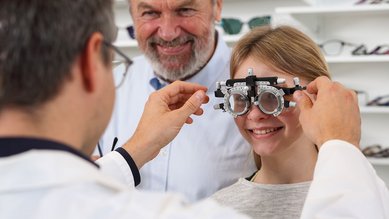
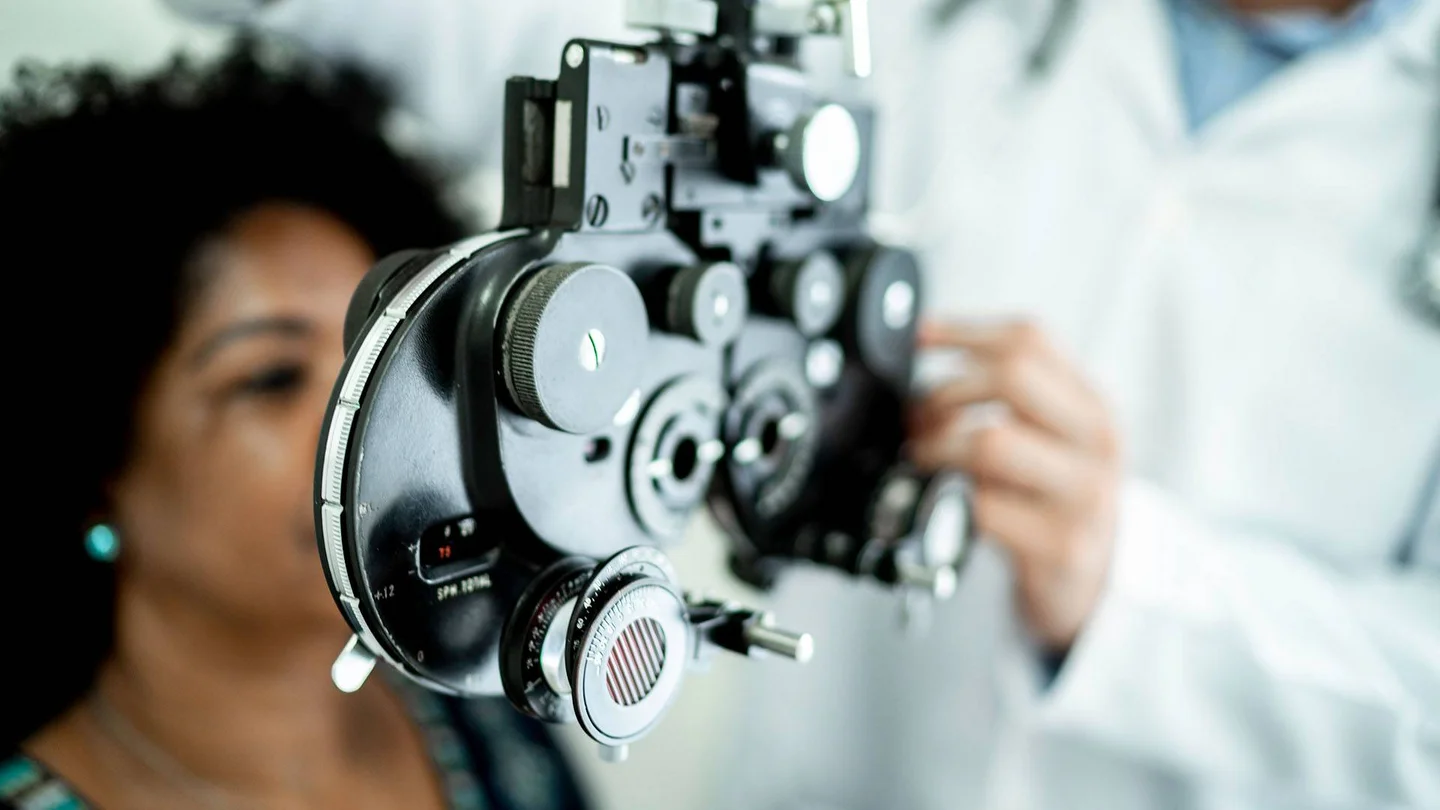
If the patient is unable to read the smaller letters or numbers, the eye specialist will try lenses of varying strengths in front of each eye until they come into focus. This test determines the person’s degree of short-sightedness.
The eye specialist will also use an instrument to measure the refractive power of the eyes, i.e. their ability to bend light rays. This enables an objective assessment of their short-sightedness, independently of the person’s own perception. The instrument sends a ray of light into the eye and measures the refraction. Refraction of the light is greater in people with short-sightedness.
How is short-sightedness treated?
Glasses or contact lenses can be used to correct short-sightedness, depending on the degree of severity in each case.
The corrective glasses and contact lenses are concave in shape. This means they are thicker around the edges then in the middle. As a result, the incoming light rays are scattered. The effect of this is to counteract the excessive refraction that occurs with short-sightedness.

In addition to glasses and contact lenses, adults with a high degree of short-sightedness have the additional option of surgery on their eyes. In most of the procedures used, the cornea of the eye is flattened to a certain extent with a laser. This in turn reduces the cornea’s refractive power.
However, this procedure is not without risk – scars may form or vision may deteriorate, e.g. at night or when focusing on objects in the distance. If vision worsens or if presbyopia (i.e. age-related long-sightedness/far-sightedness) develops, it may become necessary to wear glasses again.
- Lagrèze W A, Schaeffel F. Preventing Myopia. Dtsch Arztebl Int 2017; 114: 575–80. doi: 10.3238/arztebl.2017.0575.
- Prousali E., Haidich AB., Fontalis A. et al. Efficacy and safety of interventions to control myopia progression in children: an overview of systematic reviews and meta-analyses. BMC Ophthalmol. 2019 May 9;19(1):106. doi: 10.1186/s12886-019-1112-3. PMID: 31072389; PMCID: PMC6506938.
- UpToDate (Internet). Laser refractive surgery. Wolters Kluver 2020. Aufgerufen am 22.05.2021.
- UpToDate (Internet). Refractive errors in children. Wolters Kluwer 2020. Aufgerufen am 22.05.2021.
- UpToDate (Internet). Visual impairment in adults: Refractive disorders and presbyopia. Wolters Kluwer 2019. Aufgerufen am 15.02.2019.

In cooperation with the Institute for Quality and Efficiency in Health Care (Institut für Qualität und Wirtschaftlichkeit im Gesundheitswesen – IQWiG).
As at: