Skip navigation
gesund.bund.de - Reliable information for your health gesund.bund.de - Reliable information for your health
  • Deutsch
  • English
  • Türkçe
  • Русский
  • عربي
Sprache Language Dilim Язык اللغة
Search
  • Display format Display format
  • Sign language Sign language
  • Simple language Simple language
  • Bookmark list Bookmark list (0)
 
Skip navigation
  • Healthcare

    • Healthcare

    • The healthcare system
    • Health literacy
    • Help and advice
    • Patient rights
    • Self-help
    • Services and benefits

    • Health insurance
    • Benefits for those with health insurance
    • Prescription drugs
    • Prevention and screening
    • Out-of-hospital intensive care
  • Care

    • Topics

    • Long-term care insurance
    • Care benefits
    • Family carers
    • Everyday care and home life
  • Digital health

    • Digitization in healthcare

    • Health and digitization
    • Telemedicine
    • Digital applications

    • Electronic health record (ePA)
    • Electronic medical data cards (eGK)
    • Health apps (DiGA and DiPA)
    • E-prescriptions
    • Electronic sick leave notice
  • Healthy living

    • Staying healthy

    • Diet and exercise
    • Saving lives and helping people
    • Managing addiction
    • Environment and health
    • Life stages

    • Growing up healthily
    • Workplace health
    • Pregnancy and birth
    • Health in old age
  • Conditions

    • Topics

    • Respiratory system
    • Eyes
    • Circulatory and lymphatic systems
    • Reproductive organs
    • Ear, nose and throat
    • Skin
    • Cardiovascular system
    • Hormones
    • Immune system
    • Head and nervous system
    • Psyche
    • Muscles, bones and joints
    • Kidneys and urinary tract
    • Digestion and metabolism
    • Teeth and gums
    • Special topics

    • Allergies
    • coronavirus
    • Infections and infectious diseases
    • Cancer
    • Conditions A–Z
  • Services

    • Information

    • Emergency numbers
    • ICD and OPS codes
    • Conditions A–Z
    • Glossary
    • Infection radar
    • Media library
    • Search functions

    • Doctor search
    • Hospital search
    • Pharmacy search
 
  • Display format Display format
  • Sign language Sign language
  • Simple language Simple language
  • Bookmark list Bookmark list (0)

Nummular eczema

Read out loud

These functions require cookies. Go to Settings

  • Content

  • At a glance
  • Definition
  • Symptoms
  • Causes
  • Diagnosis
  • Treatment
  • Sources

ICD codes: L30.0 What are ICD codes?

Nummular eczema brings itchy round rashes, usually on the legs or arms. The eczema often occurs episodically over many years. The symptoms can usually be treated successfully.

At a glance

  • Nummular eczema is an inflammation of the skin.
  • Typically, itchy round spots form with a diameter of one to 10 centimeters.
  • The rashes are usually on the legs or arms.
  • Nummular eczema often develops in men over the age of 50. It is less common in women, in whom it occurs at a considerably younger age.
  • The condition occurs episodically across months or years.
  • Anti-inflammatory creams and good skincare can alleviate the symptoms.

Note: The information in this article cannot and should not replace a medical consultation and must not be used for self-diagnosis or treatment.
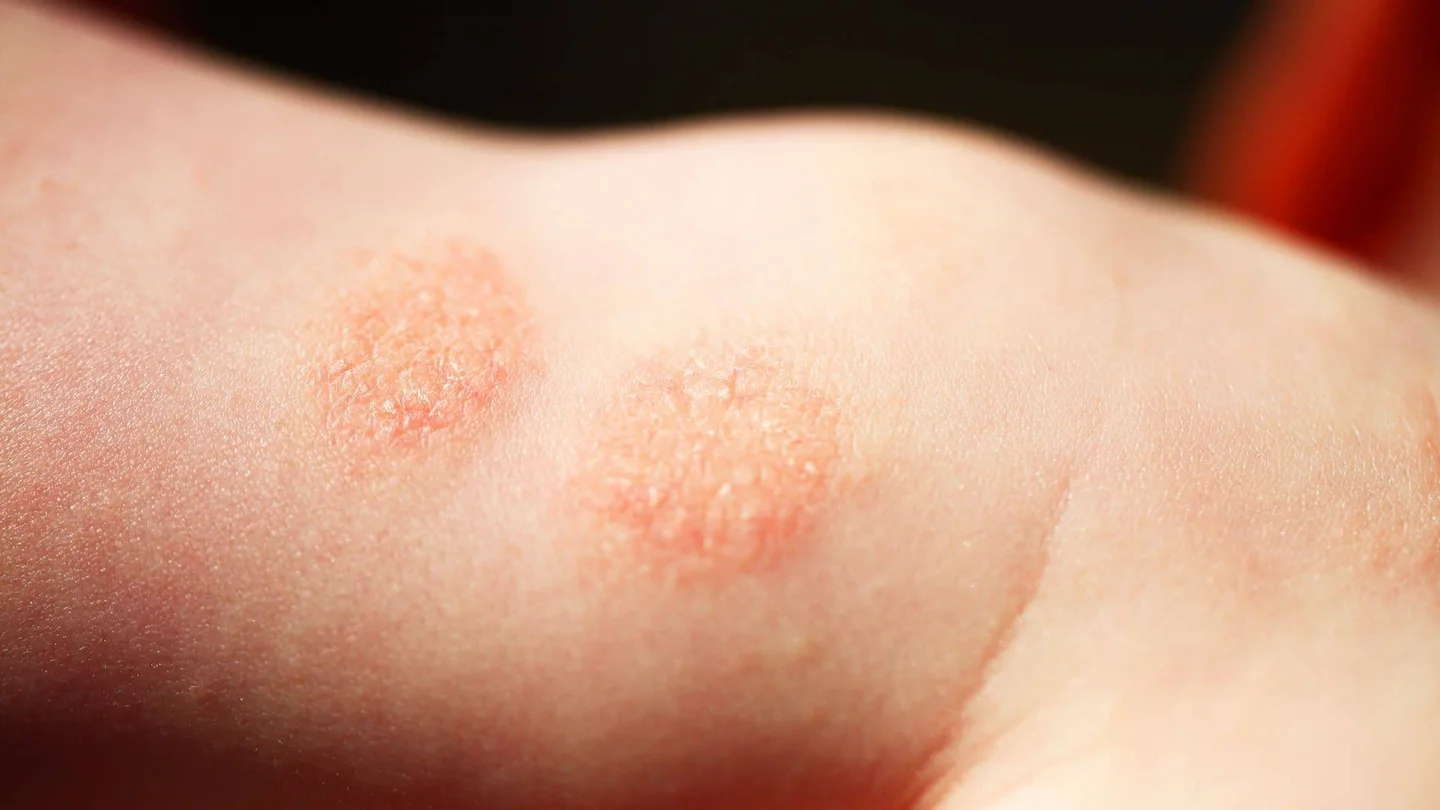
Ein menschliches Körperteil mit einem münzförmigen, rötlich-braunen Hautausschlag. Ein menschliches Körperteil mit einem münzförmigen, rötlich-braunen Hautausschlag.

What is nummular eczema?

Nummular eczema is a chronic, inflammatory skin condition associated with itchy round spots. The reddish-brown rashes are particularly common on legs and arms, and may be coin-shaped.

The eczema often occurs in men over the age of 50. It is less common in women and then tends to occur in teenagers or young adults. Children also sometimes get nummular eczema.

The skin condition usually occurs in episodes across months or years. The eczema is treated with anti-inflammatory cortisone creams, for example.

What are the symptoms of nummular eczema?

Characteristic of nummular eczema are round, reddish-brown spots on the skin. They are shaped like coins. The spots may be between one and 10 centimeters in diameter.

The characteristic features of nummular eczema (also known as nummular or discoid dermatitis) are red or brown patches on the skin.

The spots can itch and burn, first weeping and then crusting. If yellowish crusts form, it indicates an additional infection with bacteria.

Some people with nummular eczema suffer from single rashes, while others have very many. They usually occur on the legs, arms, hands, or feet. If they occur on the torso, they are usually on the lower stomach, lower back, or bottom.

The rashes can last for several weeks or even months. Over time they dry out and become flaky. Sometimes the spots get pale in the center and become ring-shaped.

Nummular eczema usually occurs in episodes. In an acute episode, the skin rashes often recur in the same or neighboring places.

What causes nummular eczema?

As yet little is known about exactly what causes nummular eczema. But it is thought that there are many contributing factors and potential triggers. These include:

  • neurodermatitis
  • contact allergies, for example to metals such as nickel
  • very dry skin
  • poor circulation and swellings in the legs
  • skin damage, for example insect bites
  • skin infections from bacteria
  • certain medications

How is nummular eczema diagnosed?

The eczema is usually identified through the typical coin-shaped rashes. Specific laboratory tests are not normally required.

Most cases of nummular eczema are diagnosed based on its typical disc-shaped rashes.

If doctors suspect an additional infection, they sometimes take a skin swab. An allergy test is sometimes carried out, too, to identify the eczema’s possible triggers.

How is nummular eczema treated?

Nummular eczema is often treated with cortisone creams that have an anti-inflammatory effect. If the skin areas affected are also infected with bacteria, doctors additionally prescribe an antibiotic aimed at the bacteria.

Antihistamines are also sometimes used, in particular to alleviate itching during the night and to prevent sleep disorders. Antihistamines act against allergic reactions. 

In general it is important to protect the skin and to care for it well. The following are recommended, for example:

  • using mild soaps
  • only brief, lukewarm showers
  • putting cream on the skin after a shower while it is still a little damp
  • avoiding known irritants and substances that trigger allergies (allergens)

  • American Academy of Dermatology. Eczema Types: Nummular Eczema Overview. Aufgerufen am 07.05.2021
  • DynaMed (Internet), Ipswich (MA). Nummular Eczema. EBSCO Information Services. Record No. T114221. 2018 (1995). Aufgerufen am 07.05.2021
  • Hardin CA, Love LW, Farci F. Nummular Dermatitis. [Updated 2021 Jan 5]. In: StatPearls [Internet]. Treasure Island (FL): StatPearls Publishing; 2021 Jan-. Aufgerufen am 07.05.2021
  • UpToDate (Internet). Nummular eczema. Wolters Kluwer 2020. Aufgerufen am 07.05.2021

Badge

In cooperation with the Institute for Quality and Efficiency in Health Care (Institut für Qualität und Wirtschaftlichkeit im Gesundheitswesen) (IQWiG).

As at: 23.06.2021

Did you find this article helpful?
Thank you for your feedback!
Thank you for your additional comments!
Sorry, your response could not be submitted due to a technical error.

Get informed Recommended articles

Neurodermatitis

People with neurodermatitis often get a rash and a nagging itching. This skin condition often occurs in children. Learn more about neurodermatitis and the treatment options.

Find out more

Psoriasis

Psoriasis is an inflammatory, non-contagious skin condition. It is characterized by reddish, flaky skin that may be itchy.

Find out more

Dyshidrotic eczema

Dyshidrotic eczema is characterized by itchy blisters that appear on the palms of the hands, fingers or soles of the feet. These are usually treated with anti-inflammatory ointments.

Find out more

Back to top
Logo - Bundesministerium für Gesundheit Logo - Bundesministerium für Gesundheit

gesund.bund.de A service from the Federal Ministry of Health.

Useful links

  • Topic overview
  • User advice
  • Website overview

Services

  • Help and advice
  • Accessibility
  • Report an accessibility barrier

About us

  • About gesund.bund.de
  • Quality assurance
  • Our partners
  • Contact

Important emergency numbers

  • Fire and ambulance services 112 112
  • Non-emergency medical assistance 116117 116117
  • Emergency numbers

Certifications

  • afgis-Qualitätslogo mit Ablauf 2026/03: Mit einem Klick auf das Logo öffnet sich ein neues Bildschirmfenster mit Informationen über Bundesministerium für Gesundheit (BMG) und sein/ihr Internet-Angebot: gesund.bund.de/
  • Logo DNGK 2025-2026
  • BIK - BITV-konform (geprüfte Seiten), zum Prüfbericht

© Copyright 2026 Bundesministerium für Gesundheit Data protection Legal notice