Skip navigation
gesund.bund.de - Reliable information for your health gesund.bund.de - Reliable information for your health
  • Deutsch
  • English
  • Türkçe
  • Русский
  • عربي
Sprache Language Dilim Язык اللغة
Search
  • Display format Display format
  • Sign language Sign language
  • Simple language Simple language
  • Bookmark list Bookmark list (0)
 
Skip navigation
  • Healthcare

    • Healthcare

    • The healthcare system
    • Health literacy
    • Help and advice
    • Patient rights
    • Self-help
    • Services and benefits

    • Health insurance
    • Benefits for those with health insurance
    • Prescription drugs
    • Prevention and screening
    • Out-of-hospital intensive care
  • Care

    • Topics

    • Long-term care insurance
    • Care benefits
    • Family carers
    • Everyday care and home life
  • Digital health

    • Digitization in healthcare

    • Health and digitization
    • Telemedicine
    • Digital applications

    • Electronic health record (ePA)
    • Electronic medical data cards (eGK)
    • Health apps (DiGA and DiPA)
    • E-prescriptions
    • Electronic sick leave notice
  • Healthy living

    • Staying healthy

    • Diet and exercise
    • Saving lives and helping people
    • Managing addiction
    • Environment and health
    • Life stages

    • Growing up healthily
    • Workplace health
    • Pregnancy and birth
    • Health in old age
  • Conditions

    • Topics

    • Respiratory system
    • Eyes
    • Circulatory and lymphatic systems
    • Reproductive organs
    • Ear, nose and throat
    • Skin
    • Cardiovascular system
    • Hormones
    • Immune system
    • Head and nervous system
    • Psyche
    • Muscles, bones and joints
    • Kidneys and urinary tract
    • Digestion and metabolism
    • Teeth and gums
    • Special topics

    • Allergies
    • coronavirus
    • Infections and infectious diseases
    • Cancer
    • Conditions A–Z
  • Services

    • Information

    • Emergency numbers
    • ICD and OPS codes
    • Conditions A–Z
    • Glossary
    • Infection radar
    • Media library
    • Search functions

    • Doctor search
    • Hospital search
    • Pharmacy search
 
  • Display format Display format
  • Sign language Sign language
  • Simple language Simple language
  • Bookmark list Bookmark list (0)

Food allergy

Read out loud

These functions require cookies. Go to Settings

  • Content

  • At a glance
  • Definition
  • Symptoms
  • Causes
  • Prevalence
  • Diagnosis
  • Treatment
  • Further information
  • Sources

ICD codes: T78.1 What are ICD codes?

Food allergies are less common than some people think. There are often other reasons for the symptoms. With a careful diagnosis, doctors can find out whether there is an allergy, and then treat it in a targeted way. This will enable patients to not have to avoid particular foods unnecessarily. They can often continue to eat those foods.

At a glance

  • With food allergies, the immune system reacts to proteins that are actually harmless as if they were foreign bodies.
  • Even small amounts of a food are enough to trigger the allergy.
  • The symptoms vary widely and may affect various organs.
  • The mucus often swells up in the mouth and throat.
  • Itching, rashes with reddening, and hives are also common symptoms.
  • Around 4 percent of the population have a food allergy.

Note: The information in this article cannot and should not replace a medical consultation and must not be used for self-diagnosis or treatment.

Nahrungsmittelallergie: Ein Junge sitzt an einem Tisch vor einer Schale mit Erdnüssen. Nahrungsmittelallergie: Ein Junge sitzt an einem Tisch vor einer Schale mit Erdnüssen.

What is meant by a food allergy?

Nausea, an ill feeling, or a rash: people with a food allergy always experience the same symptoms. They occur after eating even tiny quantities of the food concerned.

However, food allergies are less common than many believe. There are often other reasons for the symptoms. So a careful diagnosis is important. The doctor can then determine whether there actually is an allergy and, if so, treat it appropriately. If it turns out that no allergy exists, the foods can often continue to be eaten.

Video What is an allergy?

The video below explains what can trigger an allergy and what symptoms can occur.

This and other videos can also be found on YouTube

Watch now

The privacy policy indicated there applies.

What are the symptoms of a food allergy?

Someone who has a food allergy often reacts when consuming small amounts of a food. There is a wide range of symptoms and various organs may be affected.

Possible symptoms include:

  • swelling of the mucus in the mouth and throat
  • itching
  • rashes and reddening
  • hives
  • nausea
  • stomach or gastrointestinal problems, for example diarrhea
  • breathing problems

The allergic reaction usually begins within half an hour, but at most a few hours after consuming the food.

A food allergy can also cause an anaphylactic reaction: drop in blood pressure, loss of consciousness, rash, and swellings in the face are possible symptoms. If swelling occurs in the airways it can cause breathlessness.

With fruit and vegetable allergies, the symptoms tend to be milder, such as rashes. It is more often nuts and shellfish that cause more severe allergic reactions.

Important: Other conditions or intolerances, such as lactose intolerance or celiac disease, can also trigger symptoms that are typical of a food allergy. As a result, it is easy to get them confused. For example, additives and flavorings in foods, such as glutamate, can cause similar symptoms, for example. Stomach problems can also be caused by infections or irritable bowel syndrome. So someone with a possible food allergy should always see their doctor to clarify the situation.

What can cause a food allergy?

With food allergies, the immune system reacts to proteins that are actually harmless as if they are foreign bodies.

Some people have a genetic tendency to have allergic reactions. In addition, a food allergy may occur in conjunction with a cross-sensitivity to pollen. In other words, people with a pollen allergy may also have an allergic reaction to certain foods. This is because the proteins in the triggering food are very similar to those in pollen. For example, birch pollen can cause a cross-sensitivity to apples, celery, nuts, or carrots. Apart from this connection, however, the precise causes of a food allergy are not understood.

Food allergies are typically triggered by nuts, pulses (legumes), cow’s milk, hen’s eggs, soya, wheat, stone fruit, pome fruit, vegetables such as celery or carrots, meat, fish and seafood.

Typical triggers include: 

  • peanuts, walnuts, hazelnuts
  • pulses (legumes)
  • cow’s milk, hen’s eggs, soya, wheat
  • stone fruit and pome fruit
  • vegetables such as celery or carrots
  • fish and seafood
  • meat

Important: Children most commonly suffer allergic reactions to nuts, cow’s milk, soya, wheat, and hen’s eggs. Adults tend more to react to nuts, soya, celery, or seafood. Most people with a food allergy have a reaction to between one and three different types of food.

How common are food allergies?

Around 4 percent of the population in Germany have a food allergy. They can begin at any age. How it progresses varies greatly, depending on the trigger and the age of the person.

Around 4% of the population in Germany has a food allergy.

It is difficult to say how long a food allergy will last and how it will evolve. Children who are allergic to milk protein, wheat or soya have a good chance that their problems will disappear after a few years. This is because the body learns to cope with the substances triggering the allergy.

Someone who first reacts to foods such as fish or seafood when they are of adult age usually finds that the allergy is long-term. Nut allergies also often last longer or for life. Around half of children with a food allergy later develop an allergic asthma or an allergic rhinitis.

The probability that an allergy will be permanent rises along with the severity of the complaints. Significant reactions in allergy tests also point to a lasting allergy.

How is a food allergy diagnosed?

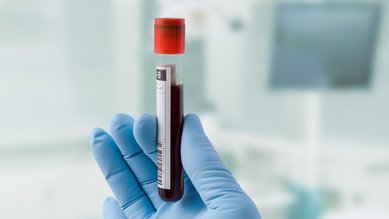
Skin and blood tests, for example, can verify whether someone has a food allergy. Doctors use the tests to see whether the immune system reacts excessively, i.e. allergically, to particular substances.

In a skin prick test, various potential allergens are placed on the forearm, spaced out at regular intervals. The skin is then scratched lightly in these locations to allow the substances to enter the skin. The skin on the forearm is then observed to see whether it reddens or itchy hives break out. In a blood test, the doctor determines whether the body has formed specific anti-bodies (in particular IgE antibodies) against a food.

However, these types of tests are usually not enough to identify a food allergy definitively. So a provocation test is also often carried out: with this, the sufferers eat the suspicious food under medical observation.

Depending on the individual situation, a daily diary of food and intake and symptoms or an elimination diet may help.

How can food allergies be treated?

With a food allergy, the main thing is to avoid the trigger food. In the short term, severe symptoms can also be treated with drugs. As a rule, drugs are not used on an ongoing basis with food allergies.

The most severe form of allergic reaction is called anaphylaxis. With this, the entire body reacts and at least two organs are affected simultaneously – for example the skin and the airways or the gastrointestinal tract and the cardiovascular system. Should this type of anaphylactic reaction occur, a special emergency kit is used. Severe symptoms can be treated with the drugs in the kit. They also help prevent any deterioration.

It is also possible to save information about severe allergies in the emergency data record on the electronic medical data card.

For more detailed information, for example on how a food allergy is treated, go to gesundheitsinformation.de.

What else do I need to know?

There is more information on food allergies at allergieinformationsdienst.de (in German).

  • Biedermann T, Heppt W, Renz H, Röcken M (Ed). Allergologie. Berlin 2016.
  • de Silva D, Geromi M, Panesar SS, Muraro A, Werfel T, Hoffmann-Sommergruber K et al. Acute and long-term management of food allergy: systematic review. Allergy 2014; 69(2): 159-167. Aufgerufen am 26.06.2024.
  • Deutsche Gesellschaft für Allergologie und klinische Immunologie (DGAKI). Leitlinie zum Management IgE-vermittelter Nahrungsmittelallergien (S2k-Leitlinie). AWMF-Registernr.: 061-031. 2021.
  • Institut für Qualität und Wirtschaftlichkeit im Gesundheitswesen (IQWiG). AR101 (Erdnussallergie): Dossierbewertung; Auftrag A21-135. 2022.
  • Kurowski K, Boxer RW. Food allergies: detection and management. Am Fam Physician 2008; 77(12): 1678-1686. Aufgerufen am 01.06.2020.
Badge

In cooperation with the Institute for Quality and Efficiency in Health Care (Institut für Qualität und Wirtschaftlichkeit im Gesundheitswesen – IQWiG).

As at: 27.05.2024
Did you find this article helpful?
Thank you for your feedback!
Thank you for your additional comments!
Sorry, your response could not be submitted due to a technical error.

Get informed Recommended articles

Dust mite allergy

In dust mite allergies, it isn’t the dust itself that causes the symptoms. Instead, the symptoms such as sneezing are triggered by substances that are mainly found in the dust mites’ feces.

Find out more

Hay fever

Many children and adults are affected by hay fever in the spring and summer months, when plants grow and bloom. It is caused by an allergic reaction to pollen in the air, affecting the upper airways.

Find out more

Allergies

An allergy occurs when the immune system has an overly sensitive reaction to a harmless substance such as plant pollen. There are various ways to treat an allergy.

Find out more

Back to top
Logo - Bundesministerium für Gesundheit Logo - Bundesministerium für Gesundheit

gesund.bund.de A service from the Federal Ministry of Health.

Useful links

  • Topic overview
  • User advice
  • Website overview

Services

  • Help and advice
  • Accessibility
  • Report an accessibility barrier

About us

  • About gesund.bund.de
  • Quality assurance
  • Our partners
  • Contact

Important emergency numbers

  • Fire and ambulance services 112 112
  • Non-emergency medical assistance 116117 116117
  • Emergency numbers

Certifications

  • afgis-Qualitätslogo mit Ablauf 2026/03: Mit einem Klick auf das Logo öffnet sich ein neues Bildschirmfenster mit Informationen über Bundesministerium für Gesundheit (BMG) und sein/ihr Internet-Angebot: gesund.bund.de/
  • Logo DNGK 2025-2026
  • BIK - BITV-konform (geprüfte Seiten), zum Prüfbericht

© Copyright 2026 Bundesministerium für Gesundheit Data protection Legal notice