Managing addiction with a self-help group
Most people with an addiction find it difficult to cope with daily life without the substance or behavior to which they are addicted. Self-help groups provide support from people with similar experiences, and allow members to share their stories and take part in group activities. There are self-help groups catering to a wide range of addictions.
At a glance
- Self-help for addiction is a form of support for people with an addiction and their loved ones.
- Self-help groups give them a safe space in which to share their experiences with other people who are dealing with the same issues.
- Self-help groups have been proven to help people with an addiction to live without addictive substances on a permanent basis.
- Self-help groups specific to addiction can be found by consulting the websites of self-help associations for addiction or through self-help contact and information points.
What is self-help for addiction?
Many people in Germany are affected by addiction – including addictions to alcohol, cannabis or other illegal substances, gambling, social media and gaming. When it gets to the stage where life is controlled by their addiction, it can be very difficult to break free. Even after therapy, it takes no small effort to keep an addiction under control in the long term. Self-help for addiction supports people with addictions and their families and loved ones. This support may be provided during and after or independently of professional therapy and medical treatment. Many people are familiar with Alcoholics Anonymous. However, there are also many more self-help groups in existence for a wide range of addictions.
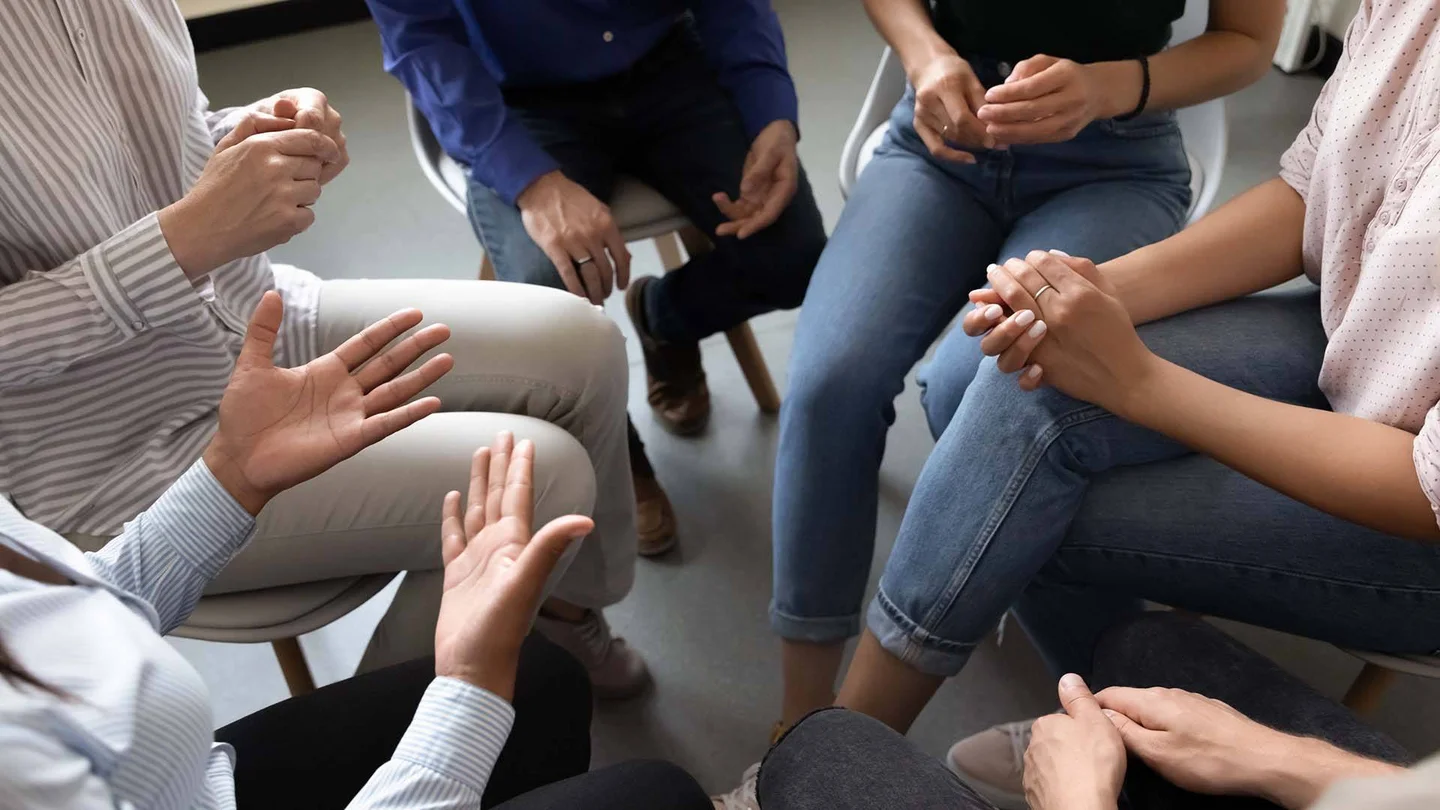
In these groups, people with an addiction problem and their families and loved ones can share their experiences with people in similar situations, find more information about the addiction and seek advice on how to help themselves. All of the people in the group are either in a similar situation currently or have been in the past. By sharing information and exchanging knowledge with others, it often becomes easier to manage daily life without the addiction and avoid becoming isolated.
What are the unique features of self‑help groups for addiction?
Self-help groups for addiction are organized on a voluntary basis – by addicts and their loved ones for addicts and their loved ones. The focus is on helping people to recognize, understand and manage their own addiction.
Each group decides how their meetings are structured. Everything discussed within the group is treated as confidential. Self-help groups are led by people who have their own experience of addiction. In this context, addiction does not exclusively refer to the abuse of and dependence on illegal drugs. People can become dependent on many different legal and illegal substances, such as alcohol, prescription medication, cannabis, cocaine or new psychoactive substances. There are also other forms of addiction, including addictions to gambling and social media.
What are the benefits of self-help groups for addiction?
Self-help groups help people to stop their addiction from taking control of their lives. For many people, this means abstaining from the addictive substance of behavior. In other cases – for example, when prescription drugs are involved – a self-help group can help the person to take control of their use of the substance.
Various studies have demonstrated the potential success of this approach. For example, one survey found that only 13 percent of the members of various self-help groups had experienced a relapse. Of these, more than three-quarters had found their way back to a life free from addiction thanks to self-help.

Members of a self-help group help one another to remain free from addiction on a daily basis. They may do so in a number of different ways – for example, by sharing information and addresses, by accompanying each other to appointments, by giving helpful advice on dealing with addiction, offering training or simply organizing addiction-free activities for the group.
Many people with an addiction, as well as their families and loved ones, also find that self-help groups help them to overcome feelings of loneliness, isolation and shame. The self-help group provides an important port of call when family or friends turn away. The group members accept the person with the addiction and help them see things from different perspectives.
How to find a self-help group for addiction
Many local and regional self-help for addiction are organized into associations. National associations represent the common interests of groups and their members. Most national associations are members of the German Center for Addiction Issues (Deutsche Hauptstelle für Suchtfragen e.V. – DHS).
DHS provides contact details for local and regional self-help contact points on its website.
The following links provide information about the regional groups of some self-help associations:
- Blue Cross (Blaues Kreuz) addiction support
- Blue Cross in the Evangelical Church – Federal Association
- Friendship Groups for Addiction Support (Freundeskreise für Suchtkrankenhilfe) – Federal Association
- Good Templars in Germany
- Kreuzbund e. V. – Self-Help and Helping Community for Addicts and Relatives
- National Association of Parent Groups with Children at Risk of or Suffering from Drug Addiction (Bundesverband der Elternkreise suchtgefährdeter und suchtkranker Söhne und Töchter e. V.)
Other self-help associations for addiction also offer information about local groups on their websites:
- Alcoholics Anonymous
- German Women’s Association for Alcohol-Free Culture (Deutscher Frauenbund für alkoholfreie Kultur e. V.)
- German Red Cross
- Professional Association for Gambling Addiction
- Narcotics Anonymous
Five German self-help associations have come together to create a Google map indicating where self-help groups can be found around the entire country.
Self-help contact and information points also serve as professional advice centers to help people find a self-help group.
You will find the addresses of self-help contact and information points in the database of the National Contact and Information Point for Encouraging and Supporting Self-Help Groups (Nationale Kontakt- und Informationsstelle zur Anregung und Unterstützung von Selbsthilfegruppen – NAKOS).
Digital self-help
As well as meet-ups in person, self-help for addiction also offers digital services and formats – from group meetings via video conference, through hybrid meetings, to chats, podcasts and contacts in the digital space.
Where to find more information about self-help
More information about the organization and independence of self-help services and about how the interests of people with disabilities and chronic illnesses are represented at a political level is provided in our self-help topic overview.
- Aktionswoche Alkohol 2022. Digitale Sucht-Selbsthilfe. Aufgerufen am 30.05.2022.
- Aktionswoche Alkohol 2022. Sucht-Selbsthilfe ist ... Aufgerufen am 30.05.2022.
- Aktionswoche Alkohol 2022. Sucht-Selbsthilfegruppe finden. Aufgerufen am 30.05.2022.
- Bundesministerium für Gesundheit. Sucht und Drogen. Aufgerufen am 30.05.2022.
- Deutsche Hauptstelle für Suchtfragen e. V. (DHS). DHS-Memorandum Angehörige in der Sucht-Selbsthilfe. II. Was leistet die Sucht-Selbsthilfe? Aufgerufen am 30.05.2022.
- Deutsche Hauptstelle für Suchtfragen e. V. (DHS). Medikamente und Sucht. Sucht-Selbsthilfe und Selbsthilfegruppen. Aufgerufen am 30.05.2022.
- Deutsche Hauptstelle für Suchtfragen e. V. (DHS). Statistik 2017 der fünf Sucht-Selbsthilfe- und Abstinenzverbände. Aufgerufen am 30.05.2022.
- Deutsche Hauptstelle für Suchtfragen e. V. (DHS). Sucht-Selbsthilfe. Aufgerufen am 30.05.2022.
- Kreuzbund. Selbsthilfe im Kreuzbund. Erfolge und Leistungen. Aufgerufen am 30.05.2022.

Reviewed by the German National Association for Self-Help (Bundesarbeitsgemeinschaft Selbsthilfe e.V. – BAG SELBSTHILFE).
As at: