Acute pancreatitis
ICD codes: K85 What are ICD codes?
An acutely inflamed pancreas – known in medical terms as acute pancreatitis – causes sudden, intense pain in the upper abdomen. The inflammation is often triggered by gallstones.
At a glance
- Acute pancreatitis (inflammation of the pancreas) is usually expressed by severe pain in the upper abdomen.
- For many people, this hurts so much that they immediately seek medical assistance.
- The most common causes of pancreatitis are gallstones and high alcohol consumption.
- Every year, about 55,000 people are treated in hospital for acute pancreatitis.
- Most patients recover fully after 1 to 2 weeks.
- But about 3 percent die from the consequences.
Note: The information in this article cannot and should not replace a medical consultation and must not be used for self-diagnosis or treatment.


What is acute pancreatitis?
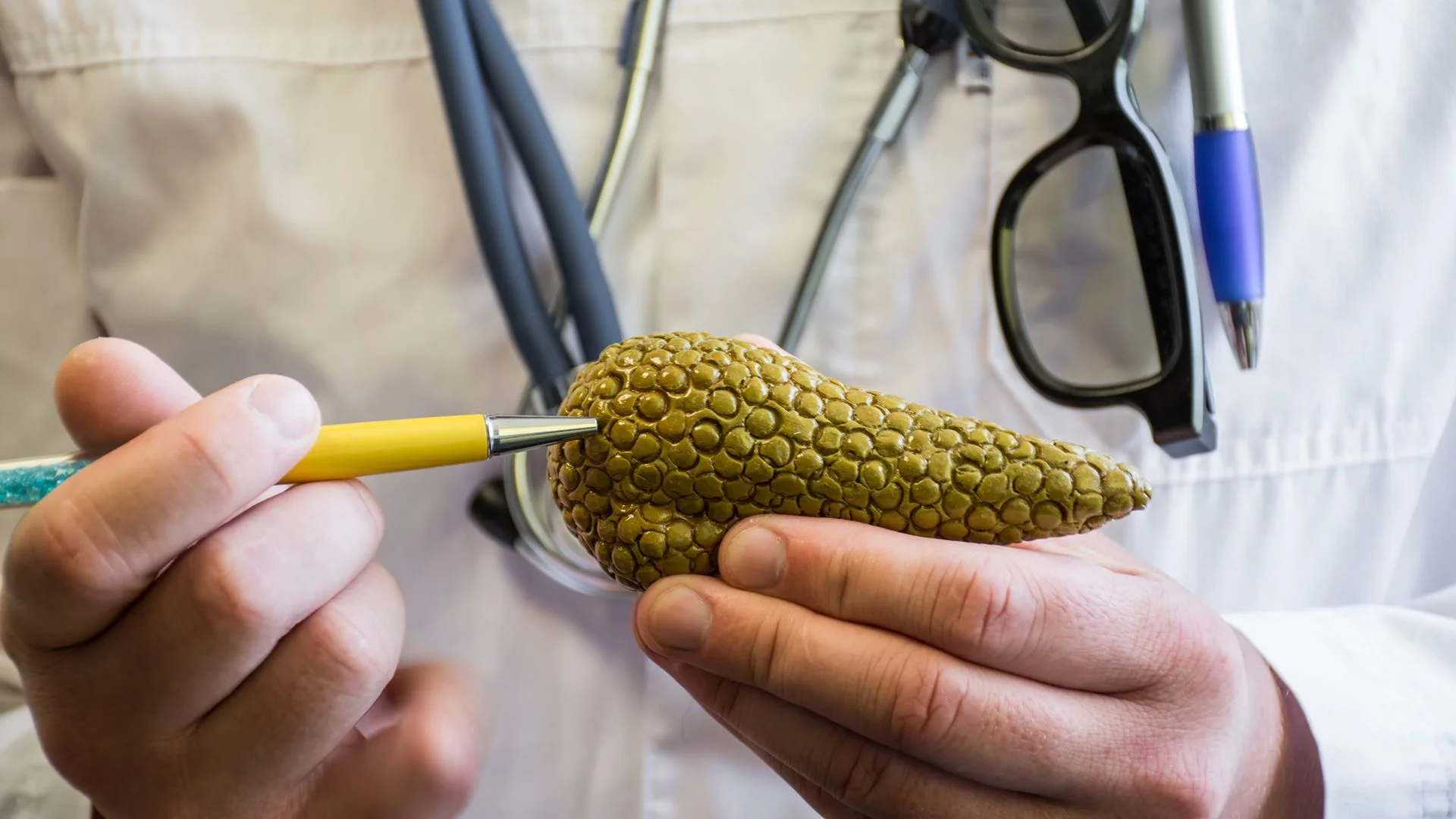
If a person has an inflamed pancreas, this is known as pancreatitis. An acute inflammation is indicated by sudden, extremely intense stomach pain. This is often caused by gallstones or heavy alcohol consumption.
Acute pancreatitis is treated in hospital as it can be fatal if particularly severe.
Most people fully recover from the acute inflammation after 1 to 2 weeks. In the event of complications and secondary diseases, treatment can take several months.
What are the symptoms of acute pancreatitis?
Acute pancreatitis almost always causes severe pain in the upper abdomen, which can radiate all the way round into the back. This is usually accompanied by nausea and vomiting, and often also by a high temperature, circulatory problems and a bloated stomach.
The sudden pain is so severe that most people with an inflamed pancreas immediately consult their doctor. They are then usually admitted to hospital on the same day.
What causes acute pancreatitis?
Acute pancreatitis is usually caused by gallstones. The pancreas produces a digestive juice that flows through a duct into the duodenum. This pancreatic duct connects to the bile duct just before the intestine. If this shared outlet is blocked by gallstones, gall and pancreatic juice can accumulate. Experts believe that this backlog leads to acute pancreatitis.
The second most common cause is heavy alcohol consumption. This connection has already been confirmed by various studies although how exactly alcohol triggers pancreatitis is not yet clear.

Certain drugs or a viral infection can also cause the pancreas to become inflamed. Other factors that increase the risk include bile duct strictures and increased levels of certain fats (triglycerides) or calcium in the blood.
In up to 10 percent of people with pancreatitis, the cause cannot be reliably diagnosed.
Video How do gallstones develop?
Watch this video to find out how gallstones develop and what symptoms they may cause.
This and other videos can also be found on YouTube
Watch nowThe privacy policy indicated there applies.
How common is acute pancreatitis?
Every year, around 55,000 people receive hospital treatment for acute pancreatitis in Germany. That equates to about 70 in every 100,000 inhabitants.
Most people with pancreatitis are over the age of 45. Furthermore, the condition is slightly more common among men than women.

How does acute pancreatitis progress?
The way acute pancreatitis progresses depends on the severity of the inflammation and the extent to which it is attacking the glandular tissue. About 80 percent of people treated recover from acute pancreatitis after about 1 to 2 weeks. However, some still have pain and digestive problems or feel totally exhausted even after they have been discharged from hospital.
About 20 percent of patients experience serious secondary conditions. In such cases, full recovery can take several weeks or months. About 3 percent of people with an acutely inflamed pancreas die of complications.
If the inflammation was caused by gallstones, relapses are very common. The gallbladder can be removed to prevent this.
How is acute pancreatitis diagnosed?
If a patient is suspected of having acute pancreatitis, the doctor will start by palpating the stomach. He/she will also ask about risk factors such as taking medication, alcohol consumption and indications of gallstones such as cramp-like upper abdominal pain (colic). A blood sample is also usually taken and an ultrasound performed.
The blood sample is used to determine factors such as the content of the enzyme lipase. This is produced in the pancreas and usually travels into the intestine. If the lipase content in the blood is significantly higher than usual, this indicates inflammation of the pancreas. Other blood test results can indicate biliary stasis.
Important: Further investigations are sometimes necessary. Computed tomography (CT), for example, can be used to help assess the progression of pancreatitis and identify complications. Bile ducts and gallstones can also be detected using magnetic resonance imaging (MRI).
There are several health conditions that have symptoms similar to those of acute pancreatitis. These include a heart attack, an inflamed gallbladder and a perforated stomach due to an ulcer.
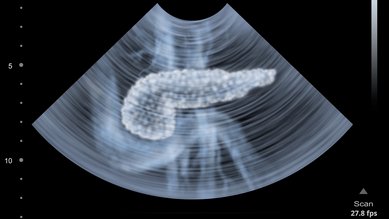
Usually, an ultrasound alone shows if the pancreas has changed due to inflammation. Often, gallstones can also be seen on an ultrasound.
If a suspected case of acute pancreatitis is confirmed, the patient will be hospitalized on the same day.
How is acute pancreatitis treated?
It is not possible to treat the causes of acute pancreatitis. Treatment primarily focuses on measures that reduce the symptoms and relieve the strain on the pancreas.
As acute pancreatitis can lead to dehydration, an infusion is initially used to ensure an adequate fluid intake. Medication is used to alleviate symptoms such as pain, nausea and vomiting. Strong drugs such as opioids, which make patients drowsy or groggy, are often needed to combat the pain.
To enable the pancreas to recover, patients are not given any solid food until they have recovered somewhat and regained their appetite. In the case of minor pancreatitis, patients can often start to eat again after 2 days. If the symptoms persist for longer, an artificial diet may be needed to supply the body with sufficient nutrients.
Further information on the treatment of acute pancreatitis can be found on the website gesundheitsinformation.de.
- Boije K, Drocic A, Engström M et al. Patients' Perceptions of Experiences of Recovering From Acute Pancreatitis: An Interview Study. Gastroenterol Nurs. 2019 May/Jun;42(3):233-241. doi: 10.1097/SGA.0000000000000375. PMID: 31145247.
- Boxhoorn L, Voermans RP, Bouwense SA et al. Acute pancreatitis. Lancet. 2020 Sep 5;396(10252):726-734. doi: 10.1016/S0140-6736(20)31310-6. PMID: 32891214.
- Deutsche Gesellschaft für Ernährungsmedizin e.V. (DGEM) in Zusammenarbeit mit der GESKES, der AKE und der DGVS. Klinische Ernährung in der Gastroenterologie (Teil 2) – Pankreas. S3-Leitlinie. AWMF-Registernummer 073/025. 04.2014.
- Johnson CD, Besselink MG, Carter R. Acute pancreatitis. BMJ. 2014 Aug 12;349:g4859. doi: 10.1136/bmj.g4859. PMID: 25116169.
- Moggia E, Koti R, Belgaumkar AP et al. Pharmacological interventions for acute pancreatitis. Cochrane Database Syst Rev. 2017 Apr 21;4(4):CD011384. doi: 10.1002/14651858.CD011384.pub2. PMID: 28431202; PMCID: PMC6478067.
- National Institute for Health and Care Excellence (NICE). Pancreatitis. NICE Guidelines, Band NG104. 12.2020.
- Statistisches Bundesamt (Destatis). Diagnosedaten der Krankenhäuser ab 2000 (Eckdaten der vollstationären Patienten und Patientinnen). 2020. Aufgerufen am 20.04.2021.

In cooperation with the Institute for Quality and Efficiency in Health Care (Institut für Qualität und Wirtschaftlichkeit im Gesundheitswesen – IQWiG).
As at: