Acute appendicitis
ICD codes: K35 K36 K37 K38 What are ICD codes?
Inflammation of the appendix normally leads to severe abdominal pain, nausea and a high temperature. To avoid complications such as a ruptured appendix, in most cases, the inflamed part of the appendix is surgically removed.
At a glance
- Typical signs of acute appendicitis are abdominal pain, nausea, vomiting and a high temperature.
- Appendicitis is when an appendage of the cecum (the first part of the large intestine) becomes inflamed. This appendage is usually called the appendix, but may also be referred to as the cecal appendage, vermiform appendix or vermiform process.
- The most common and most effective treatment is for the appendix to be surgically removed.
- Without treatment, the appendix could rupture, i.e., break or tear. Rupture can cause life-threatening circulatory disorders or sepsis.
Note: The information in this article cannot and should not replace a medical consultation and must not be used for self-diagnosis or treatment.

What is appendicitis?
With acute appendicitis, the appendix – a small pouch attached to the cecum (first section of the large intestine) – becomes inflamed. If the appendix wall becomes inflamed, this often causes severe abdominal pain.
The inflammation can result in the formation of pus. Without treatment, a hole in the intestinal wall can also develop, allowing the inflammation to spread to the abdomen. Such a rupture of the appendix is life-threatening. This is why most cases of acute appendicitis are quickly treated with surgery.
Video What happens during appendicitis?
The video below explains what happens during appendicitis. What are the symptoms and how can it be treated?
This and other videos can also be found on YouTube
Watch nowThe privacy policy indicated there applies.
What are the symptoms of appendicitis?
Appendicitis usually starts with pain, often in the upper abdomen or around the naval (belly button).
This is later followed by other symptoms such as:
- severe pain, typically in the lower right abdomen
- loss of appetite
- nausea and vomiting
- constipation or sometimes even diarrhea
- high temperature

With some people, the symptoms are not as typical or are only mild in nature: pregnant women often experience pain in the upper abdomen while children and older people sometimes only experience mild pain.
Not everybody’s appendix is in the same place. Sometimes it is located more towards the person’s back but it may also protrude further into the pelvis. As a result, non-typical abdominal pain or discomfort when urinating may also occur.
The longer the symptoms last, the higher the risk of a ruptured appendix. Suspected appendicitis should therefore be assessed by a doctor without delay.
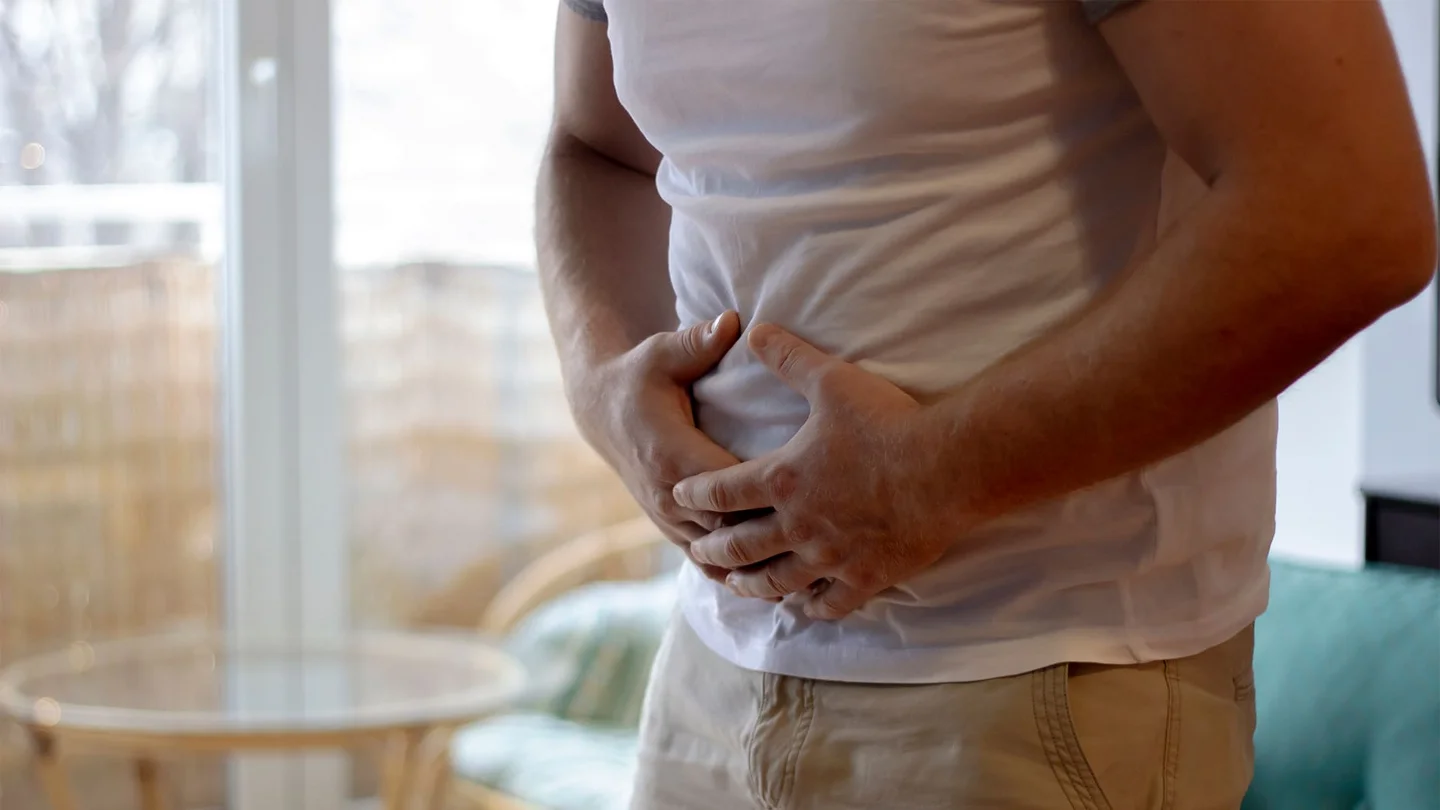
Important: A hard abdominal wall and a doubled-over posture due to abdominal pain can indicate a ruptured appendix. A rupture is a life-threatening complication that must be treated in hospital immediately.
What causes appendicitis?
The appendix is a small protuberance of the cecum that has a narrow lumen (opening). If this lumen is bent or blocked, the appendix swells, interrupting the blood flow. The cells in the wall of the appendix die off and inflammation develops, fostered by bacteria from the intestine.
The often purulent inflammation attacks the wall of the appendix, potentially creating a hole. This is known as a ruptured (or perforated) appendix. If the inflammation spreads to the abdomen, it can be life-threatening. In some cases, the ruptured appendix becomes walled off, creating a pus-filled cavity known as an abscess.
What causes a blocked appendix?
There are lots of defense cells in the wall of the appendix, especially in young people. If this local immune system is activated, for example by an infection, the mucous membrane swells and the narrow lumen of the appendix closes up.
With older people, the immune system in the appendix gradually becomes less efficient. As a result, there are usually other reasons for the appendix becoming blocked – for example, hardened fecal matter or changes to the intestinal wall. In rare cases, worms or tumors in the appendix can cause a blockage.
How common is appendicitis?
Acute appendicitis is one of the most common causes of severe abdominal pain and one of the most common reasons worldwide for emergency abdominal surgery. Appendicitis can occur at any age, but is especially likely between the ages of 10 and 19.
Approximately one in 1,000 people develop appendicitis every year. Boys and men have an about 9 percent risk of developing acute appendicitis at some point in their life. For girls and women, the risk is around 7 percent.
How does appendicitis develop?
Sometimes a grumbling appendix settles down on its own. If the condition progresses, several outlooks are possible:
- Uncomplicated appendicitis: inflammation of the appendix with no further complications. This form is the most common.
- Ruptured appendix: a hole develops in the intestinal wall. This allows feces, bacteria and pus to escape and causes life-threatening peritonitis. A hard abdominal wall, a doubled-over posture, pallor, an accelerated pulse and light-headedness can all be indications of a ruptured appendix.
- Formation of abscesses and phlegmons: a walled-off pus cavity (abscess) or purulent inflammation in the surrounding tissue (phlegmons) may develop, depending on the location of the hole in the intestinal wall.
How is appendicitis diagnosed?
The doctor performs a physical examination to identify the first signs of appendicitis. This involves feeling the person’s abdomen. If pressing on certain areas of the stomach is particularly painful, this indicates appendicitis or peritonitis.
Many other abdominal and pelvic diseases cause abdominal pain similar to appendicitis, for example, inflammation of other parts of the intestine or diseases of the bladder or sex organs.
As there are no physical signs that clearly indicate appendicitis, further examinations often follow:
- a blood sample to measure inflammatory markers in the blood
- an ultrasound examination to detect changes to the appendix or the formation of pus
- a computed tomography (CT) scan or magnetic resonance imaging (MRI) scan to identify appendicitis and rule out other conditions
- in some cases, a diagnostic laparoscopy
How is appendicitis treated?
The most common and most effective treatment for acute appendicitis is surgery. This removes the inflamed appendix. There are two procedures: an incision in the abdominal wall or a minimally invasive abdominal examination (laparoscopy). With a laparoscopy, special endoscopes are introduced into the abdominal cavity via several incisions.

If a pus-filled cavity (abscess) has already formed, the abscess is removed and any further fluid drained out through a small tube.
The precise timing of the surgery depends on whether any complications have already developed and whether circulation remains stable. Surgery usually occurs within 24 hours of the diagnosis. Prior to the surgery, the patient is given an antibiotic to stop the inflammation from spreading. Painkillers may also be administered.
Doctors can sometimes treat uncomplicated appendicitis with antibiotics instead of surgery. However, this treatment does not always work: in approximately 20 out of every 100 patients, the inflammation persists or returns later.
More detailed information about surgically removing an inflamed appendix can be found at gesundheitsinformation.de.
- Di Saverio S, Podda M, De Simone B et al. Diagnosis and treatment of acute appendicitis: 2020 update of the WSES Jerusalem guidelines. World J Emerg Surg. 2020 Apr 15;15(1):27. doi: 10.1186/s13017-020-00306-3. PMID: 32295644; PMCID: PMC7386163.
- Gorter RR, Eker HH, Gorter-Stam MA et al. Diagnosis and management of acute appendicitis. EAES consensus development conference 2015. Surg Endosc. 2016 Nov;30(11):4668-4690. doi: 10.1007/s00464-016-5245-7. Epub 2016 Sep 22. PMID: 27660247; PMCID: PMC5082605.
- Jaschinski T, Mosch CG, Eikermann M et al. Laparoscopic versus open surgery for suspected appendicitis. Cochrane Database Syst Rev. 2018 Nov 28;11(11):CD001546. doi: 10.1002/14651858.CD001546.pub4. PMID: 30484855; PMCID: PMC6517145.
- Kothadia JP, Katz S, Ginzburg L. Chronic appendicitis: uncommon cause of chronic abdominal pain. Therap Adv Gastroenterol. 2015 May;8(3):160-2. doi: 10.1177/1756283X15576438. PMID: 25949528; PMCID: PMC4416293.
- Low ZX, Bonney GK, So JB et al. Laparoscopic versus open appendectomy in pediatric patients with complicated appendicitis: a meta-analysis. Surg Endosc. 2019 Dec;33(12):4066-4077. doi: 10.1007/s00464-019-06709-x. Epub 2019 Feb 25. PMID: 30805783.
- Müller M. Chirurgie – Für Studium und Praxis 2020/21. Medizinische Verlags- u. Informationsdienste: Breisach 2020.
- Poprom N, Numthavaj P, Wilasrusmee C et al. The efficacy of antibiotic treatment versus surgical treatment of uncomplicated acute appendicitis: Systematic review and network meta-analysis of randomized controlled trial. Am J Surg. 2019 Jul;218(1):192-200. doi: 10.1016/j.amjsurg.2018.10.009. Epub 2018 Oct 9. PMID: 30340760.
- Poprom N, Wilasrusmee C, Attia J et al. Comparison of postoperative complications between open and laparoscopic appendectomy: An umbrella review of systematic reviews and meta-analyses. J Trauma Acute Care Surg. 2020 Oct;89(4):813-820. doi: 10.1097/TA.0000000000002878. PMID: 32649616.
- Prechal D, Damirov F, Grilli M et al. Antibiotic therapy for acute uncomplicated appendicitis: a systematic review and meta-analysis. Int J Colorectal Dis. 2019 Jun;34(6):963-971. Doi: 10.1007/s00384-019-03296-0. Epub 2019 Apr 19. PMID: 31004210.
- Talan DA, Di Saverio S. Treatment of Acute Uncomplicated Appendicitis. N Engl J Med. 2021 Sep 16;385(12):1116-1123. Doi: 10.1056/NEJMcp2107675. PMID: 34525287.
- Teoule P, Laffolie J, Rolle U et al. Acute Appendicitis in Childhood and Adulthood: An Everyday Clinical Challenge. Dtsch Arztebl Int. 2020 Nov 6;117(45):764-774. Doi: 10.3238/arztebl.2020.0764. PMID: 33533331; PMCID: PMC7898047.
- Van Dijk ST, van Dijk AH, Dijkgraaf MG et al. Meta-analysis of in-hospital delay before surgery as a risk factor for complications in patients with acute appendicitis. Br J Surg. 2018 Jul;105(8):933-945. doi: 10.1002/bjs.10873. PMID: 29902346; PMCID: PMC6033184.
- Yang Z, Sun F, Ai S et al. Meta-analysis of studies comparing conservative treatment with antibiotics and appendectomy for acute appendicitis in the adult. BMC Surg. 2019 Aug 14;19(1):110. doi: 10.1186/s12893-019-0578-5. PMID: 31412833; PMCID: PMC6694559.

In cooperation with the Institute for Quality and Efficiency in Health Care (Institut für Qualität und Wirtschaftlichkeit im Gesundheitswesen – IQWiG).
As at: