Hand, foot and mouth disease
ICD codes: B08.4 What are ICD codes?
Hand, foot and mouth disease (HFMD) is a viral infection which primarily affects infants and children under the age of 10. The disease is highly contagious, but usually harmless. People generally recover within a few days without any after-effects.
At a glance
- Hand, foot and mouth disease is a very contagious viral infection which primarily affects infants and young children.
- The disease is usually mild and clears up by itself in just over a week.
- The initial symptoms of infection are high temperature, sore throat and loss of appetite.
- These symptoms are followed by painful sores in the mouth, as well as a rash on the surfaces of the hands and soles of the feet that is not itchy.
- Children with the disease remain contagious as long as the skin rash persists. They should stay at home during this period.
- Good hand hygiene is important to prevent infection.
Note: The information in this article cannot and should not replace a medical consultation and must not be used for self-diagnosis or treatment.
What is hand, foot and mouth disease?
Hand, foot and mouth disease is a highly contagious infectious disease caused by viruses.
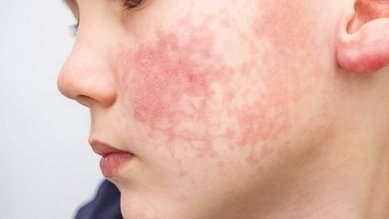
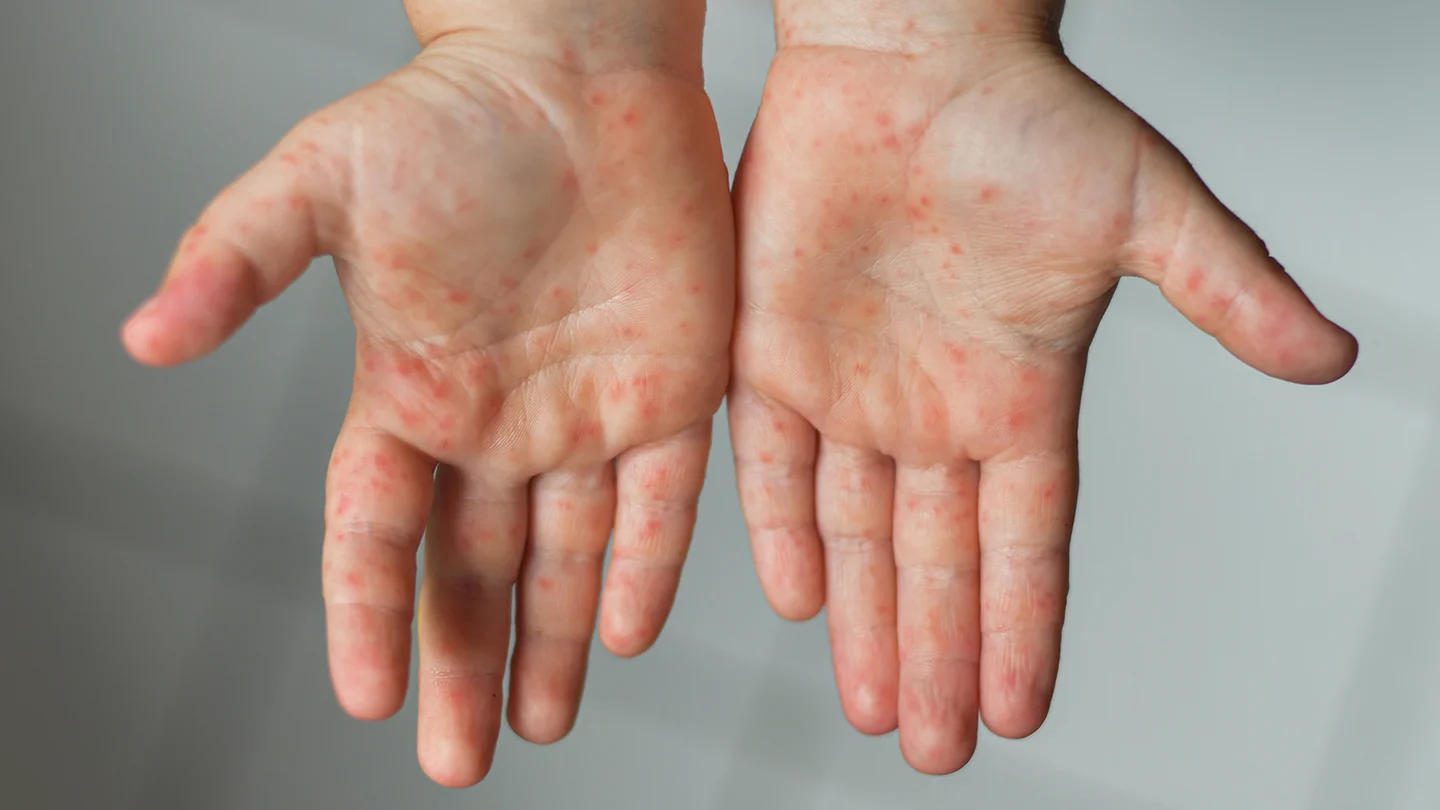
Typical indicators of the viral infection are a skin rash consisting of red spots, as well as blisters on the hands, feet and mouth.
Hand, foot and mouth disease mainly affects children under the age of 10. Adults are rarely affected. The infection is usually harmless.
Hand, foot and mouth disease is not to be confused with foot and mouth disease found in animals. They are two different, entirely unrelated diseases.
What are the symptoms of hand, foot and mouth disease?
Most people infected with hand, foot and mouth disease have no symptoms. This is the case with adults in particular.
If symptoms occur, the first signs of the disease are usually:
- fever
- sore throat
- loss of appetite
Typical symptoms
One to two days after the onset of the fever, a painful rash with small red spots and blisters develops in the mouth. Ulcers often also occur, especially on the tongue, gums and lining of the mouth.

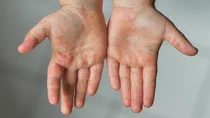
Around the same time, a non-itchy rash develops on the skin around the mouth, the surfaces of the hand and the soles of the feet. The rash consists of small red spots, which may be flat or raised. Blisters sometimes develop.
The rash remains for approximately 10 days. The blisters may burst. They then crust over and heal without leaving scars.
Atypical symptoms
In rare cases, a rash develops on the bottom, around the genitals, on the knees or on the elbows. The rash is sometimes very itchy.
How do people get hand, foot and mouth disease?
Hand, foot and mouth disease is mainly caused by an infection with group A enteroviruses. The viruses are highly contagious and spread easily from person to person. It takes 3 to 10 days from infection to the onset of symptoms (incubation period).
How do people get infected with the viruses?
People are infected through direct contact with body fluids. These include:
- nose and throat secretions
- saliva
- fluid from the blisters of the rash
- stool
How are the viruses transmitted?
The main way in which the disease is spread is by people touching bodily fluids containing the virus with their hands and then touching their mouths with their hands. This type of infection by touch is known as “smear infection” and can also occur when people touch objects that are contaminated with viruses, such as door handles or baby’s pacifiers.
Transmission via saliva occurs, for example, when kissing. Transmission via stool (feces) can occur, for example, when changing a diaper.
At the beginning of an infection, it is also possible to spread the virus via viral droplets that are released when a person speaks, coughs or sneezes (droplet infection).
Important: The risk of catching the illness from an infected individual is greatest while they have the rash. It decreases as soon as the rash has healed. Once the symptoms have cleared up, infected individuals may still shed some virus in their stool (feces).
Video Are childhood diseases dangerous?
The video below outlines the most common childhood diseases and the symptoms they present.
This and other videos can also be found on YouTube
Watch nowThe privacy policy indicated there applies.
How many people are affected by hand, foot and mouth disease?
Hand, foot and mouth disease is not a notifiable disease in Germany. As a result, it is only possible to estimate its prevalence.
It is assumed that between 80,000 and 140,000 people in the country catch hand, foot and mouth disease every year.
Most cases occur in late summer and autumn.
How does hand, foot and mouth disease progress?
Hand, foot and mouth disease is usually mild.
Most people infected recover within 7 to 10 days without requiring medical treatment. It is rare for people who have recovered from the disease to get infected a second time.
In rare cases, the virus can spread to the brain and spinal cord. If this happens, it can cause complications such as encephalitis, meningitis or paralysis.
In atypical cases, the fingernails and toenails may fall out. However, these grow back again later.
How does an enterovirus progress in pregnant women and newborn babies?
Pregnant women usually experience enterovirus infections with mild symptoms or no symptoms at all.
In extremely rare cases, mothers who have symptoms of an enterovirus infection close to their delivery date and have not yet been able to form antibodies for defense against the virus can transmit the virus to the newborn baby.
Most infections in newborns are mild. In very rare cases, the virus spreads throughout the entire body. If organs such as the liver or heart are affected, the disease can be life-threatening.
How can hand, foot and mouth disease be prevented?
Observing certain hygiene and other precautionary measures on a daily basis goes a long way towards preventing hand, foot and mouth disease.
To prevent the virus from spreading through the community, additional recommendations apply to attendance at community facilities such as kindergartens or schools.
A preventive vaccine is not yet available in Germany.
Measures at home
The most important measures include:
- washing hands regularly and thoroughly with soap, especially after changing diapers and using the toilet
- thoroughly cleaning contaminated surfaces and objects, including toys and door handles
- avoiding close contact with infected individuals; not kissing or hugging while the person is contagious
- not sharing cutlery or crockery with infected individuals
- using a personal towel

What is the advice on attending community facilities?
To prevent the spread of the disease among children, acutely ill children should be kept at home.
Children who no longer have any symptoms and whose rash blisters have healed can return to kindergarten or school without a letter from their doctor.
How is hand, foot and mouth disease diagnosed?
Doctors usually diagnose hand, foot and mouth disease on the basis of its typical symptoms.
In severe cases, doctors may also examine stool samples, throat swabs or the fluid from inside the blisters using a PCR test to detect the virus’s genetic material.
If there are neurological symptoms such as paralysis, doctors may consider testing the cerebrospinal fluid (liquor) to detect the pathogen.
How is hand, foot and mouth disease treated?
There is no specific therapy, i.e. one that targets the virus directly.
As such, treatment focuses on alleviating the symptoms.
As with other viral illnesses, it is essential for children to drink sufficient fluids – even if they have painful ulcers and blisters in the mouth.
Anti-inflammatory medication such as ibuprofen or paracetamol can relieve the pain. Specific mouthwashes can also be used for gargling.
A doctor should be consulted if the child still resists drinking any or sufficient fluids or if the symptoms become more severe.
- Bundeszentrale für gesundheitliche Aufklärung (BZgA). Hand-Fuß-Mund-Krankheit. infektionsschutz.de. Aufgerufen am 13.02.2023.
- Guerra AM, Orille E, Waseem M. Hand Foot And Mouth Disease. [Updated 2022 Oct 9]. In: StatPearls [Internet]. Treasure Island (FL): StatPearls Publishing; 2022 Jan-. Aufgerufen am 13.02.2023.
- Robert Koch-Institut (RKI). RKI-Ratgeber. Hand-Fuß-Mund-Krankheit (HFMK). Aufgerufen am 13.02.2023.

Reviewed by the German Society for Pediatric Infectiology (Deutsche Gesellschaft für Pädiatrische Infektiologie e.V.).
As at: