Telemedicine house call
A telemedicine house call involves a specially trained healthcare assistant paying a visit to a patient’s home. Doctors can be contacted by video call if required. This enables patients to get medical care that would otherwise be difficult for them to access. This healthcare service is currently being trialled in some regions of Germany.
At a glance
- Telemedicine house calls are conducted by specially trained healthcare assistants rather than by doctors.
- They measure vital data and attend to tasks such as wound care and administering medication.
- The data collected is sent to the doctor’s practice using digital media.
- Video contact with a doctor can be established at any time if required.
- With telemedicine house calls, patients don’t have to make potentially strenuous trips to doctors’ practices and hospitals.
- They also allow doctors to save time making physical house calls to their patients.
What is a telemedicine house call?
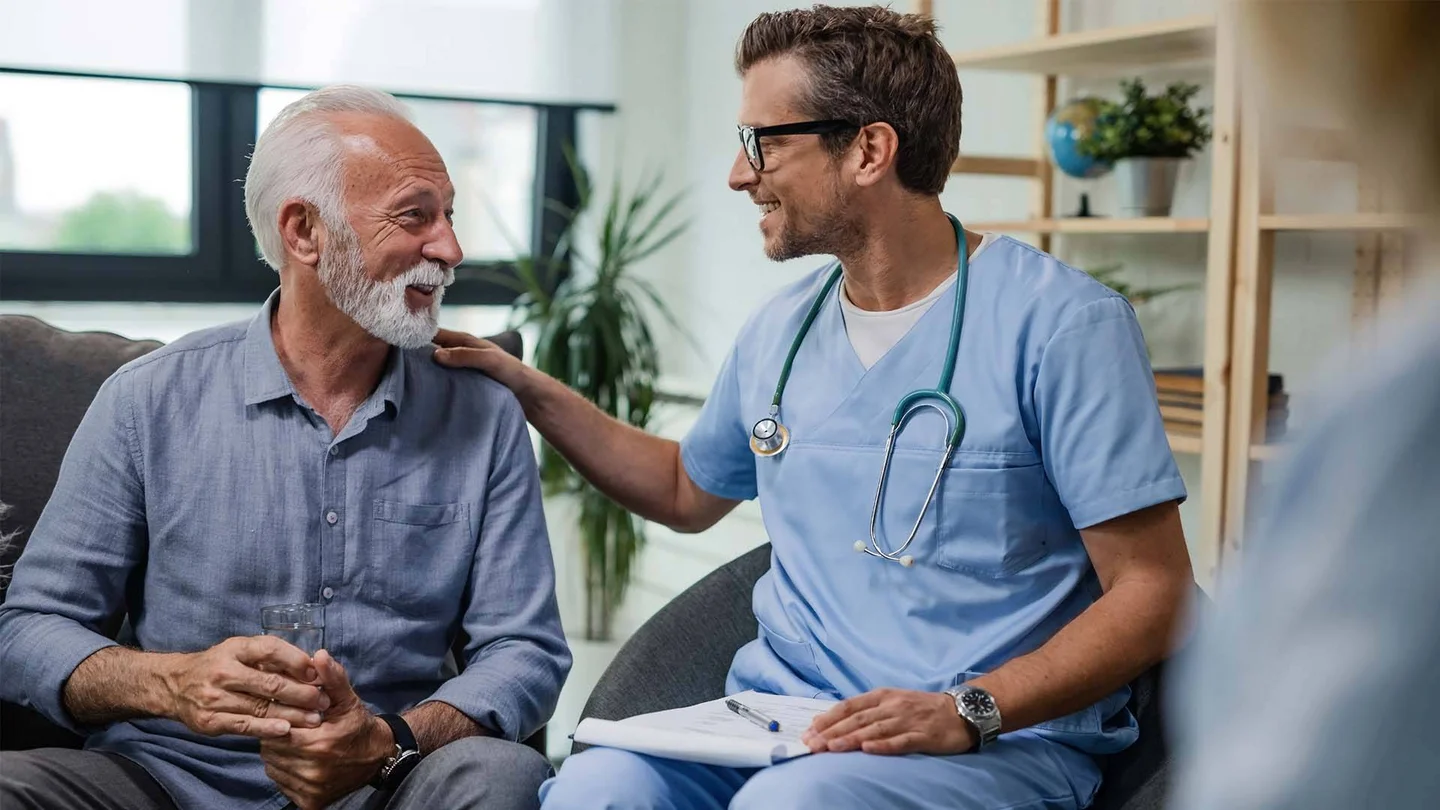
Some patients find it difficult to regularly attend their family doctor’s practice for essential monitoring or follow-up treatment. Telemedicine house calls, which are currently being trialled in some regions of Germany, may provide the perfect solution in such cases.

Instead of a doctor, a specially trained healthcare assistant calls to the patient’s home at a pre-arranged time. Their tasks include:
- measuring vital data, such as blood pressure or blood sugar
- monitoring healing processes or checking whether treatment is proving effective
- checking chronic conditions
- wound care
The healthcare assistant is equipped with special measuring devices, such as a mobile ECG device. Using digital technology, they can measure the patient’s health data and send this data to the doctor’s practice.
Doctors are always responsible for diagnosis and for choice of treatment. If necessary, the patient’s doctor can join by video call. This enables personal contact with patients despite physical distance.
Telemedicine house calls allow doctors to closely supervise the care of their patients
- even if patients have limited mobility
- in rural areas where few doctors are available
- in the case of chronic conditions that require regular monitoring
With this type of house call, a severely ill or immobile patient doesn’t have to pay repeated visits to the doctor’s practice or hospital. Telemedicine house calls enhance outpatient or inpatient care. They also allow doctors to save time making physical house calls to their patients.
However, telemedicine house calls are currently only available in some federal states and regions of Germany.
How does a telemedicine house call differ from a video consultation?
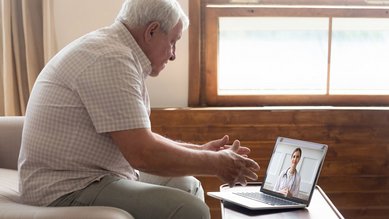
With a telemedicine house call, video contact with the doctor responsible for treating the patient is only established if necessary. The healthcare assistant who is on location at the patient’s home has the equipment required and establishes the video connection.
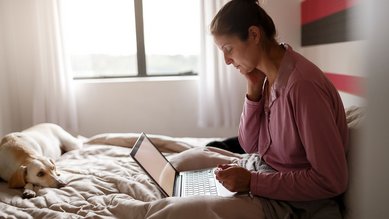
In a video consultation, the patient has direct contact with the doctor. Patients require their own technical equipment and must use it themselves.
What are the benefits of telemedicine house calls?
Telemedicine house calls are aimed at people who
- are confined to bed or have limited mobility
- have chronic conditions that require regular monitoring
To date, this type of house call has primarily been used in rural regions due to a lack of doctors able to make home visits in person.
How do patients benefit from telemedicine house calls?
Telemedicine house calls enable people to get medical care that would otherwise be difficult for them to access.
- They save time traveling to the practice and waiting to be seen.
- Hospital stays can be avoided in certain cases.
- They enable improved monitoring of the progression of chronic conditions.
- Faster responses are possible if a person’s health deteriorates.
- Patients experience personalized care and a personal approach.
- Contact can be made with the doctor treating the patient if necessary.
- The doctor-patient relationship is maintained.
- Patients don’t require any technology or technical knowledge.
After a stay in hospital, telemedicine house calls can help people transition back into their home environment while continuing to receive high-quality medical care.
How does a telemedicine house call work?
As in the case of a regular house call, patients are examined and cared for by a healthcare assistant. This includes:
- taking a blood sample
- measuring blood pressure
- measuring blood glucose levels
- performing an electrocardiogram (ECG)
- checking lung function
- measuring body temperature
- determining body weight
- wound care
- administering injections
- conducting a dementia test
- assessing the patient’s capacity for self-care
- documenting the course of treatment
- passing on the data collected
- setting up a video connection to the doctor’s practice
The healthcare assistant carries special equipment with them to perform these tasks. This equipment includes, for example, medical monitors (e.g., to measure blood sugar and blood pressure).
A tablet PC is normally used to record patient data and send it to the practice. At the doctor’s practice, this data and the measures taken are entered in the patient record and evaluated. The visiting healthcare assistant and the doctors responsible also discuss these with one another in person.
When is video contact established with the doctor’s practice?
If treatment is urgently required or any pressing questions arise during the house call, the visiting healthcare assistant can use their tablet PC to establish video contact with the doctor responsible for the patient’s treatment. The doctor is available to the assistant making the house call at all times. Video contact may be necessary, for example, if the patient is feeling unwell of if their condition has deteriorated.

During the video call, the doctor can get an overview of the situation, give the visiting healthcare assistant instructions and see that these are carried out correctly. For complex issues, several doctors can take part in the video conference. Patients can also ask questions, so that they maintain their personal relationship with their doctor.
What legal requirements apply to house calls?
Doctors must only task specially trained healthcare assistants to conduct the house calls. These are known as non-physician practice assistants (“NäPa” for short in German).
Trained health workers and nurses and physician assistants with three years’ professional experience can undergo further training to become non-physician practice assistants. These non-physician practice assistants may also be referred to as care assistants or healthcare assistants (HCA) in primary care or in general practice (known as “VERAH” for short in German), telemedicine assistants (TMA) or supporting physician assistants (“EVA” in German).
These specially trained healthcare assistants must only provide treatment under the direction of the doctor responsible and must document all measures taken. The data collected must be in the possession of the doctor’s practice by the next working day at the latest.
The relevant doctor is responsible for the telemedicine house call and for any measures taken during the house call. They make decisions about diagnosis and treatment.
How secure is data protection with telemedicine house calls?
During a telemedicine house call, data is transferred using digital media. Rigorous security standards apply – only special software and encryptions approved and certified by the National Association of Statutory Health Insurance Providers (“Kassenärztliche Bundesvereinigung”) are to be used. This also applies to the video services used.
- Bohnet-Joschko S, Stahl T (2019): Telegeriatrische Modelle: Einblick in die Zukunft der Versorgung. Pflegezeitschrift, 72, S. 50-53. doi: 10.1007/s41906-018-0013-z.
- Doctors.today. Auch der Hausbesuch wird digitaler. Aufgerufen am 09.03.2022.
- Kassenärztliche Bundesvereinigung. Regelungen zur Delegation ärztlicher Leistungen. Aufgerufen am 09.03.2022.
- Kassenärztliche Bundesvereinigung. Vereinbarung über die Delegation ärztlicher Leistungen an nichtärztliches Personal in der ambulanten vertragsärztlichen Versorgung gemäß § 28 Abs. 1 S. 3 SGB V vom 1. Oktober 2013. Stand: 1. Januar 2015. Aufgerufen am 09.03.2022.
- Medizinjobs-direkt.de. Telemedizin: Wenn die Krankenschwester Hausbesuche macht! Aufgerufen am 09.03.2022.
- Michaela Warzecha, Jeanette Dräger, Gregor Hohenberg. Telemedizinische Betreuung. Visite via Monitor. Pflegezeitschrift 2018. Jg. 71, Heft 4: 31-33.
- Niedersächsisches Ministerium für Soziales, Gesundheit und Gleichstellung. Wenn beim Hausbesuch die Telemedizin zum Einsatz kommt. Aufgerufen am 15.03.2022.
- Springer Medizin ÄrzteZeitung. Delegation geht in die Fläche. Mit dem Tele-Rucksack auf Hausbesuch. Aufgerufen am 07.03.2022.
- Springer Medizin ÄrzteZeitung. Tele-Doc PLUS - ein Modell zum Ausrollen. Aufgerufen am 07.03.2022.
- Ulrich Weigelt. Digitalisierung in der Hausarztpraxis: 146-149. Aufgerufen am 07.03.2022.