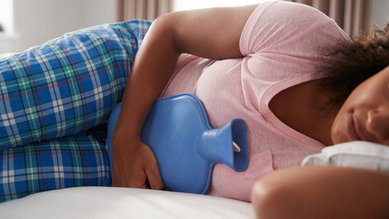
Severe menstrual bleeding
ICD codes: N92 What are ICD codes?
Some women always feel tired, unwell and are in pain during their period. Severe menstrual bleeding is often the reason. Such bleeding can be relieved with drugs and by surgical interventions.
At a glance
- About 10 out of 100 women experience severe menstrual bleeding (hypermenorrhea).
- It is possible to relieve severe bleeding with drugs or surgical treatments.
- If a woman loses too much blood during her menstruation, this can cause an iron deficiency. Anemia can develop.
- The most common cause of severe menstrual bleeding is that the womb cannot contract properly.
Note: The information in this article cannot and should not replace a medical consultation and must not be used for self-diagnosis or treatment.


What is referred to as severe menstrual bleeding?
Many women have pain, cramps and irregular or severe bleeding during their period. If pads or tampons often need changing even after 1 to 2 hours or the menstrual cup needs to be emptied after a few hours, the menstrual bleeding is probably more severe than normal. If the bleeding impairs the daily routine and weakens the body, it is severe menstrual bleeding (hypermenorrhea).

About 10 out of 100 women experience hypermenorrhea. If the menstrual bleeding lasts longer than 5 to 7 days, it is prolonged bleeding (menorrhagia). Both often occur together since they have the same cause.
Some women find good ways to manage their severe bleeding. But if the bleeding causes iron deficiency or is too troublesome, it can be relieved with drugs. Surgery is also possible in these cases.
What are the symptoms of severe menstrual bleeding?
Women typically lose about 60 milliliters of blood during their period. That is the equivalent of about one and a half shot glasses. If this blood flows regularly, it takes about 4 hours until a pad or tampon of normal size has to be changed. However, these are averages.
The bleeding can actually be more severe on some days and more moderate on others. The amount of blood that is lost during menstruation can thus temporarily feel even greater.
If a woman loses more than 80 milliliters of blood altogether during her period, gynecologists assume severe menstrual bleeding.
The following signs may indicate this condition:
- Pads or tampons often have to be changed after 1 to 2 hours.
- A menstrual cup has to be emptied after only a few hours.
- Weakness, fatigue and lethargy during the period.
- The menstruation blood contains many thick clots.

What are the causes of severe menstrual bleeding?
Some girls have severe menstrual bleeding from the outset. Most often however, the bleeding only becomes more severe later in life. Hormonal changes such as those that occur in menopause may also make menstrual bleeding more severe.
The most common cause for severe menstrual bleeding is that the womb cannot contract properly. Contraction normally helps loosen the mucosa in the womb. It can then be washed out with some blood. Contraction moreover ensures that bleeding does not continue for too long.
Larger benign tumors like fibroids and mucosal polyps can impede contraction of the uterine muscles.
Fibroids form in the muscle layer of the uterus, while polyps form in the endometrium (uterine lining). It is also possible for a contraceptive coil to obstruct the uterine muscles.
Furthermore, growths on the uterus and inflammations of the uterus or fallopian tubes often cause severe bleeding. In some cases, however, the cause cannot be clearly determined.
What are the potential complications of severe menstrual bleeding?
If a woman loses too much blood during her menstruation, this can cause an iron deficiency. Iron is very important for building red blood cells. With iron deficiency, the body is unable to produce a sufficient number of red blood cells. One possible consequence of this is anemia.
Red blood cells transport oxygen to the organs. If there are too few red blood cells, the organs will have a poor oxygen supply. This leads to a feeling of weakness and lassitude. Pallor and cold hands are also indications of anemia. With more severe anemia moreover, symptoms such as breathlessness and a rapid heartbeat may occur, especially after physical exertion.
How is severe menstrual bleeding diagnosed?
For diagnosis, it is firstly important to know the severity of the blood loss during the period. While the amount of blood cannot be precisely determined, it can nonetheless be estimated. Indications of the severity are given for instance by the number of pads or tampons that are needed on different days during the period or the frequency with which a menstrual cup has to be emptied. It can thus be useful to note these numbers down over one or two months.
The uterus is usually examined first to clarify the cause of severe menstrual bleeding. To this end, the doctor palpates the uterus and carries out an ultrasound examination. In some cases a hysteroscopy is advisable. For this procedure, a small camera is inserted into the uterus.
A blood test is used to check whether anemia has developed as a result of the severe menstrual bleeding. In the process, the amount of hormones in the blood, which influence the endometrium and menstrual cycle, can be measured.
Furthermore, the personal situation and type of symptoms can give important indications about causes. Patients with severe menstrual bleeding should therefore also talk with their doctor about existing conditions, diseases in the family, any medication they are taking, weight problems or any psychological stress they are under.
How is severe menstrual bleeding treated?
The treatment options for severe menstrual bleeding will depend on the cause. Fibroids, polyps or other benign proliferations in the uterus can be surgically removed. But many women first try to relieve the bleeding tendency with drugs. The bleeding can also be reduced a little with certain painkillers.
Hormonal contraceptives like the birth control pill or a hormonal coil can relieve severe bleeding. That is because these contraceptives inhibit the growth of the endometrium.
If severe symptoms occur and the woman has no desire to conceive, it is moreover possible to remove or shrink the uterine lining. This is also referred to as an endometrial resection or endometrial ablation. Another option is the removal of the uterus (hysterectomy), which is a major surgical procedure. This step is only considered for very severe and debilitating symptoms.
Important: If severe menstrual bleeding does not cause anemia, a treatment is not really necessary.
In a first step, women considering treatment should get information about the advantages and drawbacks of medication or surgical procedures. The choice of treatment depends on whether there is a desire to have children. Getting pregnant is impossible while contraceptives like the pill or hormonal coil are being used – and will never be possible again after the uterus has been removed.
The decision aid from gesundheitsinformation.de can help you choose an appropriate treatment for severe menstrual bleeding.
What is everyday life like with severe menstrual bleeding?
Many women with severe menstrual bleeding feel groggy and tired during and just after their period.
If these symptoms are very severe, they may find it difficult to accomplish their daily routine – whether at home or at work. Even social activities and hobbies that are otherwise fun can be stressful at that time.
The need to frequently change pads, tampons or the menstrual cup during the night affects a woman’s sleep. Severe menstrual bleeding can also be accompanied by abdominal pain.
But severe bleeding may not just be physically stressful. Many women find it embarrassing. It can moreover be troublesome, for instance during sex. Some are also frightened by severe menstrual bleeding.
Menstruation is part of a woman’s life. But if severe menstrual bleeding impairs well-being, there are ways to relieve the symptoms and cope with it better.
- Duckitt K. Menorrhagia. BMJ Clin Evid. 2015 Sep 18;2015:0805. PMID: 26382038; PMCID: PMC4574688.
- Garside R, Britten N, Stein K. The experience of heavy menstrual bleeding: a systematic review and meta-ethnography of qualitative studies. J Adv Nurs. 2008 Sep;63(6):550-62. doi: 10.1111/j.1365-2648.2008.04750.x. PMID: 18808575.
- Lethaby A, Farquhar C. Treatments for heavy menstrual bleeding. BMJ. 2003 Nov 29;327(7426):1243-4. doi: 10.1136/bmj.327.7426.1243. PMID: 14644939; PMCID: PMC286237.
- National Institute for Health and Care Excellence (NICE). Heavy menstrual bleeding: assessment and management. NICE clinical guidelines, Band 44. 08.2016.
- O'Flynn N, Britten N. Menorrhagia in general practice – disease or illness. Soc Sci Med. 2000 Mar;50(5):651-61. doi: 10.1016/s0277-9536(99)00318-4. PMID: 10658846.
- Protheroe, J., & Chew-Graham, C. (2005). The role of primary care in the diagnosis and management of menorrhagia: A qualitative study of women with menorrhagia. Primary Health Care Research & Development, 6(3), 217-223. doi:10.1191/1463423605pc251oa.

In cooperation with the Institute for Quality and Efficiency in Health Care (Institut für Qualität und Wirtschaftlichkeit im Gesundheitswesen – IQWiG).
As at: