Retinal detachment
ICD codes: H33 What are ICD codes?
Retinal detachment is a rare eye condition. It can lead to vision loss if left untreated. Light flashes, black specks or a black shadow in the field of vision are typical symptoms. Vision damage can often be avoided if retinal detachment is treated promptly.
At a glance
- Retinal detachment is a rare eye condition, which can have a severe impact on a person’s sight.
- Light flashes, black specks or streaks in the field of vision are typical symptoms.
- Urgent medical treatment is needed if these symptoms occur.
- Retinal detachment can be caused by certain diseases such as diabetes, eye surgery, accidents or age-related changes to the eye.
- People who are very short-sighted are more likely to suffer retinal detachment.
Note: The information in this article cannot and should not replace a medical consultation and must not be used for self-diagnosis or treatment.


What is retinal detachment?
Retinal detachment is a rare eye condition, which, if left untreated, can cause vision impairment and result in blindness.
The retina contains millions of photoreceptor cells, which detect light and convert it into nerve signals. If individual parts of the retina separate from the back of the eye, the blood supply to the photoreceptors is reduced or cut off entirely and these cells begin to die off.
Important: Retinal detachment is an emergency that requires immediate treatment.
What are the symptoms of retinal detachment?
People who experience retinal detachment see flashes of light in the dark and when their eyes are closed. Some people see “soot marks” or a “rain of soot”, i.e., a large number of black dots, which may appear almost like a spiderweb. Some may see a large black area that moves downwards like a curtain falling or makes their vision cloudy.
These symptoms may be accompanied by floaters (sometimes called “mouches volantes” – French for “flying flies”), although these may also occur with other eye conditions. Floaters appear as streaks and dots not unlike a swarm of small flies. This symptom may be harmless and occur temporarily due to vitreous opacities. However, it is advisable to consult a doctor if floaters remain in the field of vision for a long time.
If these signs appear on the edge of a person’s visual field, they may not be noticed. As a result, some people don’t initially realize that their retina is becoming detached.
What causes retinal detachment?
The retina is made up of two layers – the upper, neural layer contains photoreceptors and nerve cells. Below this is the pigment epithelium, or pigment layer. Its purpose is to supply the nerve cells with nutrients.
If fluid comes between these two layers – for example, due to a tear – they will separate from one another. As a result, the photoreceptors and nerve cells no longer receive an adequate supply of blood. This results in the typical visual impairments described.
There are various reasons why the two retinal layers may separate:
- tears in the retina
- traction (pulling) on bands of connective tissue
- fluid entry
Rhegmatogenous retinal detachment – detachment due to tears in the retina
The most common cause of this type of retinal detachment is posterior vitreous detachment, where the vitreous humor pulls away from the retina. The vitreous humor (also known as the vitreous body) is a ball of gel-like material that gives the eyeball its shape and stabilizes the retina. The aging process as well as certain illnesses cause the vitreous humor to shrink. This may cause a tear or hole in the retina as it pulls away. As a result, fluid from the eyeball can enter into the space between the upper and lower layers of the retina, causing them to separate.
Detachment of the retina due to retinal tears can also occur due to the effect of external force (e.g., an accident or blow to the eye) or cataract surgery.
Tractional retinal detachment – detachment due to pulling on the retina
This can occur if other illnesses cause scars to form from connective tissue in the eye. The connective tissue can then shrink and pull on the retina. This type of scarring occurs, for example, in people who have had diabetes for many years.
Exudative retinal detachment – detachment due to fluid entering the retina
In this type of detachment, fluid from other parts of the eye penetrates the space between the two layers of the retina, causing them to separate from one another. Frequent causes are inflammations or tumors.
What factors increase the risk of retinal detachment?
The risk of experiencing retinal detachment increases with age. It also occurs more frequently in people with diabetes.

People who are very short-sighted (myopic) are also at an increased risk of retinal detachment because their eyeball is slightly too long. As a result, the retina is always under a little tension and can tear more easily.
The risk of retinal detachment is also increased if the condition runs in the family.
How common is retinal detachment?
Retinal detachment is rare. It is estimated that, every year, around 1 person in every 10,000 experiences retinal detachment due to a tear in the retina. This figure rises to around 2 to 3 people in every 10,000 in those aged over 60.

What is the outlook for people who experience retinal detachment?
With a severely torn retina, it may become completely detached within 1 to 2 days. However, if the tears and holes are small, the retina detaches over a longer period of weeks or even months.
Visual impairments and visual field losses will increase gradually as this occurs. As a result, vision becomes partially blurred or lost, so that reading is no longer possible, for example.
If retinal detachment is not halted promptly with treatment, it can result in serious visual impairment and even blindness.
What can be done to prevent vision loss due to retinal detachment?
The most important way to prevent vision damage is to ensure prompt diagnosis and treatment.
For people who are very short-sighted (in excess of minus 3 diopters), have illnesses such as diabetes or a family history of retinal detachment, it is advisable to have regular check-ups and consultations with an eye specialist (ophthalmologist).
How is retinal detachment diagnosed?
If retinal detachment is suspected, the ophthalmologist will examine the eye by means of an ophthalmoscopy.
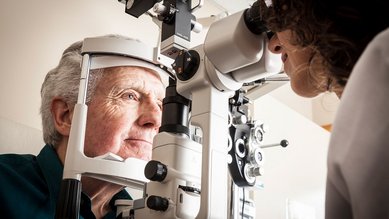
Eye drops are administered beforehand to dilate the pupils. Using a combination of a microscope and a special type of light called a slit lamp, the ophthalmologist can examine the back of the eye to detect changes to the retina. Tears, holes, creases or bleeding indicate retinal detachment.
Sometimes, an ultrasound scan is also needed to produce a definitive diagnosis.
How is retinal detachment treated?
The faster the treatment of retinal detachment is administered, the better the outcome. If the nerve cells in the retina are deprived of a blood supply for even a few hours, this may result in serious long-term effects.
Laser treatment, freezing or surgery are used to treat retinal detachment.
Laser treatment or freezing
If the ophthalmologist sees that there is a tear in the retina but that the retina has not yet become detached, laser treatment may be sufficient. Using a special laser or freezing probe, the upper layer of the retina can be re-attached to the lower layer. The laser beam or freezing gas is applied to the retina, causing scarring that knits the two layers back together.
Surgery
If the retina has already detached, it can be re-attached using surgery. Various surgical procedures can be used, depending on the type and severity of the retinal detachment that has occurred.
One relatively new approach is to remove the vitreous humor (vitrectomy). In this procedure, the surgeon removes the gel-like fluid in the vitreous humor and replaces it with a special solution or gas in order to exert pressure on the retina. This presses the two layers back together.
Important: Surgery on the retina should be performed in a specialized hospital or center.
- Kuhn F. Retinal detachment. BMJ Best Practice. Dezember 2020. Aufgerufen am 01.04.2022.
- Langmann G. Richtlinien zur Indikationsstellung bei netzhautchirurgischen Maßnahmen (einfache Buckelchirurgie, pneumatische Retinopexie, Endotamponadechirurgie). Klinisches Monatsblatt Augenheilkunde 2004; 221: 160–174. Georg Thieme Verlag Stuttgart. doi: 10.1055/s-2004 – 812 722.
- UpToDate (Internet). Overview of eye injuries in the emergency department. Wolters Kluwer 2020. Aufgerufen am 01.04.2022.
Link: Overview of eye injuries in the emergency department - UpToDate (Internet). Retinal Detachment. Wolters Kluwer 2020. Aufgerufen am 01.04.2022.

In cooperation with the Institute for Quality and Efficiency in Health Care (Institut für Qualität und Wirtschaftlichkeit im Gesundheitswesen – IQWiG).
As at: