Pneumonia
ICD codes: J18 What are ICD codes?
Pneumonia typically brings on a sudden high fever, coughing and breathlessness. Healthy people usually recover after a few weeks. In infants and older people, the illness cannot always be recognized immediately because it may show atypical symptoms.
At a glance
- With pneumonia, the pulmonary alveoli and the surrounding tissue become inflamed.
- Common symptoms are a sudden high fever, coughing and breathlessness, and feeling very ill.
- Pneumonia is usually caused by bacteria. So the illness can be successfully treated with antibiotics.
- Special vaccines can also protect against infection by particular viruses.
- However, it can take a month, or several months, before the body recovers its strength.
Note: The information in this article cannot and should not replace a medical consultation and must not be used for self-diagnosis or treatment.

What is pneumonia?
Pneumonia is an inflammation of the pulmonary alveoli and the surrounding tissue. The infection can usually be identified through a sudden high fever, feeling very ill, coughing and breathlessness.
It is generally wise to use antibiotics because pneumonia is usually caused by bacteria. There are also specific vaccines against particular types of pathogens.
Pneumonia usually only lasts for a few weeks in otherwise healthy people. However, sufferers should note that it can take months before they regain their full physical strength.
Pneumonia particularly becomes life-threatening when the patient has been weakened by another illness. Infants and older people are also in the at-risk groups.
How can pneumonia be identified?
Typical indications of pneumonia are:
- high fever and shivering
- weakness and feeling very ill
- coughing and sputum
- breathlessness and rapid breathing
- rapid pulse
But symptoms may only occur singly, or atypical symptoms such as diarrhea, stomach ache or impaired consciousness may be the main complaint. This is particularly the case with children and older people.
What causes pneumonia?
Pneumonia is usually caused by bacteria. Which bacteria are involved usually depends on where the infection occurs. If the patient becomes ill in a domestic environment, pneumococci are usually the cause. Other pathogens, more difficult to treat, particularly occur with infections in hospitals.

If the airways are already inflamed by flu viruses or other pathogens, the bacteria can settle there more easily and cause a bacterial pneumonia. In contrast, viruses alone are rarely responsible for a pneumonia, while fungi are even more rarely the cause.
Swallowing can also favor an infection: with so-called aspiration pneumonia, germs from the oral and throat cavity, food residue or stomach contents get into the airways and cause pneumonia.
Pneumonias that are not caused by germs but rather, for example, by radiation or inhaled toxins, an allergic reaction or circulatory disorders, do not occur very often. A bacterial inflammation spreading via circulating blood from another location to the lung is equally rare.
Which factors can increase the risk of pneumonia?
Infants and people over the age of 65, in particular, are pneumonia risk groups. There is also more risk when the immune system is weak, for instance due to diabetes, a kidney function disorder, or cancer.
Other factors that can favor infection are lung conditions such as asthma, COPD and smoking. Certain viral infections such as the flu also make pneumonia more likely.
Video What is the lung disease COPD?
The video below explains the possible symptoms, causes, and treatment methods of the lung disease COPD.
This and other videos can also be found on YouTube
Watch nowThe privacy policy indicated there applies.
Aspiration pneumonia, i.e. an infection caused by swallowing, usually occurs in people who are bedridden, have difficulties swallowing, or have impaired consciousness. Both are possible consequences of dementia or a stroke.
Still being debated is whether certain drugs increase the risk of pneumonia, for example drugs that inhibit gastric acids.
How common is pneumonia?
Over 500,000 people per year get pneumonia in Germany, of whom around 250,000 are treated in hospital. Of these, some 20,000 people die – they are mostly people over the age of 65 and those who were already ill for other reasons. As a result, pneumonia is one of the ten most common causes of death in Germany.

Pneumonia is even more common in poorer countries, particularly in infants and children.
How does pneumonia progress?
A sudden high fever and shivering are characteristic of pneumonia. Then symptoms such as coughing, breathlessness and sputum develop, and patients feel very ill. But the inflammation can also evolve slowly and stealthily, and begin with few or mild symptoms. This is particularly the case with older people.
If the high fever is not treated it takes around one week until the body temperature returns to normal values. This is the critical “defervescence” or “crisis”. This usually involves outbreaks of heavy sweating and a dilation of the blood vessels in the skin: this enables the body to lose heat more easily. Because people with pneumonia are often very weak, this phase can be very stressful for the heart and circulation, and lead to complications.
Once the crisis phase has passed, the person’s general health slowly improves again. Over the next approximately 4 weeks the pneumonia then usually fades away completely.
During the recovery phase the person should look after themselves to prevent a relapse or other complications.
After-effects
With pneumonia, the costal pleura can become inflamed, which leads to severe pain when coughing and breathing. Breathing can also become more difficult if fluid gathers between the lung and the chest wall. A lung abscess – the formation of a pus-filled cavity – may also occur.
Complications that can occur with pneumonia include cardiac arrythmias, circulatory collapse, respiratory or heart failure or also blood poisoning (sepsis). The risk of developing complications is higher among people who:
- are below the age of 2 or above the age of 65
- have a weakened immune system
- need to be ventilated
- have other illnesses such as heart or kidney conditions
- have been infected in hospital
How can pneumonia be prevented?
To prevent infections of the airways, simple hygiene measures are usually recommended, including regular hand washing and maintaining physical distance.
If there is an elevated risk of pneumonia or its complications, vaccinations may also be considered. For children, for example, these are vaccinations against the bacterium Haemophilus influenzae and against pneumococci. The flu and pneumococci vaccine is available to people over the age of 60.
Video How do vaccinations work?
The video below explains how a vaccination works.
This and other videos can also be found on YouTube
Watch nowThe privacy policy indicated there applies.
Important: Herbal medicines or food supplements such as vitamin products are often advertised to strengthen the immune system. However it has not been scientifically proven that these products are useful. On the other hand, when there is a proven vitamin deficiency, usually caused by a very imbalanced diet, the use of such products has been shown to be effective.
How is pneumonia diagnosed?
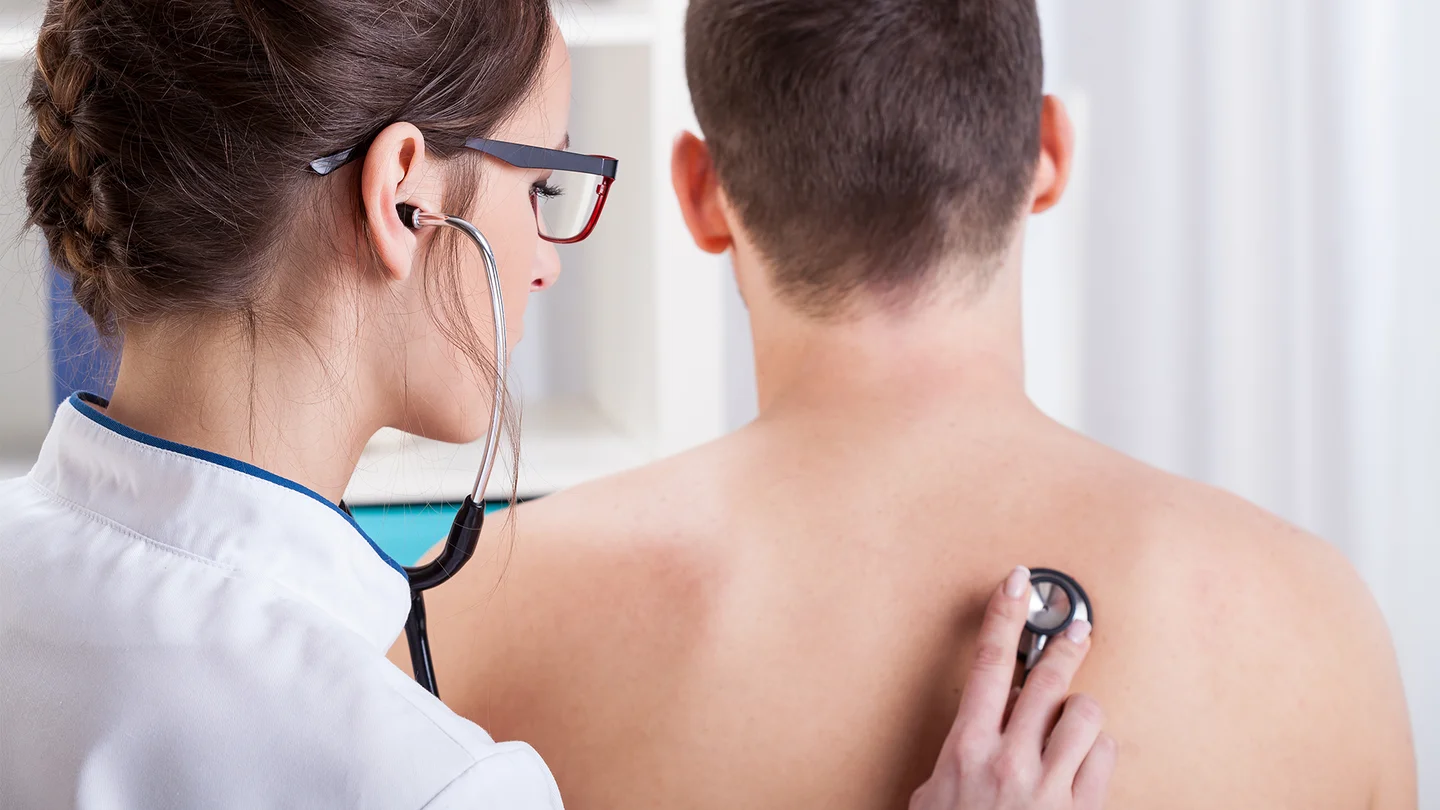
The typical symptoms described above usually indicate pneumonia. The doctor diagnoses the illness by listening to the lungs with a stethoscope, and by taking pulse and blood pressure measurements.
The lungs are often also x-rayed to get a more detailed look at the inflammation of the lung tissue. In some cases, to enhance the x-ray examination, a computed tomography (CT) scan is also taken. Ultrasound enables changes in the outer area of the lungs to be identified.
Blood is taken to determine the inflammation levels and other values. An inflamed lung no longer works well. So the oxygen content of the blood may be monitored, too. This also works without taking blood, rather by using so-called pulse oximetry, which determines the oxygen content through an optical method. To do this, a clip with a light sensor is attached to the finger.
Blood, urine and phlegm that has been coughed up are examined in the lab to identify the specific pathogens.
How is pneumonia treated?
The infection is usually caused by bacteria. So in most cases pneumonia is treated with antibiotics, based on the type of bacteria.
If the pneumonia is severe, anti-inflammatory cortisone is also sometimes injected. If there is a shortage of oxygen a nasal mask is normally used. Ventilation is required less often.
If viruses, for example the SARS-CoV-2 coronavirus, cause the pneumonia, the drugs used differ from those used for a bacterial infection. With the flu, so-called virostatics that act specifically against viruses may be considered.
Important: With cases of pneumonia, doctors advise against cough medicines from the pharmacy, special breathing exercises, or physiotherapy.
For more detailed information, for example on pneumonia types and their treatment, go to gesundheitsinformation.de.
- Almirall J, Serra-Prat M, Bolíbar I, Balasso V. Risk Factors for Community-Acquired Pneumonia in Adults: A Systematic Review of Observational Studies. Respiration. 2017;94(3):299-311. doi: 10.1159/000479089. Epub 2017 Jul 25. PMID: 28738364.
- Baskaran V, Murray RL, Hunter A, Lim WS, McKeever TM. Effect of tobacco smoking on the risk of developing community acquired pneumonia: A systematic review and meta-analysis. PLoS One. 2019 Jul 18;14(7):e0220204. doi: 10.1371/journal.pone.0220204. PMID: 31318967; PMCID: PMC6638981.
- Briel M, Spoorenberg SMC, Snijders D et al. Corticosteroids in Patients Hospitalized With Community-Acquired Pneumonia: Systematic Review and Individual Patient Data Metaanalysis. Clin Infect Dis. 2018 Jan 18;66(3):346-354. doi: 10.1093/cid/cix801. PMID: 29020323.
- Chang CC, Cheng AC, Chang AB. Over-the-counter (OTC) medications to reduce cough as an adjunct to antibiotics for acute pneumonia in children and adults. Cochrane Database Syst Rev 2014; (3): CD006088.
- Chaves GS, Freitas DA, Santino TA et al. Chest physiotherapy for pneumonia in children. Cochrane Database Syst Rev. 2019 Jan 2;1(1):CD010277. doi: 10.1002/14651858.CD010277.pub3. PMID: 30601584; PMCID: PMC6353233.
- Das RR, Singh M, Naik SS. Vitamin D as an adjunct to antibiotics for the treatment of acute childhood pneumonia. Cochrane Database Syst Rev. 2018 Jul 19;7(7):CD011597. doi: 10.1002/14651858.CD011597.pub2. PMID: 30024634; PMCID: PMC6513535.
- Deutsche Gesellschaft für Pädiatrische Infektiologie (DGPI), Gesellschaft für Pädiatrische Pneumologie (GPP). Management der ambulant erworbenen Pneumonie bei Kindern und Jugendlichen (pädiatrische ambulant erworbene Pneumonie, pCAP). S2k-Leitlinie. AWMF-Registernummer 048-013. 03.2017.
- Deutsche Gesellschaft für Pneumologie und Beatmungsmedizin (DGP). Behandlung von erwachsenen Patienten mit ambulant erworbener Pneumonie und Prävention – Update 2016. S3-Leitlinie. 02.2016.
- Eppinger M, Müller M. Pädiatrie für Studium und Praxis. Medizinische Verlags- und Informationsdienste: Breisach 2016.
- Hemilä H, Louhiala P. Vitamin C for preventing and treating pneumonia. Cochrane Database Syst Rev. 2013 Aug 8;(8):CD005532. doi: 10.1002/14651858.CD005532.pub3. PMID: 23925826.
- Herold G. Innere Medizin. Selbstverlag: Köln 2017.
- Horita N, Otsuka T, Haranaga S et al. Adjunctive Systemic Corticosteroids for Hospitalized Community-Acquired Pneumonia: Systematic Review and Meta-Analysis 2015 Update. Sci Rep. 2015 Sep 16;5:14061. doi: 10.1038/srep14061. PMID: 26374694; PMCID: PMC4571641.
- Huang J, Guo J, Li H, Huang W, Zhang T. Efficacy and safety of adjunctive corticosteroids therapy for patients with severe community-acquired pneumonia: A systematic review and meta-analysis. Medicine (Baltimore). 2019 Mar;98(13):e14636. doi: 10.1097/MD.0000000000014636. PMID: 30921179; PMCID: PMC6456091.
- Jiang S, Liu T, Hu Y et al. Efficacy and safety of glucocorticoids in the treatment of severe community-acquired pneumonia: A meta-analysis. Medicine (Baltimore). 2019 Jun;98(26):e16239. doi: 10.1097/MD.0000000000016239. PMID: 31261585; PMCID: PMC6616855.
- Kasper DL, Fauci AS, Hauser SL, Longo DL, Jameson JL, Loscalzo J. Harrison's Principles of Internal Medicine. McGraw-Hill: New York 2015.
- L Lambert AA, Lam JO, Paik JJ et al. Risk of community-acquired pneumonia with outpatient proton-pump inhibitor therapy: a systematic review and meta-analysis. PLoS One. 2015 Jun 4;10(6):e0128004. doi: 10.1371/journal.pone.0128004. PMID: 26042842; PMCID: PMC4456166.
- L Larsen T, Lee A, Brooks D et al. Effect of Early Mobility as a Physiotherapy Treatment for Pneumonia: A Systematic Review and Meta-Analysis. Physiother Can. 2019 Winter;71(1):82-89. doi: 10.3138/ptc.2017-51.ep. PMID: 30787503; PMCID: PMC6373606.
- L Lux LJ, Posey RE, Daniels LS, Henke DC, Durham C, Jonas DE, Lohr KN. Pharmacokinetic/Pharmacodynamic Measures for Guiding Antibiotic Treatment for Hospital-Acquired Pneumonia [Internet]. Rockville (MD): Agency for Healthcare Research and Quality (US); 2014 Nov. Report No.: 14(15)-EHC032-EF. PMID: 25577937.
- Marti C, Grosgurin O, Harbarth S et al. Adjunctive Corticotherapy for Community Acquired Pneumonia: A Systematic Review and Meta-Analysis. PLoS One. 2015 Dec 7;10(12):e0144032. doi: 10.1371/journal.pone.0144032. PMID: 26641253; PMCID: PMC4671611.
- National Clinical Guideline Centre (UK). Pneumonia: Diagnosis and Management of Community- and Hospital-Acquired Pneumonia in Adults. London: National Institute for Health and Care Excellence (UK); 2014 Dec. PMID: 25520986.
- Nguyen PA, Islam M, Galvin CJ, Chang CC, An SY, Yang HC, Huang CW, Li YJ, Iqbal U. Meta-analysis of proton pump inhibitors induced risk of community-acquired pneumonia. Int J Qual Health Care. 2020 Jun 17;32(5):292-299. doi: 10.1093/intqhc/mzaa041. PMID: 32436582.
- Prina E, Ranzani OT, Torres A. Community-acquired pneumonia. Lancet. 2015 Sep 12;386(9998):1097-108. doi: 10.1016/S0140-6736(15)60733-4. Epub 2015 Aug 12. PMID: 26277247; PMCID: PMC7173092.
- Robert Koch-Institut (RKI). Empfehlungen der Ständigen Impfkommission (STIKO) am Robert Koch-Institut – 2019/2020. (Epidemiologisches Bulletin; Band 34). Aufgerufen am 22.08.2019.
- Robert Koch-Institut (RKI). SARS-CoV-2 Steckbrief zur Coronavirus-Krankheit-2019 (COVID-19). Aufgerufen am 07.08.2020.
- Siemieniuk RA, Meade MO, Alonso-Coello P, Briel M, Evaniew N, Prasad M et al. Corticosteroid Therapy for Patients Hospitalized With Community-Acquired Pneumonia: A Systematic Review and Meta-analysis. Ann Intern Med 2015; 163(7): 519-528.
- Statistisches Bundesamt (Destatis). Häufigste Todesursachen. Aufgerufen am 26.02.2021.
- Stern A, Skalsky K, Avni T, Carrara E, Leibovici L, Paul M. Corticosteroids for pneumonia. Cochrane Database Syst Rev. 2017 Dec 13;12(12):CD007720. doi: 10.1002/14651858.CD007720.pub3. PMID: 29236286; PMCID: PMC6486210.
- Weltgesundheitsorganisation (WHO). Pneumonia. 02.08.2019.
- Yakoob MY, Salam RA, Khan FR, Bhutta ZA. Vitamin D supplementation for preventing infections in children under five years of age. Cochrane Database Syst Rev. 2016 Nov 9;11(11):CD008824. doi: 10.1002/14651858.CD008824.pub2. PMID: 27826955; PMCID: PMC5450876.
- Yang M, Yan Y, Yin X et al. Chest physiotherapy for pneumonia in adults. Cochrane Database Syst Rev. 2013 Feb 28;(2):CD006338. doi: 10.1002/14651858.CD006338.pub3. PMID: 23450568.
- Zhou YF, Luo BA, Qin LL. The association between vitamin D deficiency and community-acquired pneumonia: A meta-analysis of observational studies. Medicine (Baltimore). 2019 Sep;98(38):e17252. doi: 10.1097/MD.0000000000017252. PMID: 31567995; PMCID: PMC6756683.

In cooperation with the Institute for Quality and Efficiency in Health Care (Institut für Qualität und Wirtschaftlichkeit im Gesundheitswesen) (IQWiG).
As at: