Pityriasis versicolor (tinea versicolor)
ICD codes: B36 B36.0 What are ICD codes?
Many people with pityriasis versicolor have no idea that the reason for their blotchy skin is a fungus. Proliferation of the fungus causes the disease to develop. The skin rash is usually harmless, is not infectious and can be treated.
At a glance
- Tinea versicolor is a skin disease in which dark or light patches form on the skin.
- It is caused by a yeast fungus that occurs on the skin of nearly all people.
- Tinea versicolor is normally harmless and not infectious.
- It is not clear why the fungi only multiply on some people and cause patches on the skin.
Note: The information in this article cannot and should not replace a medical consultation and must not be used for self-diagnosis or treatment.
What is pityriasis versicolor?
With pityriasis versicolor, light or dark patches form on the skin. It is caused by a yeast fungus that occurs on the skin of nearly all people. The skin disease is not infectious and is normally harmless. Pityriasis versicolor is also called tinea versicolor. In many parts of South Asia, it is known as Peter Elam’s disease.
As a general rule, pityriasis versicolor can be treated effectively with externally applied remedies, such as special creams or shampoos.
What are the symptoms of pityriasis versicolor?
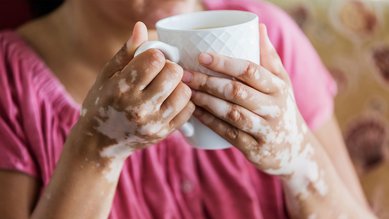
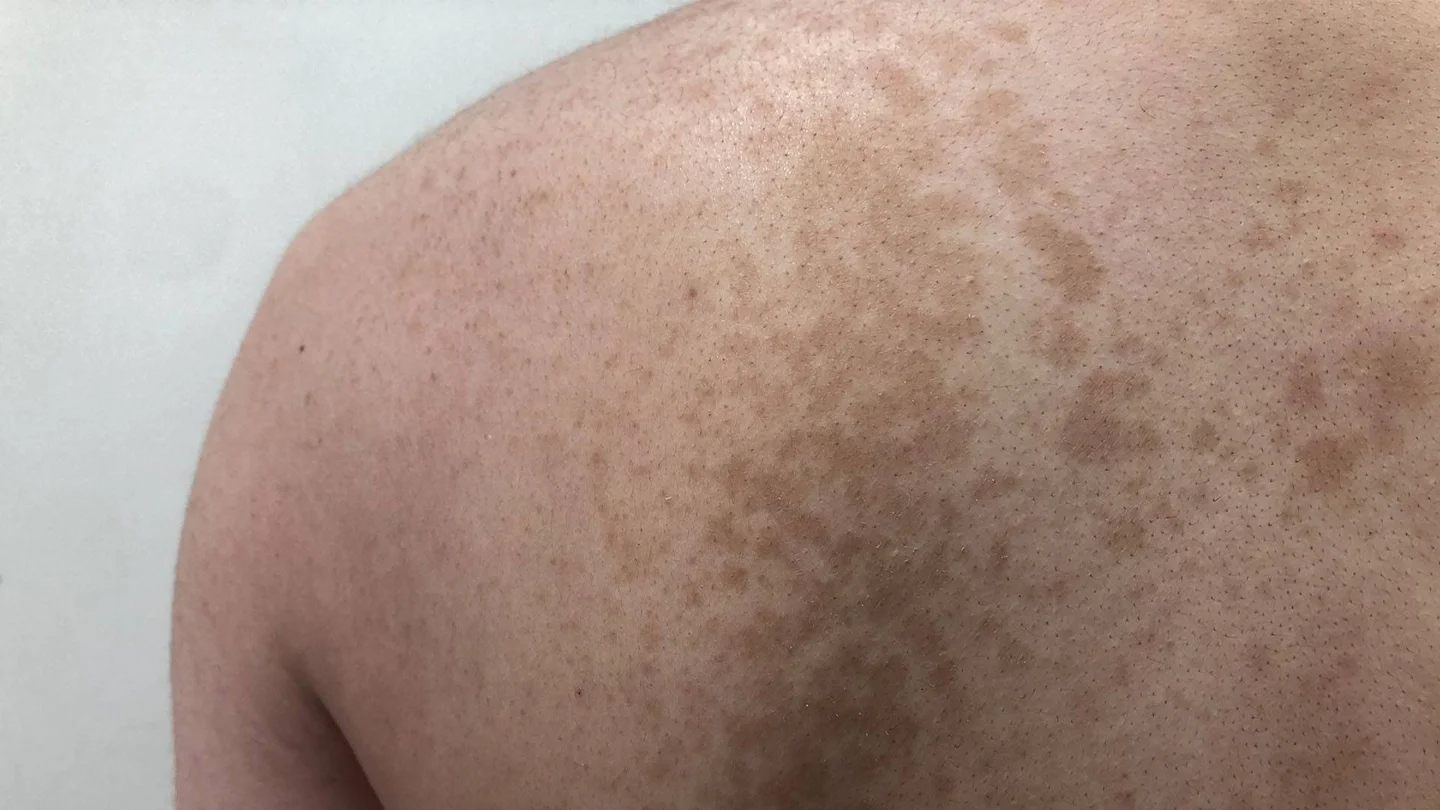
Anyone who has pityriasis versicolor initially develops small round or oval patches on the skin. Over time, these grow together into larger patches with irregular shapes.
The patches develop on the chest, neck, back and arms in particular. The face can also be affected, especially in children.
The patches can have different colors. In some people, they are yellowish or brownish, while they may be pink or reddish in others. On darker or tanned skin, they are often lighter, while they tend to be darker than healthy skin in individuals with fairer skin.
The areas of skin affected by the yeast fungus barely change when viewed under UV light. Skin areas affected by pityriasis versicolor can also be somewhat flaky. Itching is rare and only mild if it does occur.
What causes pityriasis versicolor?
Pityriasis versicolor is caused by yeast fungi that are on nearly everyone’s skin. It is not clear why these fungi only multiply on some people and cause visible patches.
Important: Pityriasis versicolor is not caused by poor hygiene. It is also not infectious.
Which risk factors favor pityriasis versicolor?
Among other things, pityriasis versicolor can be favored by these factors:
- warm and moist climate
- increased production of sweat – for instance, in people who sweat easily or exercise a lot
- oils or cosmetics that can seal the skin pores

Furthermore, a hereditary predisposition probably plays a role.
With a weakened immune system, the general risk for infections and thus also pityriasis versicolor increases. For example, the immune system can be weakened by certain kinds of cancer or drugs that suppress the body’s immune response.
How common is pityriasis versicolor?
Pityriasis versicolor is a common skin disease. It is estimated to occur in about 1 percent of the population in countries with a moderate climate. In some tropical countries, up to 40 percent of people have pityriasis versicolor.

Men and women are equally affected. Pityriasis versicolor usually appears for the first time in adolescence.
How is pityriasis versicolor diagnosed?
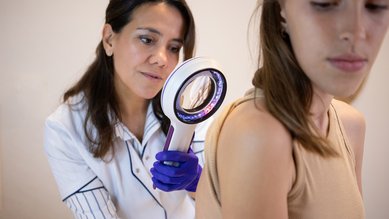
A doctor can often recognize pityriasis versicolor by the light or dark patches that typically occur on the upper body or arms.
To rule out other skin diseases, some flakes of skin can be taken with the aid of clear sticky tape and observed under a microscope. In general, pityriasis versicolor can be easily detected in this way.
How is pityriasis versicolor treated?
Cool or dry weather can make pityriasis versicolor recede. However, it does not usually clear up on its own. For the rash to disappear entirely, it must be treated with creams, lotions and head and body shampoos in particular. These remedies contain fungistatic or fungicidal substances.
Creams and lotions are applied to the affected skin areas. The hair and scalp are also washed with a special shampoo to prevent fungi spreading from there.
Many remedies take just a few minutes to have an effect, while others need several hours. For this reason, creams and lotions are often applied at night and washed off in a shower the next morning.
After a successful treatment, it may take several weeks or even months for the patches on the skin to disappear. Pityriasis versicolor is only rarely treated with tablets.
More detailed information about pityriasis versicolor is available at gesundheitsinformation.de.
- Choi FD, Juhasz ML, Atanaskova Mesinkovska N. Topical ketoconazole: a systematic review of current dermatological applications and future developments. J Dermatolog Treat. 2019 Dec;30(8):760-771. doi:10.1080/09546634.2019.1573309.
- Hu SW, Bigby M. Pityriasis versicolor: a systematic review of interventions. Arch Dermatol. 2010 Oct;146(10):1132-40. doi:10.1001/archdermatol.2010.259.
- Renati S, Cukras A, Bigby M. Pityriasis versicolor. BMJ. 2015 Apr 7;350:h1394. doi:10.1136/bmj.h1394.
- Schwartz RA. Superficial fungal infections. Lancet. 2004 Sep 25-Oct 1;364(9440):1173-82. doi: 10.1016/S0140-6736(04)17107-9.

In cooperation with the Institute for Quality and Efficiency in Health Care (Institut für Qualität und Wirtschaftlichkeit im Gesundheitswesen) (IQWiG).
As at: