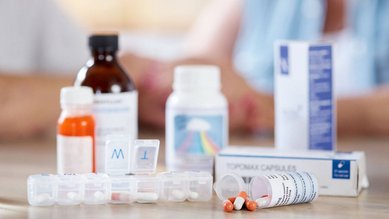
Medication – prescription and over-the‑counter drugs
Most types of medication are only available from pharmacies. Many of these also require a prescription. Certain medicinal remedies that are not associated with any known health risks can also be sold in other types of retail outlets other than pharmacies.
At a glance
- Most medication is only available from a local or online pharmacy.
- If the medication should only be taken under medical supervision, it also requires a prescription from a doctor. In this case, it is known as a prescription drug.
- Over-the-counter (OTC) medicinal remedies such as vitamin supplements or medicinal teas can also be purchased in drugstores, supermarkets or health stores.
- Caution is advised when purchasing medication online. The EU safety logo serves to identify trustworthy online retailers.
- If a certain medication is in short supply, it is often possible to replace it with an alternative preparation.


Where can medication be purchased?
Most medication (medicines) can only be purchased in a pharmacy. This may be a local brick-and-mortar pharmacy or an online pharmacy.
Many are also only available on prescription. This is to ensure that they can only be taken as part of treatment prescribed by a doctor. In this way, a doctor can monitor the effect of the medication on the patient’s symptoms and make adjustments if necessary. Some types of medication require a special prescription. Examples include anesthetics, including very strong painkillers that can only be prescribed using a special anesthetic prescription. The costs of prescription medication are usually covered to a large extent by health insurance providers.
Some medication can also be sold in retail outlets other than pharmacies – for example, in drugstores. These are known as over-the-counter (OTC) drugs.
When is a medication a prescription-only medication?
The requirement for certain medication to be subject to a medical prescription is regulated by the Pharmaceutical Products Act (Arzneimittelgesetz, AMG). The Federal Ministry of Health (Bundesministerium für Gesundheit, BMG) is, in principle, responsible for determining whether a certain medication requires a prescription or can be sold over-the-counter. A committee of experts under the direction of the Federal Institute for Drugs and Medical Devices (Bundesinstitut für Arzneimittel und Medizinprodukte, BfArM) advises on applications that are submitted by companies or authorities, for example. The committee of experts submits recommendations to the Federal Ministry of Health. The committee normally convenes twice a year.
Applications can be submitted to the office of the committee of experts, for example, for a medication to be made available on prescription only because it has very strong side-effects and should only be taken under medical supervision. Applications can also be made to have the requirement for a prescription lifted – for example, if an active ingredient is widely used and well documented and if no unknown side-effects are to be expected from short-term treatment.
People can also purchase non-prescription medication without a prescription from a doctor in order to treat mild illnesses themselves. Non-prescription medication includes, for example, most cold remedies and headache treatments, as well as medication to treat minor ailments. The effects and side-effects of these medications are unknown. The side-effects are generally mild in nature.
When is a medication available without a prescription?
Over-the-counter (OTC) medication or drugs are not only sold in pharmacies. No known risks are associated with their use – provided that the product information is observed. Customers don’t require any advise from a pharmacist when purchasing these drugs. They are sold in drugstores, health stores and supermarkets, for example.
Examples of OTC medication include:
- medicinal teas
- throat lozenges taken for coughs and hoarseness
- mild sleep-inducing agents
- vitamin supplements

However, the prerequisite that applies to most medication sold outside of a pharmacy setting is that the retailer must be able to demonstrate that they have the required specialist knowledge in this area. They can do so by taking an exam or have a corresponding qualification – for example, as an officially approved druggist (chemist) or pharmacy technician.
Important: Over-the-counter medication is not associated with any significant side-effects. Despite this, caution is still advised – especially if they are taken in combination with other medication. This is because drug interactions may occur under certain circumstances. It’s also important to monitor whether they actually bring about an improvement in symptoms. If not, medical advice should be sought.
What to consider when buying medication online
Ordering medication online is associated with a certain degree of risk that the product may not comply with required standards. Counterfeit medication looks very similar to authentic medication and can easily be confused with it. However, the dosage may be too low or too high, the product may contain toxic substances or it may simply be ineffective because it contains insufficient amounts of active ingredient or none at all.

When purchasing medication online, it is important to buy from legal, registered suppliers only. An EU safety logo helps to identify such suppliers. The logo is mandatory – all online pharmacies and other retailers (e.g., drugstores) must ensure that it is clearly visible on their websites if they are operating an online mail-order business that sells medication directly to customers. Clicking on this logo provides a simple way to check whether a supplier is authorized to sell medication for human use online in accordance with the relevant national legislation.
For more information about buying medication online, see the website of the Federal Institute for Drugs and Medical Devices (Bundesinstitut für Arzneimittel und Medizinprodukte, BfArM).
What is a supply shortage?
A supply shortage is a situation in which the delivery of a medication in the usual quantities is interrupted for a period of more than two weeks. It can also occur if there is a surge in demand for a certain medication and this demand cannot be met.
Reasons for supply shortages include:
- Production problems: Staff shortages or technical outages mean that the medication cannot be manufactured.
- Quality problems: The medication cannot be approved due to impurities being detected or similar quality issues.
- Increased demand: More people than usual are in need of a certain type of medication.
- Tightening of the market: The medication is only being made by a small number of manufacturers. As a result, few alternatives are available if one manufacturer is unable to deliver.
However, a shortage in supply doesn’t always mean that patient treatment has to be interrupted. Alternative medication is often available so that uninterrupted patient treatment can be ensured.
For information about which medication is currently in short supply, see pharmnet-bund.de.
For more information about shortages in supply, see the BfArM website.
- Bundesinstitut für Arzneimittel und Medizinprodukte (BfArM). Lieferengpässe. Aufgerufen am 02.05.2025.
- Bundesinstitut für Arzneimittel und Medizinprodukte (BfArM). Sicherer Arzneimittelkauf im Internet. Aufgerufen am 02.05.2025.
- Bundeskriminalamt (BKA). Arzneimittelkauf über das Internet. Stand: 01.08.2022.
- Bundesministerium der Justiz (BMJ). Verordnung über apothekenpflichtige und freiverkäufliche Arzneimittel. Stand: 10.2020.
- Bundesministerium für Gesundheit (BMG). Zugang zu Arzneimitteln. Aufgerufen am 02.05.2025.
- Kassenärztliche Bundesvereinigung (KBV). Arzneimittel-Richtlinie. Aufgerufen am 02.05.2025.
- Korzilius H. Lieferengpässe bei Arzneimitteln: Ein Missstand, der nicht mehr hinnehmbar ist. Deutsches Ärzteblatt. 2019.

In cooperation with the Federal Institute for Drugs and Medical Devices (BfArM).
As at: