Greenstick fractures
ICD codes: T14.2 What are ICD codes?
A greenstick fracture is when the bone cortex and the associated periosteum are damaged. These surround the solid bone, which remains intact. Such fractures only occur in children.
At a glance
- A greenstick fracture is when the outer bone cortex and the periosteum are damaged. The solid bone remains intact.
- Greenstick fractures primarily occur in children aged under 10.
- Greenstick fractures usually affect the forearm and upper arm bones, and are often caused by falling on an outstretched arm.
- The fracture is detected through a physical examination and an ultrasound scan.
- The diagnosis can be confirmed by using X-ray images to show an incomplete fracture line.
- The fractured arm is immobilized and then encased in plaster. Sometimes, a splint suffices. Surgery is seldom necessary.
Note: The information in this article cannot and should not replace a medical consultation and must not be used for self-diagnosis or treatment.


What is a greenstick fracture?
Doctors talk about greenstick fractures in the event of an incomplete break (fracture), where the bone cortex and associated periosteum are damaged. These surround the inner bone substance, known as spongy bone.

Greenstick fractures only affect children, primarily those under the age of 10. This is because their bones are still growing. They are not as ossified as adults’ bones and are therefore more flexible.
The bone fracture can be imagined like a green branch being snapped: as it is very soft, it only breaks on one side instead of all the way through.
Greenstick fractures usually affect the long bones.
Greenstick fractures most commonly occur in the arm, affecting either one of the forearm bones (ulna or radius) or the upper arm bone.
However, such fractures are also possible in the thigh or lower leg (fibula or tibia). They rarely affect the face, ribs, collarbone or shoulder blades.
Most greenstick fractures heal without consequence.
What are the symptoms of a greenstick fracture?
The symptoms of a greenstick fracture usually include a limited ability to move the affected limb and pain when touching the injured area. Small areas of bleeding under the skin can also occur.
If the fracture is more serious, further symptoms are also possible. These include swelling due to the accumulation of water (edema), abrasions or injuries to the surrounding tissue.
What causes a greenstick fracture?
The most common cause of a greenstick fracture is falling on an outstretched arm, especially when running around or doing sport.

When children fall, they unconsciously try to stop themselves with an outstretched wrist. This results in a strong force on the forearm, causing it to twist.
Examples of sporting activities that increase the risk of a greenstick fracture include skateboarding, inline skating, horse riding and snowboarding. The risk of injury can be reduced by wearing wrist guards.
However, greenstick fractures can also be the result of rear-end collisions or being struck on the arm with an object.
What are the potential consequences of a greenstick fracture?
Greenstick fractures usually heal well and without consequence. Check-ups are required to ensure that the bone segments are growing back together correctly.
If the fracture is not treated or the bone segments do not grow back together correctly, misalignments can occur. The arm may also no longer have the same range of movement as it did prior to the accident.
Greenstick fractures furthermore increase the probability of further forearm fractures.
Video How does a broken bone heal?
The following video explains how a broken bone heals.
This and other videos can also be found on YouTube
Watch nowThe privacy policy indicated there applies.
How are greenstick fractures diagnosed?
To diagnose greenstick fractures, the doctor starts by asking how the accident occurred.
Checks are then performed to see if the area is painful and if any soft tissue has been damaged. This indicates whether the fracture is open or closed.
In addition, examinations are performed to determine whether and to what extent the blood vessels have been damaged.
To confirm the diagnosis, the doctor performs scans with an x-ray machine. In the event of a greenstick fracture, the images show a curved injury with a fracture line that does not go all the way through the bone.
Alternatively, fractures can be identified using an ultrasound scan, which is particularly advantageous in the case of children.
How are greenstick fractures treated?
First, the greenstick fracture has to be immobilized. Pain can be alleviated with painkillers such as ibuprofen or paracetamol.
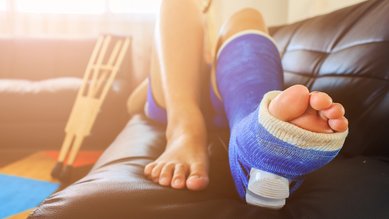
A few days after the injury, a plaster cast is applied. Depending on the site of the greenstick fracture, various plaster cast sizes are used:
- In the event of a fracture near the wrist, the doctor can apply a short plaster cast.
- In the event of a fracture to the upper arm, a plaster cast is applied to the entire arm.
The plaster cast must be worn for about three to six weeks in total, depending on the location of the fracture. A long plaster cast can be replaced with a short one after about three weeks.
In some cases, greenstick fractures can be treated using a splint. Unlike a plaster cast, this can be temporarily removed, for example when showering.
In the event of severe greenstick fractures, surgery can be required. This includes fractures where the blood vessels, nerves or joints have been injured, for example.
What happens after the greenstick fracture has healed?
To enable a greenstick fracture to heal without consequence, it is important not to immediately exert full strain on the affected limb again.
Doctors advise children not to play sport for two to four weeks after the plaster cast is removed.
Physiotherapy is not usually required as children are very active and get enough exercise of their own accord.
If the arm or leg has not regained its full range of movement after this period, the doctor will re-examine the limb.
A further ultrasound examination can sometimes be useful and additional physiotherapy may be considered.
- Atanelov Z, Bentley TP. Greenstick Fracture. [Updated 2022 Aug 1]. In: StatPearls [Internet]. Treasure Island (FL): StatPearls Publishing; 2022 Jan-. Aufgerufen am 13.12.2022.
- Deutsche Gesellschaft für Kinderchirurgie e.V. (DGKCH). Unterarmschaftfrakturen im Kindesalter. S1-Leitlinie. AWMF-Registernummer 006/062. 04.2016.
- DynaMed (Internet). Ipswich (MA). Overview of Forearm and Wrist Fractures in Children. EBSCO Information Services. Aufgerufen am 13.12.2022.
- UpToDate (Internet). Distal forearm fractures in children: Diagnosis and assessment. Wolters Kluwer 2022. Aufgerufen am 13.12.2022.

Reviewed by the German Trauma Surgery Society (Deutsche Gesellschaft für Unfallchirurgie e.V. – DGU).
As at: