Broken collarbone
ICD codes: S42.0 S42.7 What are ICD codes?
Broken collarbones are often caused by falling on the shoulder, for example during sport or traffic accidents. An X-ray usually suffices for diagnosis. Depending on the type and location of the break, it can be treated with or without surgery.
At a glance
- The collarbone (clavicle) is a strut of bone that connects the shoulder blade and the breastbone (sternum).
- It is s-shaped and most commonly breaks in the middle third.
- Broken collarbones are usually caused by a fall on the shoulder – in the case of younger people often as a result of a sport or traffic accident.
- A broken collarbone is painful when moving and when pressure is placed on the fracture. Visible swelling above the bone often occurs.
- Depending on the type and location of the break, doctors recommend immobilizing the arm with a sling or surgery.
- Most people can move their arm and use it for lifting again without pain after 2 to 3 months.
Note: The information in this article cannot and should not replace a medical consultation and must not be used for self-diagnosis or treatment.
What is a broken collarbone?
The collarbone (clavicle) is a strut of bone that connects the breastbone (sternum) and the shoulder blade. It is s-shaped and most commonly breaks in the middle third. Medical practitioners also refer to a broken collarbone as a fractured clavicle.
The collarbone often breaks due to a fall on the shoulder. In younger people, this usually occurs during sport or traffic accidents.
About 3 percent of all bone fractures involve the collarbone – especially in children, young adults and the elderly.
In the case of a break where the bone has moved considerably or that also involves damage to blood vessels and nerves, surgery is usually required.
Uncomplicated breaks can be immobilized with an arm sling. The affected arm can usually be moved again without pain before long but the bone can take 6 to 12 weeks to fully heal.
What are the symptoms of a broken collarbone?
The typical symptoms of a broken collarbone in the middle third of the bone are:
- an audible snap or crack at the time of the accident
- pain limited to one area that gets worse when moving the arm
- clear swelling above the bone
- the visible misalignment of the bone
- If the collarbone breaks at the point where it connects to the breastbone, it can protrude in front of the breastbone creating a visible bulge.
It is also possible for the collarbone to become wedged under the breastbone so that it can no longer be felt near to the breastbone. These kinds of collarbone breaks should be operated on quickly as organs below them can be damaged.
Important: If great force is applied, blood vessels, nerves or even the lungs can also be damaged. In the event of breathing or circulatory problems, the emergency services should be immediately called on 112 or the injured person taken to the emergency department.
What causes a broken collarbone?
Falling and landing on the shoulder is the most common cause of a broken collarbone. Younger people often break their collarbone as a result of sport or traffic accidents. The latter primarily involve cyclists.

Less common accidents include a direct impact on the collarbone, for example during contact sports, or a fall on the outstretched arm.
If the collarbone breaks close to the breastbone, this is usually caused by a more serious accident and is often accompanied by other injuries, for example to the lungs, ribs, cervical spine or other organs.
A further cause of a collarbone break close to the breastbone can be persistent overload. This is known as a fatigue fracture and can occur as a result of intensive sports training, especially in the case of rowing or gymnastics.
In older people with bone atrophy (osteoporosis) in particular, even a minor fall can result in a broken collarbone. The risk is also higher for people with tumor diseases or who are undergoing radiation therapy.
How does a broken collarbone heal?
Uncomplicated collarbone fractures usually heal well, enabling patients to start movement exercises quite soon. The bone usually takes 6 to 12 weeks to heal fully – or just 3 to 6 weeks in the case of children. Following a serious accident, the main focus is often on the consequences of other injuries.

If the arm has been immobilized for a long time, this can cause muscle loss and joint stiffness. It is therefore important to start movement exercises under the guidance of a physiotherapist at an early stage.
A “false joint” (pseudarthrosis) often forms after a broken collarbone. Here, instead of the broken sections of the bone growing together to form a stable joint, a connection made of fibrous cartilage forms. This does not usually cause pain or functional disorders. However, if the false joint results in a shorter collarbone or causes pain, surgery can help.
A bony protrusion can also form at the break point. In children, this protrusion usually goes away of its own accord. In adults, however, it can remain and be visible as the collarbone is located directly under the skin. If the protrusion develops deeper within the body, it can sometimes press on the nerves and cause pain.
In the case of a broken collarbone near the connection to the shoulder, painful wear symptoms may occur after several years.
Video How does a broken bone heal?
The following video explains how a broken bone heals.
This and other videos can also be found on YouTube
Watch nowThe privacy policy indicated there applies.
How is a broken collarbone diagnosed?
Doctors start by performing a physical examination and feeling the area of the suspected break. As the collarbone sits very close to the skin, any bone misalignment is often externally visible.
An X-ray is performed to determine the best treatment method. The X-ray image shows:
- the precise place where the bone is broken
- whether and to what extent the broken sections have moved
- whether the break has shortened the collarbone
- whether the bone has broken into several pieces
If the accident involved a strong impact force, other investigations such as computed tomography (CT), magnetic resonance imaging (MRI), ultrasound or neurological scans may also be required. These procedures make it possible to detect injuries to the surrounding tissue or adjacent bones.
How is a broken collarbone treated?
Straight after the injury occurs, cooling can help to alleviate the pain and any swelling. This can be done by placing a cold pack or ice on the area for 20 to 30 minutes every 1 to 3 hours. Painkillers can also be taken for a short time.
To enable a broken bone to heal, it is either immobilized (i.e. treated conservatively) or operated on. This may be done as follows:
- Conservative treatment: immobilization in an arm sling or with a clavicula bandage. This is a shoulder-to-shoulder sling that crosses the back.
- Surgical treatment: the bone is stabilized with a plate and screws or with an inner rail in the bone marrow cavity (medullary cavity).
Depending on the type of injury, there can be important or compelling reasons to operate on a broken collarbone. These include:
- Blood vessels, nerves, the skin or adjacent bones are damaged.
- The break cannot be sufficiently immobilized externally.
- The break is near a joint.
- The bone ends have been severely displaced.
- The bone has been shortened by the break or broken into several pieces.
The decision to operate also considers the person’s job or the type of sport they do. The advantages and disadvantages should be carefully discussed with a doctor prior to surgery.
Advantages of surgery
- The time it takes to be able to fully place the arm under strain again is usually shorter than without surgery.
- The probability of the bone not healing and forming a false joint is lower. However, a false joint on the collarbone does not usually cause any problems.
- In some tests, the shoulder was more mobile after surgery. However, the differences from broken collarbones that were not operated on were very minor.
- As no bony protrusion usually develops on the bone following surgery, the cosmetic result is often better.
Disadvantages of surgery
- Surgical wounds can become infected.
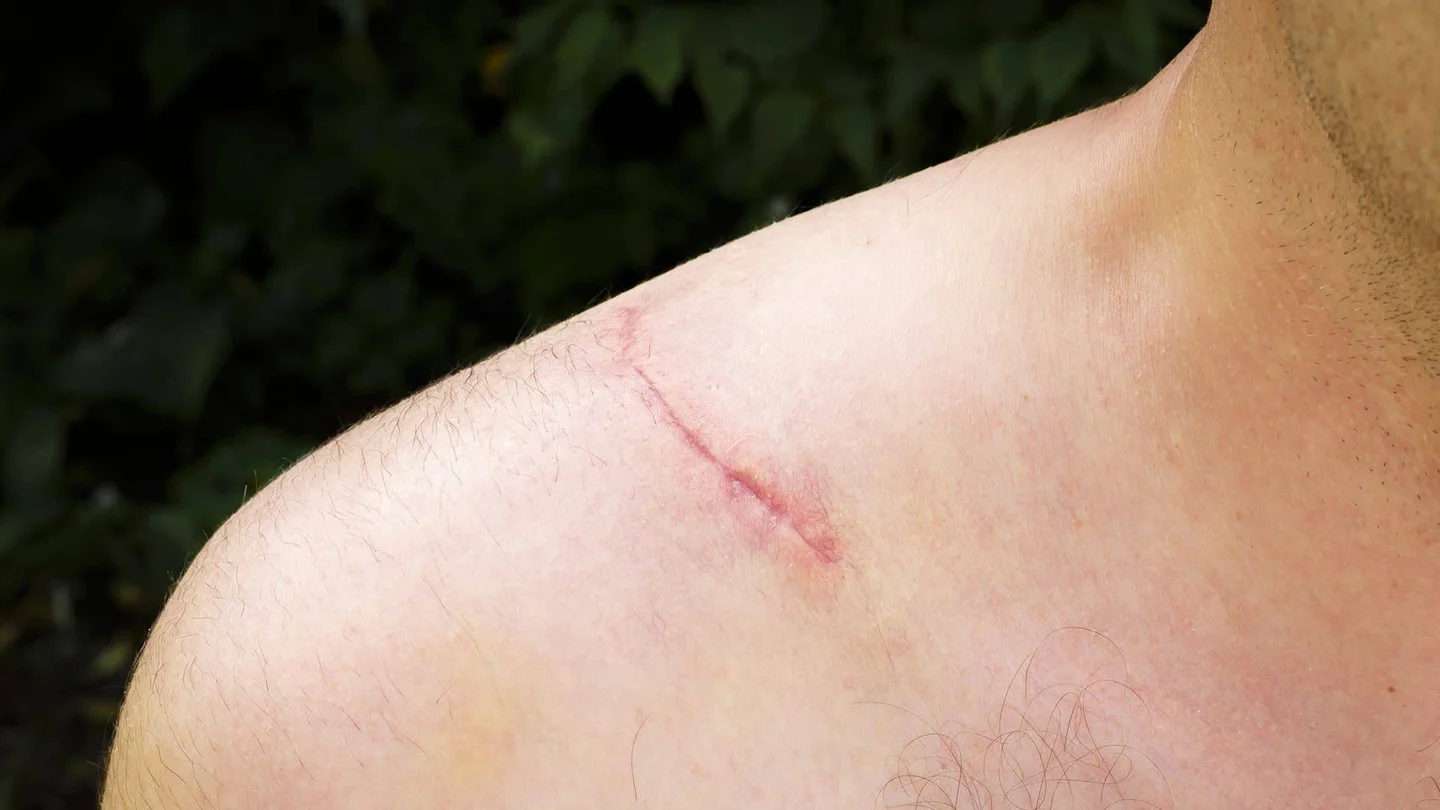
- Scars form in the area of the surgical wound.
- Surgery can damage blood vessels and nerves.
- Anesthesia errors are possible with any anesthesia.
- The cosmetic or functional result may not be as expected despite surgery.
- Metal implants, such as a plate, have to be removed in a second operation about a year later. It will not be possible to put full strain on the arm for a while after this.
What follow-up treatment is important with a broken collarbone?
To prevent permanent damage due to muscle loss and stiff joints, people should start movement exercises at an early stage after breaking their collarbone. It is important to move the wrist and elbow joints several times a day. A clavicula bandage also enables people to do light activities that do not cause pain.
Doctors will regularly examine the extent to which the shoulder can be moved without pain. Once the arm is no longer immobilized, physiotherapists help patients perform targeted movement and strength-building exercises. Within 6 to 12 weeks, the shoulder is usually as mobile as it was before the accident.
Even if free movement no longer causes pain, patients should avoid contact sports and strenuous activities for another 4 weeks (or 2 to 3 weeks in the case of children). Sports that put strain on the shoulders should not be re-initiated until about 3 to 6 months after the accident. Only then can training restart properly.
- DynaMed [Internet], Ipswich (MA). Clavicle fractures in adults. EBSCO Information Services. Record No. T1548946256960. 2020 (1995). Aufgerufen am 03.04.2021.
- UpToDate (Internet). Clavicle fractures. Wolters Kluwer 2020. Aufgerufen am 03.04.2021.
- Schiffer G et al. Klavikulaschaftfraktur: Keine harmlose Bagatellverletzung – Aktuelle Therapiekonzepte. Dtsch Arztbl Int 2010;107(41);711–7. doi: 10.3238/arztebl.2010.0711.

In cooperation with the Institute for Quality and Efficiency in Health Care (Institut für Qualität und Wirtschaftlichkeit im Gesundheitswesen – IQWiG).
As at: