Corns
ICD codes: L84 What are ICD codes?
Corns mainly occur on people’s toes and on the soles of their feet. They develop on areas of the skin repeatedly exposed to pressure or rubbing. Most of the time, they gradually go away on their own if the rubbing and pressure stop. The skin can be helped to heal by softening the corn and removing it carefully.
At a glance
- Corns develop on areas of the skin repeatedly exposed to pressure or rubbing.
- Corns usually go away on their own if the rubbing and pressure stop – for instance, if the person starts wearing shoes that fit them better.
- Corns can be painful, particularly when standing and walking.
- Corns mainly develop on areas of the skin that are close to a bone.
Note: The information in this article cannot and should not replace a medical consultation and must not be used for self-diagnosis or treatment.
What is a corn?
Corns are very common, particularly in older people. They develop as a result of constant or repeated pressure and rubbing on an area of skin. An area of thickened skin (a callus) forms at first. If it continues being exposed to pressure or rubbing, it may develop into a painful corn. Corns often occur on people’s toes and on the soles of their feet.
They usually go away on their own if the rubbing and pressure stop – for instance, if the person starts wearing shoes that fit them better. It may also be helpful to soak the excess hard skin to make it softer and remove it carefully.
The term that doctors use for a corn is clavus.
What are the signs of a corn?
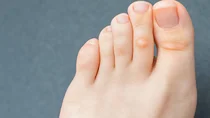
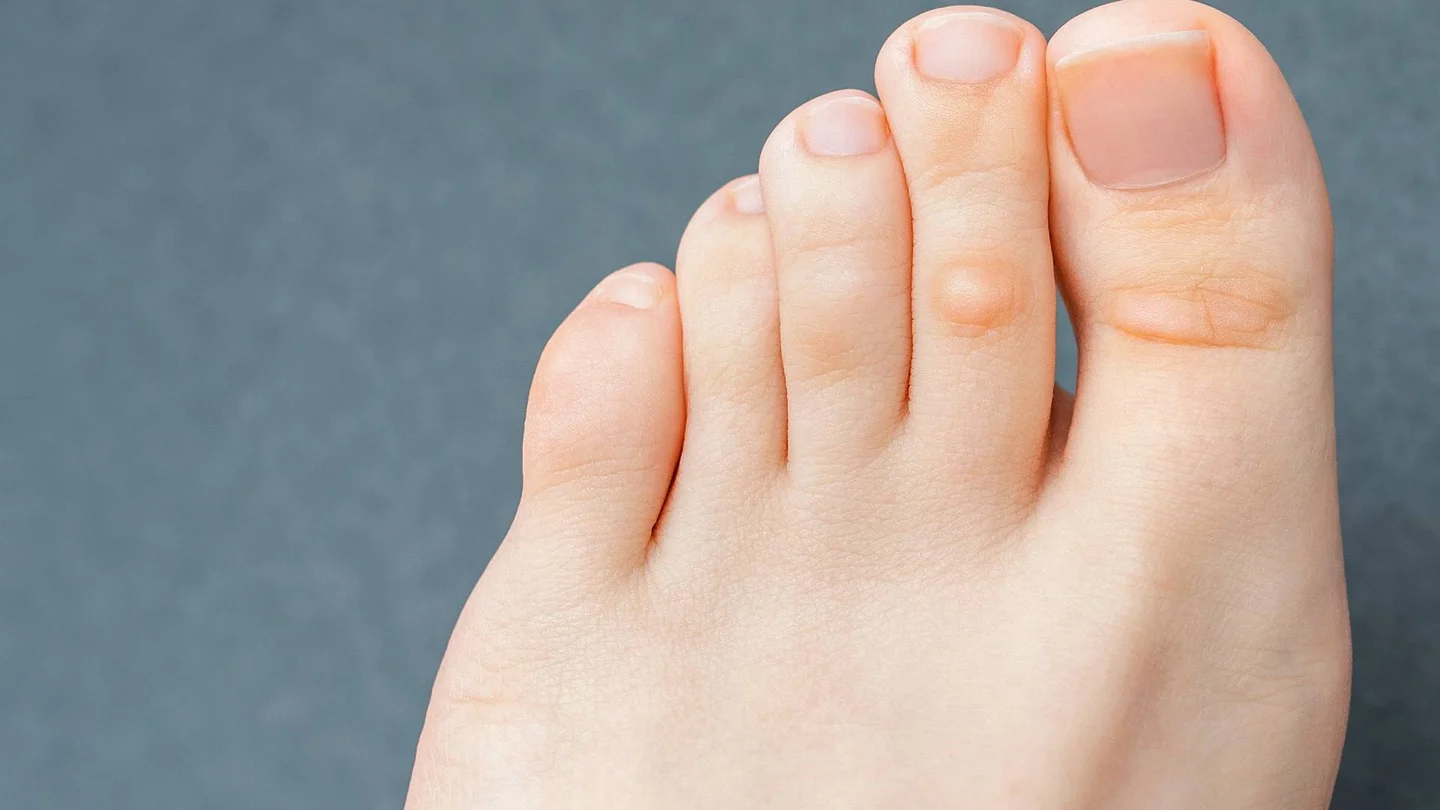
Corns are often painful. A corn on the foot is particularly painful when standing and walking. A corn looks like a round, wart-like lump of hard skin. The center usually consists of a core with a glassy appearance like a bird’s eye, which is particularly sensitive to pain.

Corns are also quite easy to see due to their raised surface and the yellowish-beige color of their hard skin. Those that occur between the toes are often whitish in color. These are softer than corns occurring elsewhere on the feet because the moisture between the toes makes the hard skin swell up.
What causes a corn?
Corns develop through constant or repeated pressure and rubbing on an area of skin. This causes cells in the outer layer of skin (the epidermis) to divide and grow more than usual. As a result, the skin becomes thicker and has more keratin in it. A round or oval area of hard skin (a callus) develops there over time.
Calluses and corns mainly develop on areas of the skin that are close to a bone. That’s why these areas of pressure are more common on hands and feet than on areas like the belly or thighs. The hands and feet are more likely to be exposed to pressure or rubbing, too.
People who have a joint disease or a foot deformity are also more likely to have corns on their feet because the ball of the affected foot has to carry more weight. Toe deformities can push the toes against each other or cause them to go in other directions, rubbing against the inside of the shoes – for example, upwards or to the sides. They can then become constricted by the shoes.
How common are corns?
Corns are very common, particularly in older people.
How does a corn develop?
If a corn continues to be exposed to pressure or rubbing, it may become thicker and harder. Over time, the growing lump of hard skin then puts pressure on the tissue too. As a result, more and more hard skin grows in the middle of the corn, thickening and digging into deeper layers of skin like a thorn, which makes the pain worse and causes a chronic inflammation.
How is a corn diagnosed?
Anyone who gets a corn or their doctor can usually recognize what it is just by looking at it. If the lump of hard skin is in a place that’s regularly exposed to pressure or rubbing, it’s also very likely to be a corn.
Although corns are sometimes mistaken for similar changes in the skin, such as warts, it’s easy to tell the difference between them based on their appearance. Plantar warts (verrucas), for instance, don’t have a visible core of dense hard skin at the center of the lump. Instead, they often have brownish dots on them.
How is a corn treated?
To treat a corn effectively, the most important thing is to eliminate the causes. In other words, further pressure and rubbing must be avoided. For instance, simply replacing tight shoes with wider, well-fitting shoes is often enough to get rid of corns on the feet.

People with corns can also use small stick-on, ring-shaped corn pads, for instance, to prevent pressure and rubbing in that area. It’s sometimes a good idea to use insoles in your shoes too. These can correct deformities leading to areas of pressure.
If the pressure and rubbing stop, corns usually go away on their own after a while. There are things you can do to try to make them go away quicker, such as regularly soaking your feet or hands in warm water.
Afterwards, you can then carefully remove some of the hard skin – for instance, using a pumice stone. Sharp knives, callus shavers or razor blades are not suitable due to the risk of injury.
People who don’t have any other skin problems can try to remove the excess hard skin with special creams or patches containing urea or salicylic acid.
For more detailed information about treating a corn, visit gesundheitsinformation.de.
- Knörzer W, Birkner G. Hühneraugen. In: Handbuch für die medizinische Fußpflege – Grundlagen und Praxis der Podologie. Ruck H. (Ed.): Stuttgart 2012.
- Moll I. Duale Reihe Dermatologie. Stuttgart 2016.
- Pschyrembel online. 2022.
- Rodríguez-Sanz D, Tovaruela-Carrión N, López-López D et al. Foot disorders in the elderly: A mini-review. Dis Mon 2018; 64(3): 64-91. doi: 10.1016/j.disamonth.2017.08.001.

In cooperation with the Institute for Quality and Efficiency in Health Care (Institut für Qualität und Wirtschaftlichkeit im Gesundheitswesen) (IQWiG).
As at: