Skip navigation
gesund.bund.de - Reliable information for your health gesund.bund.de - Reliable information for your health
  • Deutsch
  • English
  • Türkçe
  • Русский
  • عربي
Sprache Language Dilim Язык اللغة
Search
  • Display format Display format
  • Sign language Sign language
  • Simple language Simple language
  • Bookmark list Bookmark list (0)
 
Skip navigation
  • Healthcare

    • Healthcare

    • The healthcare system
    • Health literacy
    • Help and advice
    • Patient rights
    • Self-help
    • Services and benefits

    • Health insurance
    • Benefits for those with health insurance
    • Prescription drugs
    • Prevention and screening
    • Out-of-hospital intensive care
  • Care

    • Topics

    • Long-term care insurance
    • Care benefits
    • Family carers
    • Everyday care and home life
  • Digital health

    • Digitization in healthcare

    • Health and digitization
    • Telemedicine
    • Digital applications

    • Electronic health record (ePA)
    • Electronic medical data cards (eGK)
    • Health apps (DiGA and DiPA)
    • E-prescriptions
    • Electronic sick leave notice
  • Healthy living

    • Staying healthy

    • Diet and exercise
    • Saving lives and helping people
    • Managing addiction
    • Environment and health
    • Life stages

    • Growing up healthily
    • Workplace health
    • Pregnancy and birth
    • Health in old age
  • Conditions

    • Topics

    • Respiratory system
    • Eyes
    • Circulatory and lymphatic systems
    • Reproductive organs
    • Ear, nose and throat
    • Skin
    • Cardiovascular system
    • Hormones
    • Immune system
    • Head and nervous system
    • Psyche
    • Muscles, bones and joints
    • Kidneys and urinary tract
    • Digestion and metabolism
    • Teeth and gums
    • Special topics

    • Allergies
    • coronavirus
    • Infections and infectious diseases
    • Cancer
    • Conditions A–Z
  • Services

    • Information

    • Emergency numbers
    • ICD and OPS codes
    • Conditions A–Z
    • Glossary
    • Infection radar
    • Media library
    • Search functions

    • Doctor search
    • Hospital search
    • Pharmacy search
 
  • Display format Display format
  • Sign language Sign language
  • Simple language Simple language
  • Bookmark list Bookmark list (0)

Corneal ulcer

Read out loud

These functions require cookies. Go to Settings

  • Content

  • At a glance
  • Definition
  • Symptoms
  • Causes
  • Risk factors
  • Diagnosis
  • Treatment
  • Sources

ICD codes: H16 What are ICD codes?

A corneal ulcer is an eye condition that involves damage to parts of the corneal tissue. It is most commonly caused by bacterial infections. This article explains how a corneal ulcer develops and how it can be treated.

At a glance

  • A corneal ulcer involves painful damage to the cornea.
  • The condition is an emergency because it can result in a loss of sight.
  • It is often caused by an infection with bacteria.
  • Contact lenses can favor the development of a corneal ulcer.
  • A corneal ulcer often heals after the treatment – but scars may remain on the cornea.
  • Depending on their size and location, these may impair the eyesight. 

Note: The information in this article cannot and should not replace a medical consultation and must not be used for self-diagnosis or treatment.

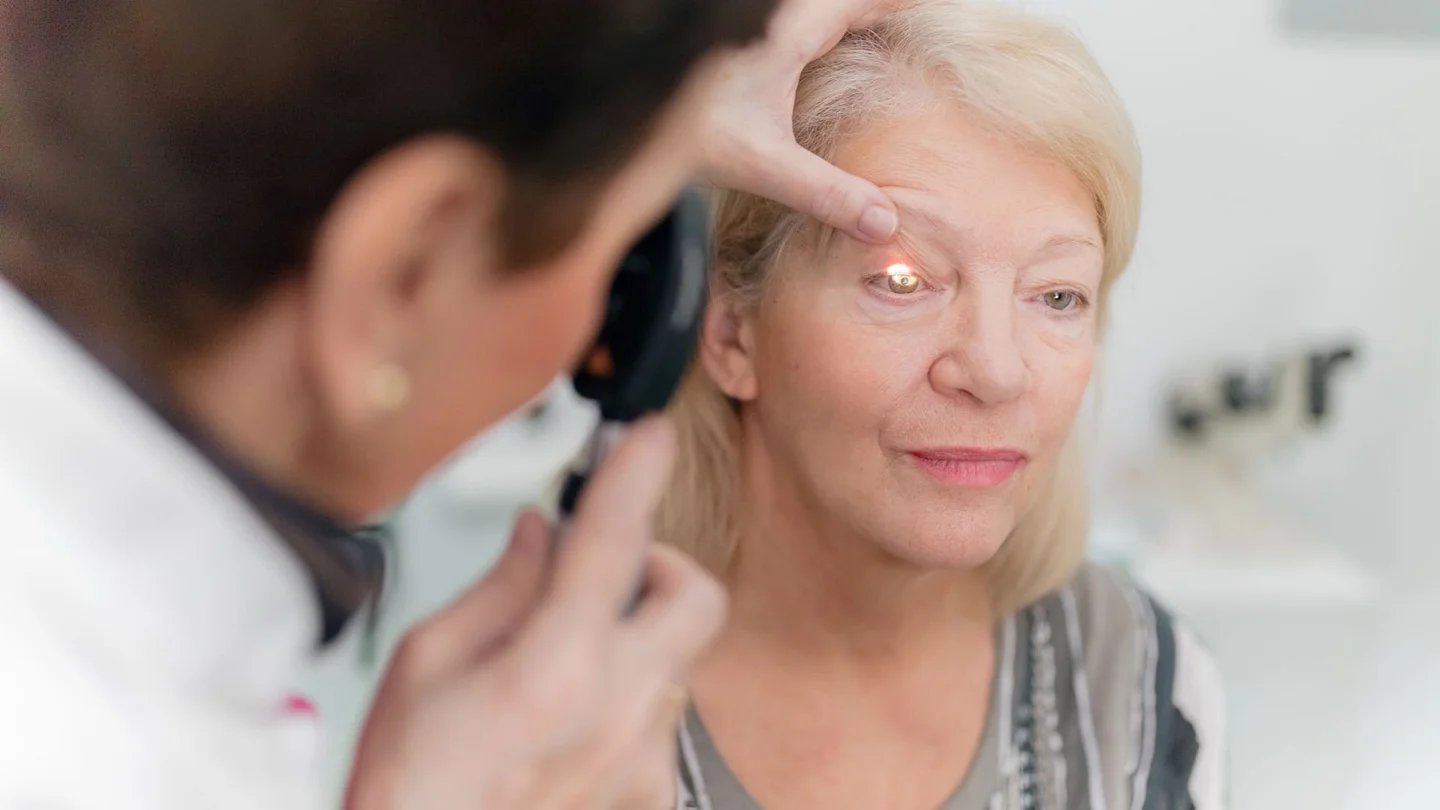
Eine ältere Frau wird untersucht, indem eine Ärztin ihr Augenlid hält und mit einem Messinstrument ins Auge leuchtet. Eine ältere Frau wird untersucht, indem eine Ärztin ihr Augenlid hält und mit einem Messinstrument ins Auge leuchtet.

What is a corneal ulcer?

A corneal ulcer is a painful eye condition. The corneal tissue is damaged in the affected area. 

An infection with bacteria, viruses or fungi can cause a corneal ulcer – as can mechanical injuries to the eye, such as scratches.

A corneal ulcer often heals after the causes have been treated – but scars may remain on the cornea. 

What are the symptoms of a corneal ulcer?

Bad eye pain that can occur suddenly is one of the most common symptoms.

The eye is often reddened and streaming. The eyesight of many people with a corneal ulcer worsens and they become sensitive to light.

What causes a corneal ulcer?

There is a distinction between infectious and non-infectious causes.

Most corneal ulcers are the result of a bacterial infection.

Most corneal ulcers occur after a bacterial inflammation (infectious). The ulcers can also occur through an injury to the cornea, for example due to a scratch (non-infectious). 

A so-called neurotrophic keratitis may also cause an ulcer. This rare disease, which involves the cornea not getting enough nutrients, favors corneal injuries. This, too, has many possible causes, including diabetes.

Another cause of corneal ulcers is toxic keratitis. This is an inflammation of the cornea that can occur as a result of medication applied externally.

What are the risk factors for a corneal ulcer?

A corneal ulcer can be favored by: 

  • contact lenses, particularly if they become dirty through being worn overnight, while swimming or showering
  • a weakened immune system
  • operations on the eye or eyelid
  • an existing corneal inflammation due to illnesses such as diabetes mellitus, a stroke, or chemical burns
People who wear contact lenses are more likely to have corneal inflammation.

How is a corneal ulcer diagnosed?

A corneal ulcer can be diagnosed by examining the eye with a so-called split lamp. The device magnifies the eye as with a microscope, illuminating it using a narrow, slit-like beam of light. This enables the wound on the cornea to be detected clearly. 

A swab can be taken to determine the cause of a corneal ulcer. A laboratory test then shows whether, for example, bacteria or fungi are the cause. 

How is a corneal ulcer treated?

Doctors first treat the causes of the condition, i.e. the bacterial infection in most cases. Antibacterial drugs are then used, normally antibiotic eye drops. 

Important: A corneal ulcer is an emergency, so a specialist should treat it as quickly as possible.

A corneal ulcer often heals after the causes have been treated – but scars may remain on the cornea. Depending on their size and location, these may make the eyesight worse. 

If the condition worsens despite treatment, an operation may be necessary. An operation is also required if the cornea has been badly damaged by the ulcer. A cornea transplant may be needed if a lot of corneal tissue is destroyed. 

  • Alhassan MB, Rabiu M, Agbabiaka IO. Interventions for Mooren's ulcer. Cochrane Database Syst Rev. 2014 Jan 22;(1):CD006131. doi: 10.1002/14651858.CD006131.pub3. PMID: 24452998.
  • DynaMed (Internet), Ipswich (MA). Corneal Ulcer. EBSCO Information Services. Record No. T900362. 2018 (1995). Aufgerufen am 02.02.2021.

Badge

In cooperation with the Institute for Quality and Efficiency in Health Care (Institut für Qualität und Wirtschaftlichkeit im Gesundheitswesen) (IQWiG).

As at: 27.04.2021


Did you find this article helpful?
Thank you for your feedback!
Thank you for your additional comments!
Sorry, your response could not be submitted due to a technical error.

Get informed Recommended articles

Cataract (gray star)

A cataract gradually turns the lens of the eye cloudy. The person's sight then becomes increasingly blurred, as if looking through a veil or fog. In the long term, only an operation will help.

Find out more

Conjunctivitis

Typical signs of conjunctivitis are eyelids that stick together and an itching and burning sensation in the eyes. It can be caused by viruses or bacteria, but can also have other causes.

Find out more

Glaucoma

Eye diseases like glaucoma can occur as we get older. The disease is also known as green star. Potential sight loss can be stopped if identified early.

Find out more

Back to top
Logo - Bundesministerium für Gesundheit Logo - Bundesministerium für Gesundheit

gesund.bund.de A service from the Federal Ministry of Health.

Useful links

  • Topic overview
  • User advice
  • Website overview

Services

  • Help and advice
  • Accessibility
  • Report an accessibility barrier

About us

  • About gesund.bund.de
  • Quality assurance
  • Our partners
  • Contact

Important emergency numbers

  • Fire and ambulance services 112 112
  • Non-emergency medical assistance 116117 116117
  • Emergency numbers

Certifications

  • afgis-Qualitätslogo mit Ablauf 2026/03: Mit einem Klick auf das Logo öffnet sich ein neues Bildschirmfenster mit Informationen über Bundesministerium für Gesundheit (BMG) und sein/ihr Internet-Angebot: gesund.bund.de/
  • Logo DNGK 2025-2026
  • BIK - BITV-konform (geprüfte Seiten), zum Prüfbericht

© Copyright 2026 Bundesministerium für Gesundheit Data protection Legal notice