Sudden hearing loss
ICD codes: H91.2 What are ICD codes?
Sudden hearing loss typically affects one ear only. It often resolves by itself, but can also cause lasting hearing damage.
At a glance
- Sudden hearing loss refers to a sudden difficulty that a person experiences with hearing – usually in one ear only (unilateral).
- Sometimes, sudden hearing loss simply feels like a sensation of pressure or having “cotton wool” in the ear. The person may also experience ringing in the ears and dizziness.
- Typically, a precise cause cannot be identified for the sudden hearing loss. There is currently no targeted treatment.
- Treatment with anti-inflammatory cortisone appears to improve the chances of recovery.
- For many patients, their hearing improves again subsequently. However, there may be permanent damage to hearing in some cases.
Note: The information in this article cannot and should not replace a medical consultation and must not be used for self-diagnosis or treatment.

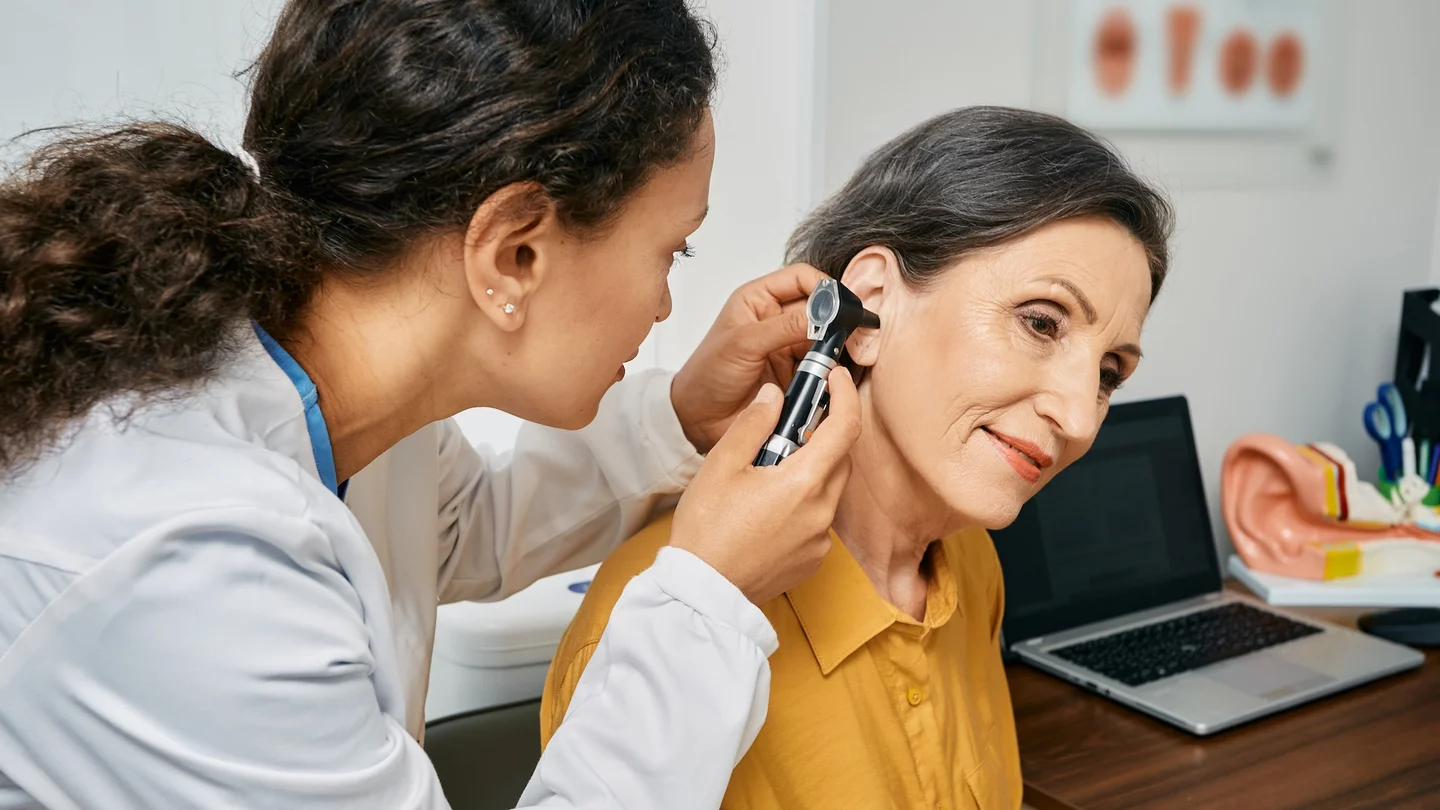
What is sudden hearing loss?
Hearing loss can sometimes occur suddenly. It usually affects one ear only and rarely affects both at the same time. Typically, it is impossible to clearly determine the cause.

Sudden hearing loss can affect hearing to varying degrees. It can even cause complete deafness in the affected ear.
The hearing loss typically occurs suddenly, within just a few minutes or hours. The likelihood of the hearing loss being permanent is proportionate to the severity of the loss suffered at the outset.
Many people temporarily experience a sudden deterioration in their hearing now and then. However, the symptoms usually disappear within a matter of seconds or minutes. This is not the same as sudden hearing loss.
Medical advice should be sought without delay if impaired hearing persists. This is the case in particular if additional symptoms such as dizziness also occur. Overall, the chances of recovery are good.
What are the symptoms of sudden hearing loss?
Sudden hearing loss typically affects one ear only. Some people discover, upon waking, that they can suddenly hear very little, if anything at all, in one of their ears. The loss of hearing is often accompanied by ringing in the ears (tinnitus).
Other people with sudden hearing loss initially only experience the sensation of their ear being “blocked” or “full”, before realizing that their hearing has deteriorated. Other possible symptoms of sudden hearing loss include dizziness and sensory disturbances (numbness) in the outer ear.
Video What is tinnitus?
The video below explains what can trigger tinnitus and what symptoms can occur.
This and other videos can also be found on YouTube
Watch nowThe privacy policy indicated there applies.
What causes sudden hearing loss?
In 90 percent of cases of sudden hearing loss, no definitive cause can be identified. The problem typically occurs in the inner ear, where the organ of hearing (cochlea) is located. In this case, doctors refer to acute idiopathic sudden sensorineural hearing loss or sudden hearing loss/sudden deafness.

It is suspected that inflammation or circulatory disturbances in the inner ear have a role to play in sudden hearing loss. Other possible factors include autoimmune reactions, in which the immune system attacks the body’s own tissue, and stress. However, the precise causes have not yet been definitively clarified.
It is important to exclude other conditions as the cause of the hearing loss. These include:
- tumors on the nerves responsible for balance and hearing, in the inner ear or in the brain
- disturbances in the production of inner-ear fluids in the cochlea (cochlear hydrops) or in the entire inner ear (Menière’s disease)
- various viral illnesses, such as flu, mumps and measles
- autoimmune disorders, including systemic lupus erythematodes
- hemorrhages (bleeding) in the inner ear
- leaking of fluid from the inner ear
- neurological disorders, such as multiple sclerosis
- metabolic disorders such as diabetes mellitus
- diseases of the blood vessels
- side-effects of certain medication
- head injuries
- the effect of noise
- barotrauma/decompression sickness (“ear squeeze”): tissue damage caused by a sharp rise or drop in pressure
What factors increase the risk of sudden hearing loss?
Only a small number of factors have been shown to increase the risk of sudden hearing loss. They are:
- smoking
- alcohol abuse
- various hereditary changes that increase the risk of blood clots
- some anti-inflammatory pain medication
How common is sudden hearing loss?
It is estimated that around 160 to 400 people out of every 100,000 people are affected by sudden hearing loss each year in Germany.
It is difficult to specify an exact figure because many people don’t seek medical advice when they experience sudden hearing loss if the symptoms recede on their own within a short period of time.
Sudden hearing loss can occur at any age. It is particularly likely to affect adults from the age of about 50 onwards. Men and women are affected more or less equally by sudden hearing loss, while it is rare in children.
How is sudden hearing loss diagnosed?
If sudden hearing loss is suspected, a specialist in ear, nose and throat (ENT) medicine will take the patient’s history and conduct a targeted examination. It is important to exclude other conditions as possible causes of the hearing loss before assuming that it is sudden hearing loss.
The ENT doctor begins by examining the ear and ear canal using a special microscope. The purpose is to exclude, for example, problems with the ear drum, middle ear or ear canal, or a buildup of earwax blocking the ear canal.
In addition, various hearing tests are performed using a tuning fork held in front of the ear or on top of the head. This allows the doctor to distinguish between sensorineural (perceptive) hearing loss in the inner ear and conductive hearing loss in the middle or outer ear.
A pure tone audiogram is the only way to obtain an accurate, measurable picture of the type and extent of the hearing damage. This involves various high tones being played for the patient over headphones, with the volume gradually increasing. This allows doctors to pinpoint the volume threshold as of which the tones at a certain frequency are heard.
If the patient is experiencing dizziness, the functioning of the vestibular system is usually also tested.
Additional tests are sometimes performed after the initial phase of the condition. These can provide more detailed information about the extent and the location of the damage. These include, for example, the measurement of brain stem potentials using an electroencephalogram (EEG).
A blood test or magnetic resonance imaging (MRI) can provide further clarification. An MRI scan, for example, can detect the presence of a tumor such as a vestibular schwannoma.
How is sudden hearing loss treated?
If the doctor identifies a specific cause for the sudden hearing loss, this will be treated accordingly.
However, it is typically impossible to determine a precise cause for sudden hearing loss. There is currently no approved medication for targeted treatment. For this reason, treatment is based on prior experience. None of the possible treatments available can reliably restore hearing to all people affected. For this reason, the patient and doctor must work together to decide on the best way to proceed.
The first course of action is usually to try using anti-inflammatory glucocorticoids such as cortisone. This medication can be taken alone or in combination with other drugs in tablet form, as an infusion into the veins or as a direct injection into the middle ear.
The form in which it is administered depends on:
- the severity of the hearing loss
- which sound frequencies are affected
- whether and which underlying illnesses are present
If the hearing loss is mild and doesn’t affect the understanding of language when communicating with other people, then it’s also possible to allow the condition to run its course naturally without treatment.
Hyperbaric oxygen therapy is sometimes offered, whereby the patient inhales pure oxygen inside a pressurized chamber. To date, however, there has been no clear evidence that this relieves or cures the symptoms.
What aftercare can be provided after sudden hearing loss?
It is useful to have a repeat hearing test approximately after the end of treatment, and again around 6 months after the end of treatment. Rehabilitation measures may be beneficial in individual cases.
If the hearing loss is permanent, a hearing aid may help. If this fails to help, a cochlear implant may also be considered.
Tinnitus often decreases in severity as soon as the patient’s hearing improves. However, they can persist in some cases and, if so, are also treated as part of rehabilitation. Dizziness may also persist and require further treatment.
- Bublak, R. Bilateraler Hörsturz hat eine schlechte Prognose. HNO Nachr 54, 16 (2024).
Aufgerufen am 31.01.2025. - Deutsche Tinnitus-Liga. Hesse, Kastellis. Der Hörsturz und seine Behandlung, TF 2/2024. Aufgerufen am 31.01.2025.
- DynaMed [Internet]. Sudden sensorineural hearing loss. Ipswich (MA): EBSCO Information Services. Aufgerufen am 24.01.2025.
- UpToDate [Internet]. Sudden sensorineural hearing loss in adults: Evaluation and Management. Wolters Kluwer 2022. Aufgerufen am 24.01.2025.
- Plontke SK, Girndt M, Meisner C et al. Efficacy and safety of systemic, high-dose glucocorticoid therapy for idiopathic sudden sensorineural hearing loss: Study protocol for a three-armed, randomized, triple-blind, multicenter trial (HODOKORT). HNO. 2022 Jul;70(Suppl 2):30-44. doi:10.1007/s00106-022-01184-8. Aufgerufen am 31.01.2025.
- Plontke SK, Girndt M, Meisner C et al. High-Dose Glucocorticoids for the Treatment of Sudden Hearing Loss. NEJM Evid. 2024 Jan;3(1):EVIDoa2300172. doi: 10.1056/EVIDoa2300172. Epub 2023 Dec 26. PMID: 38320514.
Aufgerufen am 31.01.2025. - Plontke SK, Meisner C, Agrawal S et al. Intratympanic corticosteroids for sudden sensorineural hearing loss. Cochrane Database Syst Rev. 2022 Jul 22;7(7):CD008080. doi: 10.1002/14651858.CD008080.pub2. Aufgerufen am 24.01.2025.
- Slattery WH, Andalibi A, Angeli S et al. Hearing Science Accelerator: Sudden Sensorineural Hearing Loss—Executive Summary of Research Initiatives. Otology & Neurotology. 2024, 45(10) e670-678. Aufgerufen am 13.03.2025.