Health promotion and preventive healthcare in care facilities
Health promotion and preventive healthcare are also important in care facilities. The aim is to improve or maintain the care recipients’ health, but also to encourage their independence and mobility.
At a glance
- Long-term care insurance funds are responsible for providing support to care facilities for health promotion and preventive healthcare.
- The aim is to improve or maintain the care recipients’ health, prevent further deterioration, and to encourage their self-determined participation, independence and mobility.
- Measures focus on topics such as diet, exercise, cognitive health, emotional well-being, and preventing violence.
Health promotion in residential care facilities
People want to live for a long time, but also to remain as self-determined and healthy as possible, and this also applies to residents in care facilities. Even when someone is already in need of care, there are usually ways of improving their health, counteracting any deterioration, and preventing further impairments.
In 2015, health promotion and preventive healthcare in residential and semi-residential care facilities in Germany were given a legal anchor via the Prevention Act (“Präventionsgesetz” in German). This specifically makes the long-term care insurance funds responsible for promoting and funding good health, disease prevention and screening for early detection.
For more information about the various long-term care insurance benefits that are available, see our article about long-term care insurance.
In the “Guide to Prevention in Residential Care Facilities in Compliance with § 5 SGB XI”, the National Association of Statutory Health Insurance Funds – which also represents the long-term care insurance funds (in German: GKV-Spitzenverband) summarizes the content and quality requirements that the preventive measures should satisfy. It contains the latest findings from studies of health promotion measures.
Why is health promotion important in care facilities?
People living in care facilities need everyday support due to physical, intellectual or mental impairments. In these settings, it is particularly important to promote and maintain health and independence for as long as possible. This helps improve the residents’ quality of life and enables them to actively participate in life in a self-determined manner.
Preventive healthcare measures reduce the likelihood of falls, infections, malnutrition and dehydration. Fostering the health and independence of people in need of care through preventive measures also reduces the burden on staff providing care in these facilities.
This benefit is significant, given the rising number of people in need of care in Germany. At the end of 2020, around 4.5 million people in need of care were living here. By the year 2050, experts estimate this figure will increase to around 6.5 million. The number of residents in residential or semi-residential care facilities is likely to increase, too.

Which measures are promoted in care facilities?
The Prevention Act deals with health in its broadest sense. Its ultimate goal is to prevent the occurrence of diseases or, at least, to delay their onset. To achieve this, people in need of care should be empowered to play a role in maintaining their own health independently and in a self-determined manner. If they are unable to do this for themselves, they should be able to nominate a legal representative to do so on their behalf.
Preventive healthcare also includes boosting resilience. Resilience is the emotional strength to overcome and recover from adversity. It helps people to cope with difficult life situations and crises. Preventive healthcare therefore means more than taking measures aimed directly at illnesses or impairments. Measures that serve the care recipient’s general well-being are also included. All measures are intended to help promote and maintain the independence and participation of residents in care facilities.
Measures that improve the care facility’s own capabilities are funded. These may include, for example, developing structures that promote health, such as new work process and services provided in addition to general care and support services. Examples include group activities focusing on exercise or psychosocial health. Measures that prevent violence in care settings are also funded. These include the provision of further training to staff and the implementation of guidelines for non‑violent care.

Funding is also provided for measures that improve the health of individual care recipients. These include measures such as:
- Healthy eating
- Physical activity and exercise
- Cognitive health
- Emotional well-being
Healthy eating
Appealing, varied, good-quality food and drink can prevent health problems. Residents’ preferences should be included in menus where possible. During periods of hot weather in the summer, it is particularly important to ensure an adequate intake of fluids.
It is also important to look at swallowing and chewing problems, as these are often a reason for malnutrition. If a person is malnourished, special supplementary nutrition that is rich in energy can be used for support.
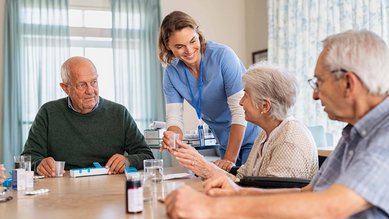
Mealtimes are also an ideal opportunity for social interaction. Cooking and eating together are ways to promote emotional well‑being.
Physical activity and exercise
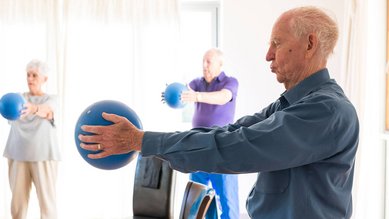
Regular exercise protects against falls, improves well-being and can reduce the risk of chronic illness. Exercise may involve climbing stairs, walking and balancing, or broader exercise programs, depending on what the care recipient is capable of doing. Every small step is important and promotes good health. Group training also boosts motivation.
Cognitive health
Tasks and exercises that train the memory and understanding help the residents’ mental health. Physical activities contribute to it, too. One way to stimulate memory function is life story work (also called “biography work”). This involves individuals using photographs, objects or letters to put together their own life story. This also stimulates mutual exchange of experiences and can boost feelings of self‑worth.
Emotional well-being
People who move into a care facility often lose contact with the previous social environment and are at risk of feeling isolated. Many are affected by physical limitations. This increases their risk of also developing mental illnesses. For this reason, it is particularly important to support mental health in a targeted way with preventive measures. Measures that promote well-being and quality of life help increase satisfaction and social cohesion and reduce depressive moods and anxiety.
There are many approaches that can be used in care facilities to promote mental health. Regular discussion groups, shared mealtimes or visits from voluntary visiting services can help foster a sense of community and belonging. Video chats can help residents keep in regular contact with family or friends who live far away.
Another preventive approach is to encourage self-worth and identity. Measures include enabling residents to continue hobbies they pursued in the past, such as arts and crafts, cooking or playing music. This creates positive experiences and also encourages individuals to participate in group activities.
Spirituality is also an important area. It can be an important resource for many residents, in particular during challenging life phases. The concept of spiritual care is another preventive healthcare measure. It involves meeting the spiritual needs of residents in a holistic way. This can be implemented through regular prayers or other forms of devotion, pastoral care or meditation. Providing this type of care helps residents to find comfort, meaning and inner peace, regardless of their religious or ideological beliefs.
How is health promotion organized in my facility?
For measures to have a positive effect, it is important that they suit the particular characteristics of the facility concerned, its residents and the staff who care for them. With this in mind, the initial situation and the needs are identified, and the measures are then based on them.
Long-term care insurance funds help care facilities to plan and implement these measures. Health promotion is more effective if everyone concerned is involved in planning and evaluating the measures – care recipients, care professionals, the board of the care facility, loved ones and legal guardians.
If you have any questions about health promotion in a particular facility, you should talk to the facility manager or a member of the care staff.
Further information
You will find more information and examples of health promotion in care facilities on the German-language website about healthy living environments run by the Association of Substitute Health Insurance Funds (Verband der Ersatzkassen, vdek).
- Bundesministerium für Gesundheit. Prävention in der Pflege. Aufgerufen am 23.01.2025.
- Bundesministerium für Gesundheit. Präventionsgesetz. Aufgerufen am 23.01.2025.
- Deutsche Gesellschaft für Ernährung. 14. DGE-Ernährungsbericht. Vorveröffentlichung Kapitel 2. 10.2019 Korrigierte Version (Erratum)
- FH Münster und Prognos AG. Wissenschaftliche Evaluation der präventiven Leistungen der Pflegekassen nach § 5 SGB XI. 08.2022
- GKV-Bündnis (GKV-Spitzenverband). Gesundheitsförderung in Pflegeeinrichtungen. Aufgerufen am 23.01.2025.
- GKV-Spitzenverband. Prävention in der stationären Pflege. Aufgerufen am 23.01.2025.
- Rütten A, Pfeifer K (Hrsg.). Nationale Empfehlungen für Bewegung und Bewegungsförderung. FAU Erlangen-Nürnberg 2016.
- Statista. Sozialsysteme - Anzahl der Pflegebedürftigen und über 80-Jährigen in Deutschland bis 2060. Aufgerufen am 23.01.2025.
- Statistisches Bundesamt (Destatis). Pflegebedürftige nach Versorgungsart, Geschlecht und Pflegegrade. Stand vom 18.12.2024.
- Woods B, O'Philbin L, Farrell EM, Spector AE, Orrell M. Reminiscence therapy for dementia. Cochrane Database of Systematic Reviews 2018, Issue 3. Art. No.: CD001120. DOI: 10.1002/14651858.CD001120.pub3.
- Wolf-Ostermann Prof. Dr. K. Nutzung von digitalen Kommunikationstechnologien in ambulanten und stationären Pflegeeinrichtungen während der Covid-19-Pandemie - Hilft Technik gegen soziale Isolation? 16.11.2022