Ovarian cysts
ICD codes: N83 What are ICD codes?
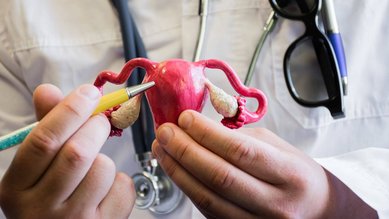
Ovarian cysts are tissue- or fluid-filled sacs in the ovaries. They are generally benign and go away naturally. In most cases, such cysts do not cause any health issues so treatment is not required.
At a glance
- Ovarian cysts are fluid- or tissue-filled sacs in the ovaries.
- Ovarian cysts are usually the size of a grape and are surrounded by a capsule.
- Most ovarian cysts go away naturally.
- The bladder-like cysts are often caused by hormonal changes during puberty or the menopause.
- Ovarian cysts are only congenital or have other causes in very few women.
- An estimated 10 in 100 women have ovarian cysts.
Note: The information in this article cannot and should not replace a medical consultation and must not be used for self-diagnosis or treatment.


What are ovarian cysts?
Ovarian cysts are usually grape-sized sacs filled with fluid or tissue. They are surrounded by a capsule and located in the ovaries. They naturally disappear by themselves in most cases and rarely cause discomfort and don’t need to be treated. Surgery is only required on very rare occasions. Ovarian cysts are often triggered by normal hormonal changes during puberty or the menopause. They are only congenital or have other causes on rare occasions.
What are the symptoms of ovarian cysts?
Most patients with ovarian cysts have few or no symptoms, although they can sometimes experience a vague, dull pain in the lower abdomen.
Very large cysts can press on the bowels or bladder. This can lead to abdominal swelling, a feeling of pressure, constipation or even discomfort when urinating.
Ovarian cysts can also disrupt the menstrual cycle by causing heavy or missed periods and spotting. This occurs if the cyst produces sex hormones and influences the growth of the uterine lining.
Cysts can rupture. This is usually harmless but perceivable as a sudden pain. The weight of the cyst can also cause the ovary to twist. If this happens, it causes sudden, strong, cramping pain on one side of the lower abdomen, as well as nausea, vomiting, and an elevated pulse.
What causes ovarian cysts?

Most ovarian cysts develop in relation to the maturation of egg cells and ovulation. These cysts are known as “functional cysts” and can occur in one or both ovaries. They primarily form during puberty or the menopause.
The most common functional ovarian cysts are:
- Follicular cysts: if ovulation does not occur, the follicle containing the egg cell can gradually fill with fluid and develop into a cyst.
- Corpus luteum cyst (yellow body cyst): this is formed when blood accumulates in the corpus luteum. The corpus luteum is created from the remains of the follicle after ovulation and produces the sex hormones progesterone and estrogen.
- Theca lutein cyst: this is usually caused by hormone treatment for fertility disorders. The hormones stimulate the maturation of the eggs in the ovaries. Cysts can be an undesired consequence.
“Chocolate cysts” (endometriomas) are a special type of cyst. They contain dark, thickened blood and can be a result of endometriosis, for example.
Another condition is polycystic ovarian syndrome (PCOS). It causes a large number of small cysts in the ovaries. The follicle is unable to mature properly due to too many male sex hormones (androgens).
How quickly do ovarian cysts disappear?

Most ovarian cysts are 1 to 3 centimeters in diameter and disappear by themselves after a few months. Only rarely will they grow large enough to cause severe discomfort. In exceptional cases, they can grow up to 15 to 30 centimeters in diameter.
Complications such as a rupture are also rare. If a cyst ruptures, its wall collapses and the fluid enters the abdomen. Ruptures are usually harmless but can be painful.
Very large cysts can press on the bowels or bladder. This can lead to abdominal swelling, a feeling of pressure, constipation or discomfort when urinating. Occasionally, bleeding occurs, which must be stopped by surgery.
It is more dangerous when an ovary twists around the ligaments that hold it in place. This can be extremely painful. Such torsion can particularly occur with larger cysts as a result of jerky movements, such as when playing tennis. The blood supply to the ovary can be interrupted. In such cases, timely surgery is required to prevent the ovary from dying.
How are ovarian cysts diagnosed?
Ovarian cysts are often detected by chance, for example during a pelvic ultrasound. Some cysts can also be detected by palpation.
In the case of a suspected ovarian cyst, the doctor will also ask about symptoms such as menstrual disorders and pain. A blood sample may be taken.
Further investigations such as computed tomography or a mirror examination are only necessary on rare occasions. Often, clarification is then required as to whether the changes to the ovarian tissue could be cancer. Cysts are usually benign but are not always immediately distinguishable from tumors.
Further information, for example about whether an ultrasound screening is useful, can be found at gesundheitsinformation.de.
How are ovarian cysts treated?
If patients have no or minor symptoms, they can usually just wait for cysts to disappear naturally. Depending on the findings, it can be wise to have the cysts checked regularly by a doctor (monthly or every few months). Pain can be temporarily managed using painkillers such as ibuprofen or other non-steroidal anti-inflammatory drugs (NSAIDs).
If cysts change or do not disappear, or if the discomfort persists, the doctor can examine them more closely by means of a laparoscopy (abdominal examination) and instantly remove them if necessary. However, removed cysts can reform.
Doctors only suggest removing one or even both ovaries on very rare occasions. This can be necessary if cancer is suspected or if it is reasonable to assume that the cysts will not be released from the tissue. Doctors try to preserve the ovary where possible, in particular if the woman wants to have children in the future.
Important: Some doctors recommend treating ovarian cysts with the contraceptive pill. However, this is not possible with functional cysts. The pill prevents ovulation by inhibiting the production of hormones in the ovaries but studies have been unable to confirm that this makes cysts disappear any quicker.
- American College of Obstetricians, Gynecologists' Committee on Practice Bulletins – Gynecology. Practice Bulletin No. 174: Evaluation and Management of Adnexal Masses. Obstet Gynecol 2016; 128(5): e210-e226. Aufgerufen am 17.10.2024.
- Grimes DA, Jones LB, Lopez LM, Schulz KF. Oral contraceptives for functional ovarian cysts. Cochrane Database Syst Rev 2014; (4): CD006134. Aufgerufen am 17.10.2024.
- Royal College of Obstetricians & Gynaecologists. The management of ovarian cysts in postmenopausal women. 07.2016 (Green-top Guideline No. 34). Aufgerufen am 17.10.2024.
- Weyerstahl T, Stauber M. Gynäkologie und Geburtshilfe. Thieme: Stuttgart 2013.
- Wolfman W, Thurston J, Yeung G et al. Guideline No. 404: Initial Investigation and Management of Benign Ovarian Masses. J Obstet Gynaecol Can 2020; 42(8): 1040-1050.e1041. Aufgerufen am 17.10.2024.

In cooperation with the Institute for Quality and Efficiency in Health Care (Institut für Qualität und Wirtschaftlichkeit im Gesundheitswesen) (IQWiG).
As at: