Molluscum contagiosum
ICD codes: B08.1 What are ICD codes?
Molluscum contagiosum causes small papules that look like “real” warts, which are usually harmless but contagious. The infection is caused by viruses. The papules usually disappear on their own within a few months.
At a glance
- Molluscum contagiosum causes wart-like, pinhead-sized papules (spots) that usually appear individually or in small clusters on various parts of the body.
- They are common in children and adolescents but less so in adults.
- They are caused by a viral infection of the skin.
- This usually harmless infection is transmitted by direct contact, for example when playing, but also by shared objects.
- The spots usually disappear on their own within 6 to 12 months. Treatment is not normally necessary.
Note: The information in this article cannot and should not replace a medical consultation and must not be used for self-diagnosis or treatment.
What is molluscum contagiosum?
Molluscum contagiosum (or MC for short) causes wart-like papules or spots that are also sometimes referred to as Dell’s warts, mollusca contagiosa or simply mollusca. The spots are caused when the skin is infected with the molluscum contagiosum virus, a type of poxvirus. They are distinct from “real” warts, which are caused by human papillomaviruses (HPV).
The spots generally appear individually or in small clusters. They are pinhead-sized and have a small dimple in the middle, from which a pulp-like, infectious fluid can escape.
An infection with molluscum contagiosum is usually harmless.
How can molluscum contagiosum be identified?
MC spots are solid white, pink or flesh-colored nodules with a shiny surface. In the middle of each nodule is a whitish-yellow dimple.
Molluscum contagiosum is not usually painful but it can sometimes cause itching. In addition, the skin around the spots may be red and inflamed or individual spots may be red and swollen.

Children usually develop less than 30 nodules on their torso, arms, legs, head and neck.
In adults, the genital area, inner thighs and lower abdomen are most commonly affected.
In people with a weakened immune system – for example, due to an infection with the human immunodeficiency virus (HIV) – the spots may be very large and widespread.
How do people get molluscum contagiosum?
The molluscum contagiosum virus, the pathogen that causes this condition, is usually transmitted by direct skin to skin contact.
However, it is also possible to contract the virus from objects, e.g. a shared towel. The virus penetrates the skin through minor injuries and spots form any time from a few days to 6 weeks later.
Children can become infected when playing and, in many cases, presumably also when using swimming pools.
Young adults are usually infected through sexual contact.
What factors increase the risk of molluscum contagiosum?
Close physical contact or sexual contact with people who have MC increases the risk of infection.

People whose immune system is weakened by an HIV infection, another medical condition or taking certain medication are also more susceptible to infection with the molluscum contagiosum virus.
Skin allergies can also increase the risk of infection.
Swimming in pools is likely to promote the transmission of MC.
How common is molluscum contagiosum?
Molluscum contagiosum is common in childhood, affecting an estimated 5 to 12 percent of children.
However, adolescents and adults can also contract MC.
Will molluscum contagiosum heal on their own?
The individual skin nodules usually heal on their own within 2 months. However, new ones can also form and it can take 6 to 12 months for all the spots to disappear. In some cases, full recovery may even take several years.
An inflammatory reaction with skin redness and swelling can be an indication that the spots are healing. This usually occurs without scarring, although not always.
How is molluscum contagiosum diagnosed?
Doctors can identify molluscum contagiosum based on the typical appearance of the spots.
In rare cases, a tissue sample is also taken to assess the changes to the skin more precisely under a microscope and rule out other conditions.
How can molluscum contagiosum be treated?
In most cases, MC is left to clear up on its own. Studies have shown that treatment is not always effective and can have side effects such as inflammation or scarring.
As a result, treatment is usually only considered in the case of severe symptoms, for cosmetic reasons or to prevent the condition spreading to other areas of the body.
If the mollusca occur in the genital area, treatment is wise to prevent sexual partners from being infected.
For people with a weakened immune system, it is important to treat MC at an early stage to avoid a severe infection.
Doctors treat molluscum contagiosum in various ways. In children, they may be removed with a sharp curette or treated by being frozen (cryotherapy) or with active substances for external use. However, the benefits and risks should always be weighed up in advance.
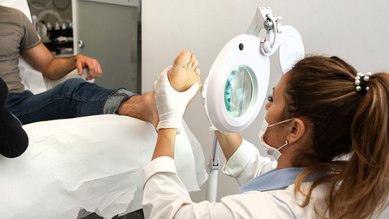
The sharp curette is a special instrument for removing mollusca contagiosa. The affected areas can be locally anesthetized beforehand.
With cryotherapy, a cotton swab with liquid nitrogen is held on the spot for a few seconds. The liquid nitrogen has a temperature of minus 196 degrees. The extreme cold kills the mollusca tissue.
MC in the genital area can be treated with cryotherapy or a podophyllotoxin solution – a herbal medicine that is also used to treat genital warts.
There are also various other solutions or ointments that can be applied to the spots to induce a local inflammatory reaction by the skin. This approach aims to speed up the healing process but its effectiveness is often unproven.
How can I deal with molluscum contagiosum in everyday life?
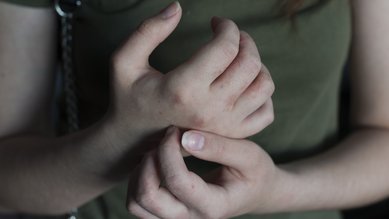
The healing process can be helped by not picking at the affected areas of skin or scratching the papules. Otherwise, the infectious viral particles may be released and the infection transmitted to other areas of skin.
When swimming, the affected areas of skin can be protected with a waterproof bandage. The same applies when taking part in contact sports or using gymnastics mats, for example. If the affected areas cannot be covered, such sports should ideally be avoided until the skin has healed.
This also minimizes the risk of transmitting the molluscum contagiosum virus to other people. In addition, children should not share towels, items such as toys or baths with others. However, they can still continue to go to kindergarten or school as normal.
- Badri T, Gandhi G. Molluscum Contagiosum [Updated 2021 March 21]. In: StatPearls [Internet]. Treasure Island (FL): StatPearlsPublishing; 2021 Jan-. Aufgerufen am 06.07.2021.
- BMJ Best Practice. Molluscum contagiosum. Aufgerufen am 06.07.2021.
- DynaMed (Internet), Ipswich (MA). Molluscum Contagiosum. EBSCO Information Services. 2018 (1995). Record No. T116448. Aufgerufen am 06.07.2021.
- Leung AKC, Barankin B, Hon KLE. Molluscum Contagiosum: An Update. Recent Pat Inflamm Allergy Drug Discov. 2017;11(1):22-31. doi: 10.2174/1872213X11666170518114456. PMID: 28521677.
- UpToDate (Internet). Molluscum contagiosum. Wolters Kluwer 2020. Aufgerufen am 06.07.2021.
- van der Wouden JC, van der Sande R, Kruithof EJ et al. Interventions for cutaneous molluscum contagiosum. Cochrane Database Syst Rev. 2017 May 17;5(5):CD004767. doi: 10.1002/14651858.CD004767.pub4. PMID: 28513067; PMCID: PMC6481355.

In cooperation with the Institute for Quality and Efficiency in Health Care (Institut für Qualität und Wirtschaftlichkeit im Gesundheitswesen – IQWiG).
As at: